
Gas-free certificate issued without testing tanks!

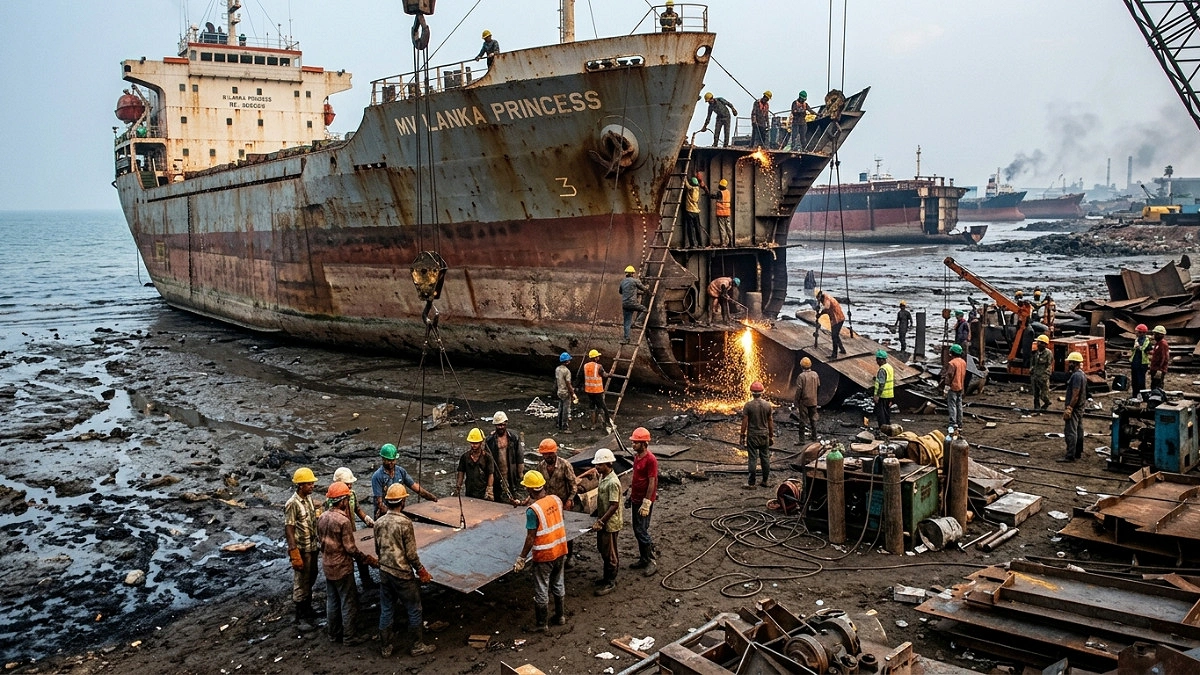
Representational image generated by AI.
Before a ship is imported as scrap and broke into pieces, a gas-free certificate must be obtained from the Department of Explosives. This certificate signifies that no toxic or flammable gases are present anywhere in the vessel.
According to regulations, this certificate should only be issued after proper inspections and tests. However, the exact opposite occurred with the ship 'MT Rassi' at Fardous Steel Shipbreaking Yard in Chittagong. The Department of Explosives issued a gas-free certificate without testing the ship's ballast tanks. The price paid for this negligence was the lives of 10 people, who died inhaling toxic hydrogen sulfide (H₂S) gas. The accident occurred on August 14 while cutting the ship's No. 3 ballast tank. These details emerged in the investigation report of the expert committee formed to determine the cause.
The three-member expert committee submitted its report to the Ministry of Industries Monday. The 20-page report includes recommendations on the causes of the accident and measures to prevent future occurrences. It also highlights safety deficiencies at the yard and the inefficiency of the rescue operations. On the same day, another 11-member committee led by Secretary A.K.M. Benjamin Riazy also submitted a report.
The expert committee was formed on August 16 to determine the source and nature of the gas leak at Fardous Steel Yard and to mitigate potential risks. It was headed by Professor Md. Easir Arafat Khan of the Chemical Engineering Department at Bangladesh University of Engineering and Technology (BUET). The members were Mohammad Shoaeb Ahmed, Director of the Bangladesh Marine Academy, and Muhammad Mehedi Islam Khan, Assistant Inspector of the Department of Explosives.
Gas-Free Certificate Without Testing Tanks
Members of the expert team inspected the ship and adjacent areas multiple times on August 17 and 18. They spoke with eyewitnesses, workers, and yard management officials. They examined various ballast tanks, deep tanks, cofferdams, and tested the air and water at the accident site to determine the source and nature of the gas.
The report references the gas-free certificate for the ship issued by the Department of Explosives a year earlier. It states that the certificate was issued without testing the ballast tanks.
Committee head Professor Yasir Arafat Khan told Agami Samay, "The Department of Explosives inspected the ship's compartments and other areas before issuing the certificate. But at that time, the ballast tanks were not tested. They issued the explosive certificate a year ago. Many things can happen to a ship within a year. New gas can also accumulate."
Armed with the department's gas-free certificate issued a year earlier, the green-certified Fardous Steel Yard began breaking the MT Rassi, a process that had been ongoing for a year.
However, committee member and Assistant Inspector of the Department of Explosives, Muhammad Mehedi Islam Khan, claimed that a gas-free certificate was never requested for the MT Rassi's ballast tanks. He said, "The gas-free certificate for the ballast tank, which was the source of the gas, was not requested a year ago. The certificate was issued based on inspections of other parts of the ship. The certificate was issued only to the extent that it was requested."
Nevertheless, according to the Department of Explosives' rules, the entire ship must be inspected before issuing a gas-free certificate. There is no provision for requesting or issuing this certificate separately for any specific part.
Cause of 10 people's Death:
Professor Yasir Arafat Khan said that these deaths occurred due to Hydrogen Sulfide (H₂S). Sample tests found traces of the gas in the water near the tank. Additionally, the same gas was detected in two other intact ballast tanks on the ship.
The investigation report details the source of the gas and the cause of death. It states that Hydrogen Sulfide gas had been dissolved in stagnant water that had accumulated over a long period at the bottom of the ballast tank. When holes were made in the bottom plates to drain the water, the gas spread into the surrounding air. This created a highly toxic environment in the drainage area. Workers present inhaled excessive amounts of Hydrogen Sulfide in a short time, suffering severe poisoning. They quickly lost consciousness, which later resulted in their deaths.
The report further explains that when seawater remains stagnant at the bottom of a ballast tank for an extended period, mud, organic matter, and various microorganisms accumulate. The dissolved oxygen in the stagnant water gradually depletes, creating an oxygen-deficient environment—evidence of which was confirmed in sample tests.
In this oxygen-depleted environment, microorganisms present at the tank bottom break down sulfates in the seawater, converting them into sulfides. Sample test results showed that in the stagnant water where oxygen levels were very low, the water was somewhat acidic and the presence of sulfides was significantly higher. A portion of these sulfides remain dissolved or bound in the water and sediment, which can easily be released and spread into the air at the drainage point.
Negligence and Inefficient Rescue Efforts
Those involved in the investigation stated that adequate equipment was not used while cutting the tank at Fardous Steel. Although a gas monitor was available, it was not used. Additionally, the workers lacked the necessary safety gear. Moreover, the rescue operation following the accident was handled inefficiently. Professional rescue teams were not called in time.
Professor Easir Arafat Khan said, "The yard had a gas monitor. But it was not used while draining the tank. If the presence of gas had been detected via the monitor during drainage, perhaps such a massive loss of life could have been avoided. Besides, there were deficiencies in the emergency rescue system."
Toxic Gas in Two Other Tanks
The MT Rassi had a total of four ballast tanks. Number 4 was cut earlier. While cutting number 3, the Hydrogen Sulfide poisoning occurred. Toxic gas was also found in tanks 1 and 2. The investigation committee has recommended following special precautions or de-ballasting procedures when cutting these two tanks.
The report states that draining water from ballast tanks is a high-risk job. Therefore, de-ballasting procedures must be followed. Before de-ballasting, the history, capacity, water volume, duration of stagnation, and potential presence of Hydrogen Sulfide and other gases in the relevant tank must be assessed. Air samples from the top, middle, and bottom sections of the tank must be tested for oxygen, Hydrogen Sulfide, and Carbon Monoxide, while water samples from different layers should be tested for pH, dissolved oxygen, etc.
Professor Easir Arafat Khan said, "The process of draining water from the tank must be carefully carried out following de-ballasting methods. Post-ventilation—that is, releasing the gas slowly into the air through small holes—is required. A monitor must be in place to continuously measure the presence of gas in the air and inside the tank. Emergency rescue arrangements must be ready. If a risk is perceived, the area must be evacuated immediately."
Recommendations for Risk Control
Among the 9-point recommendations from the investigation committee, the Bangladesh Ship Recycling Board has been directed to provide training on how to safely cut such gas-laden tanks in shipbreaking yards. The committee believes this will help mitigate future risks.
Additionally, workers must maintain a safe distance while draining water. De-ballasting must be performed by making small holes in the bottom plates, and the recommendation also ensures that this is not done in an uncontrolled manner. Other recommendations include ensuring the use of necessary equipment, using monitors to measure gas before cutting and during drainage, and using gas alarms. Emphasis was also placed on monitoring the amount of gas released into the environment and modernizing emergency rescue systems.


