
Humanitarian disaster in the Himalayan nation
Bangladesh to donate $1 million to Nepal

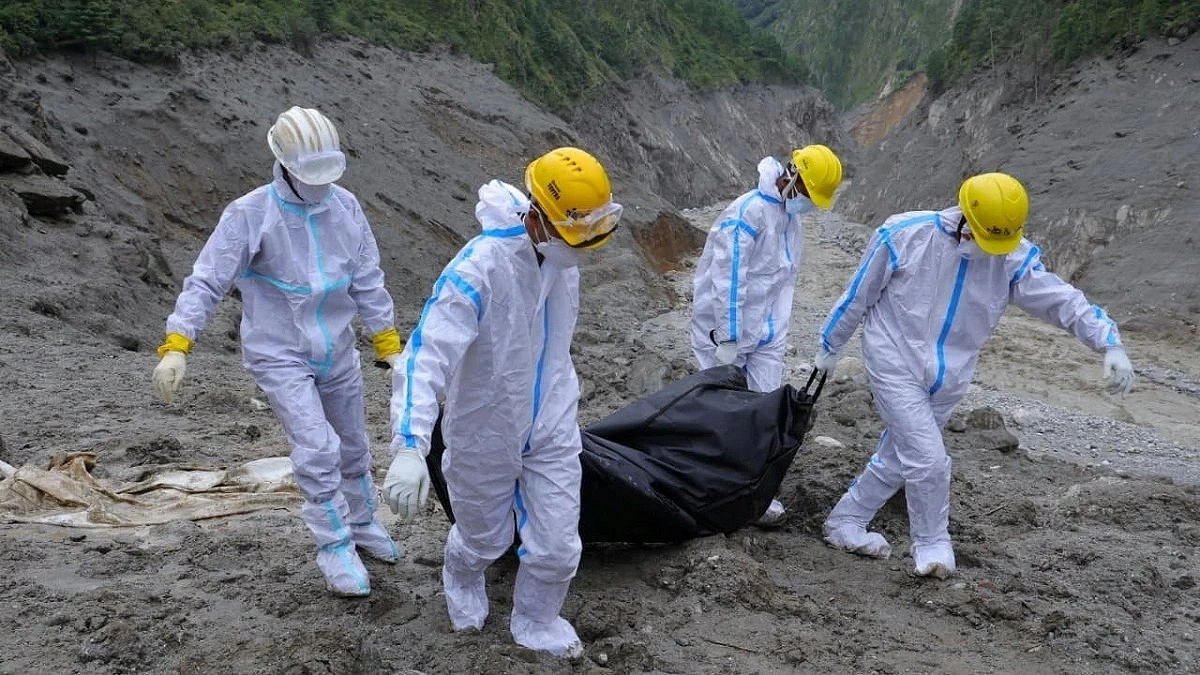
A soldier carries the body of a person recovered near a hydropower project area after sudden floods and landslides in Nepal’s Rasuwa district. Photo: Reuters
The Bangladesh government has responded quickly and appropriately to the unprecedented humanitarian crisis caused by recent landslides and flash floods in the friendly Himalayan nation of Nepal. Under the direct instructions of the Prime Minister, the government has decided to provide a financial grant of $1 million, equivalent to approximately Tk 123 million, to ensure emergency relief and medical assistance for disaster affected Nepali people.
The Ministry of Foreign Affairs made an official request to Finance Division Secretary Dr. Md. Khairuzzaman Majumder for the special financial allocation. The Ministry of Finance has given in principle approval for the release of the necessary funds, according to sources at the Ministry of Finance.
An analysis of administrative documents shows that the decision is not merely an immediate financial aid measure or an act of charity. At its core are geopolitical significance, far sighted disaster diplomacy and a strong economic foundation for historical South Asian solidarity developed in line with the founding principles of SAARC.
Disaster in Kathmandu: Devastation and unprecedented humanitarian crisis
The devastating natural disaster struck northern Nepal last Wednesday. Mountain runoff, flash floods and successive landslides have devastated settlements and basic infrastructure across the region. So far about 1,050 people have died in the disaster. Many ordinary citizens are also fighting for their lives in hospital beds with serious injuries.
Furthermore, the true scale of the humanitarian disaster has emerged from the missing persons data. More than 4,000 people, including ordinary residents, members of the Nepali armed forces and local law enforcement agencies, are still missing. The difficult terrain and disruption of major road connections have severely hampered efforts to determine the exact information and number of missing people.
Nepal’s housing system and overall structural foundation have suffered severe damage from the destructive force of nature. Thousands of families have lost their homes and have been forced to take shelter in the open. There is a severe shortage of drinking water and safe food. The lack of adequate emergency medicines and institutional health services has raised fears of epidemics and health risks across vast areas. In this situation, it became imperative for the international community to come forward immediately.
Official directive from the Foreign Affairs Division to the Finance Division
To quickly clarify Bangladesh’s position in the international humanitarian sphere, the Ministry of Foreign Affairs sent an important semi official and official note to the Finance Division on Tuesday.
The letter clearly stated that considering the overall importance of the humanitarian crisis and Bangladesh’s excellent bilateral relations with Nepal, the Prime Minister has instructed that $1 million be handed over as a grant to support those affected in Nepal. In accordance with this instruction, the ministry called for an integrated administrative process to quickly transfer the grant through a special allocation from the national budget for the 2026 to 2027 fiscal year. The urgent release of the grant from a special sector of the national budget reaffirms Bangladesh’s strong commitment to international oversight and diplomatic relations.
Bangladesh’s historic continuity in humanitarian diplomacy
Since the early days of its establishment, Bangladesh has set a distinguished example by providing humanitarian assistance during crises, particularly to neighboring countries. A statement prepared by the Ministry of Foreign Affairs mentions Bangladesh’s historic role in previous disasters in South Asian regional geopolitics.
It said that following the earthquake in Afghanistan in September 2025, Bangladesh immediately sent medicines, dry food and emergency relief supplies. After cyclones struck Sri Lanka in November and December 2025, Bangladesh quickly sent relief assistance and necessary medical supplies.
During Sri Lanka’s economic collapse, Bangladesh provided emergency medicines worth approximately Tk 160 million as a grant under an affordable international policy framework based on international humanitarian responsibility. After the earthquake in Nepal in 2015, Bangladesh earned global praise by providing state assistance and delivering large amounts of relief from ordinary citizens. During the global coronavirus pandemic, Dhaka set an example by directly sending emergency medicines and medical equipment to crisis hit Bhutan, Nepal, the Maldives and India.
According to economic analysts, although Bangladesh itself is on the path to becoming a developing country, providing direct financial and material grants from the national budget despite its own internal limitations sends a positive message about the country’s economic capacity.
Multifaceted Nepal Bangladesh relations
The geographical and political relationship between Bangladesh and Nepal is not limited to regional boundaries. Rather, it is strong and multifaceted. The relationship mainly rests on two pillars.
First, Nepal was the eighth country in the world to give full diplomatic recognition to Bangladesh as an independent and sovereign state after the bloody Liberation War in 1971. Kathmandu’s positive diplomatic position during the early days of an independent Bangladesh devastated by war was highly significant.
Second is Nepal’s cooperation regarding SAARC. SAARC was the result of the pioneering and visionary thinking of the then Bangladesh government and President Ziaur Rahman. Nepal was not only one of the founding members of the regional alliance. Its capital Kathmandu is also home to the permanent secretariat of SAARC.
The government memorandum emphasizes that it is Bangladesh’s diplomatic and moral responsibility to stand beside any of the founding members of SAARC during an extreme crisis. Providing $1 million in aid during the current crisis will significantly enhance Bangladesh’s image in the international diplomatic arena.
Impact on the budget and economic significance
According to the joint plan of the Ministry of Foreign Affairs and the Ministry of Finance, the money will be provided from the foreign assistance and humanitarian grants sector of the 2026 to 2027 fiscal year budget.
Despite facing various challenges in the global economy, including inflation and foreign exchange reserve management, continuing humanitarian assistance internationally reflects Bangladesh’s strategic foresight. The decision demonstrates that Bangladesh is not merely a recipient of grants from other global organizations. It is also prepared to act as a self reliant donor state in response to economic or natural disasters anywhere in the region.