
Nepal's flash flood halts electricity export to Bangladesh

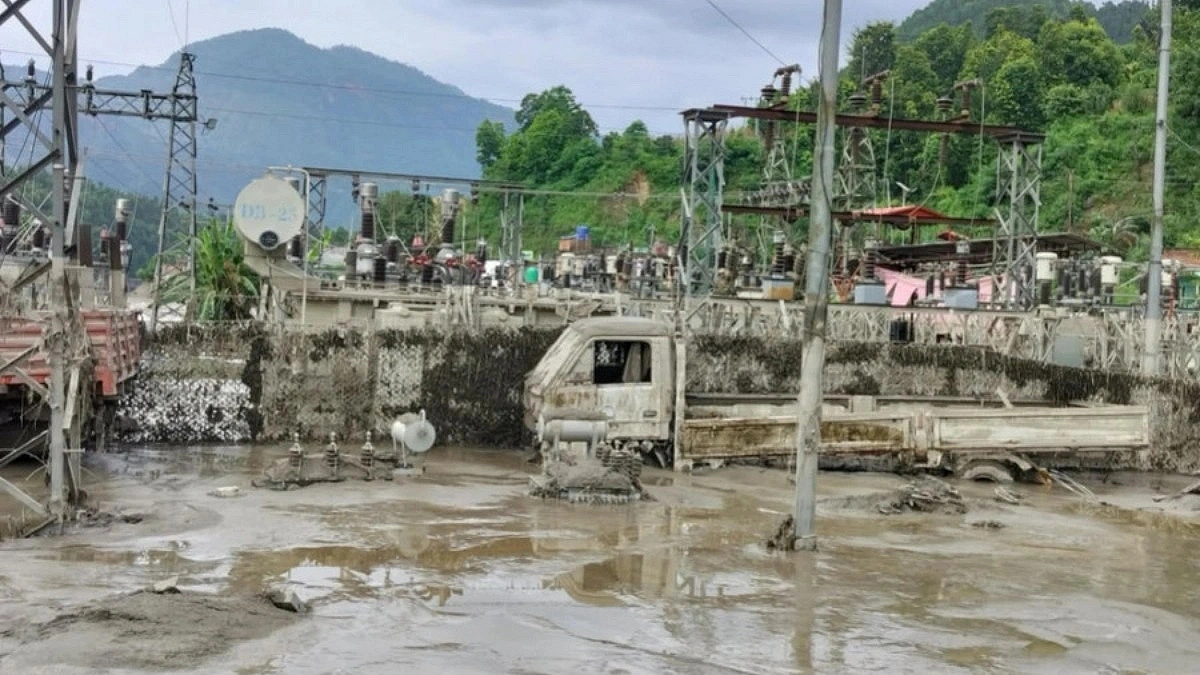
A power substation and associated vehicles seen submerged in mud, silt, and debris following flash floods in Nepal. Photo: Courtesy of the Ministry of Energy, Water Resources and Irrigation.
During the monsoon season in Nepal, river water flow usually increases substantially, boosting hydropower generation. At this time, the country exports surplus electricity to India and Bangladesh. However, this system has suffered a major setback this year due to the recent devastating flash floods.
On Wednesday morning, severe flooding in the Bhotekoshi River basin damaged several hydropower projects. This has reduced Nepal's electricity generation and exports. As a result, Nepal's electricity exports to Bangladesh have virtually ceased.
During the monsoon, Nepal used to export an average of about 1,000 MW of electricity. Currently, that has dropped to approximately 650 MW.
The Chilime hydropower project, approved to supply electricity to Bangladesh, has a generation capacity of 22.1 MW. The Trishuli project has a capacity of 24 MW. Both projects were damaged by the floods and have suspended electricity generation since last week.
Dirghayu Kumar Shrestha, Acting Managing Director of the Nepal Electricity Authority, stated that both projects supplying electricity to Bangladesh have been damaged. India has been requested to allow the transmission of electricity to Bangladesh from alternative projects. Currently, electricity exports to Bangladesh are effectively zero.
Due to the floods, production at 12 other hydropower projects in Nepal has also been halted. Several projects' transmission lines have been damaged, so they are operating on a limited scale, disconnected from the national grid.
However, floods are not the only reason for the reduced exports. Nepal is unable to export 73.75 MW of electricity from three more projects because India has not renewed its approval.
India's approval remains a major obstacle to increasing Nepal's electricity exports. So far, the country has received Indian approval to export about 1,200 MW from 37 hydropower projects.
There are also complexities regarding India's transmission capacity for Bangladesh. In November 2025, Nepal and Bangladesh agreed to increase electricity exports by 20 MW. However, India stated that it does not have sufficient transmission capacity for the additional power supply.
Nepal has also been seeking approval to export electricity from projects involving Chinese investment, contractors, or equipment. However, obtaining India's approval for these projects is becoming difficult. A prime example is the 456 MW Upper Tamakoshi hydropower project.
Nepal started exporting electricity in 2021. Before that, the country was largely dependent on electricity imports.
During the monsoon, increased river water flow allows Nepal to generate surplus electricity for export. When production decreases in the dry season, it again imports electricity from India.
In fiscal year 2025–26, Nepal exported electricity worth NPR 29.32 billion to India and Bangladesh. During the same period, it imported NPR 10.23 billion worth of electricity from India during the dry season. This gave the country a net profit of NPR 19.09 billion in the electricity trade.
This year's monsoon peak generation and export period has been severely disrupted by the Bhotekoshi floods. Alongside repairing the damaged power plants and transmission infrastructure, Nepal is trying to obtain India's permission to send power to Bangladesh from alternative projects.
Source: Kathmandu Post


