
Fuel import costs to rise by Tk 35,000 crore
- LNG Import Dependency Intensifies the Crisis

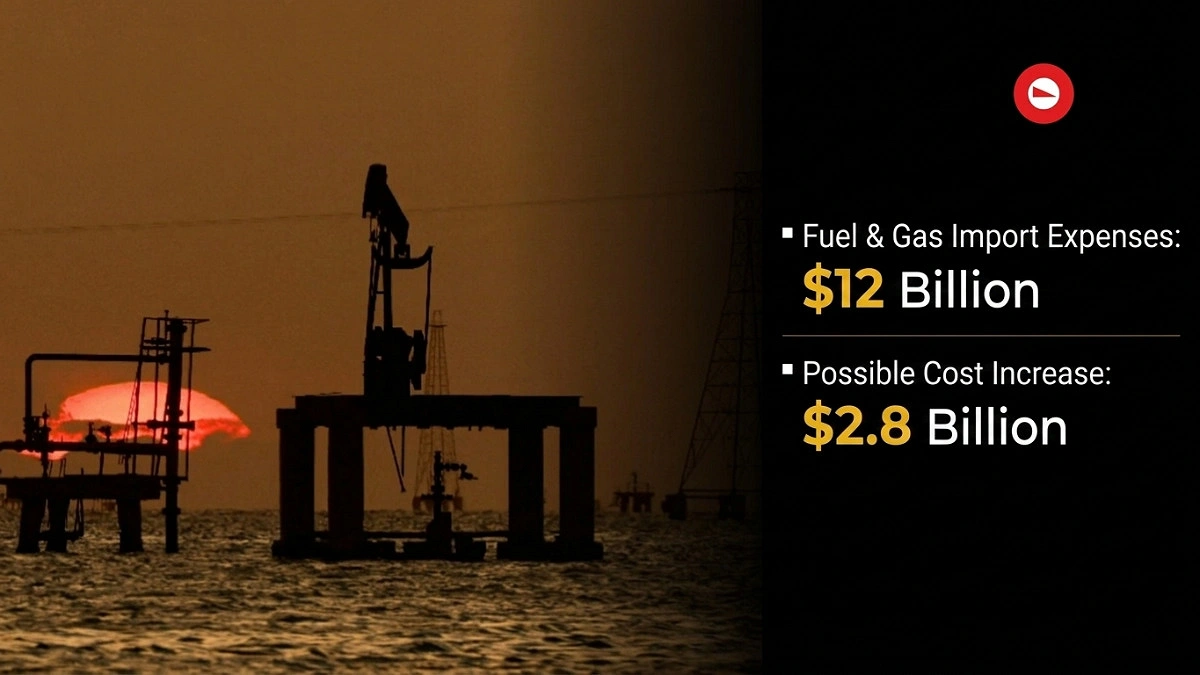
Amader Somoy graphics regenerated by AI.
If the current trends in international prices of oil, gas, and coal persist, Bangladesh's fuel import bill in 2026 could increase by $280 million (approximately Tk 35,000 crore) compared to the previous year. It could further exacerbate the country's trade deficit, inflation, and pressure on the local currency.
The crisis has been largely intensified by Bangladesh's dependency on LNG imports.
This information emerged from an analysis by the international research organization Zero Carbon Analytics (ZCA). According to the organization's estimates released on Thursday, fossil fuel import costs this year could be nearly 30% higher than in 2025. This additional expenditure is equivalent to about 10% of the country's trade deficit.
According to government data, Bangladesh spends roughly $12 billion annually on fuel imports.
ZCA states that if current fuel prices continue, the country's ability to meet import costs will diminish, potentially reducing Bangladesh's import cover from 5.7 months to 5.2 months.
The organization's analysis further notes that the additional money that could be spent on fossil fuel imports in 2026 could instead be used to install approximately 8 gigawatts (GW) of rooftop solar power. This amount of solar capacity would add about 25% to the country's current power generation capacity of nearly 32 GW.
LNG Imports Decrease, But Costs Do Not
From January to August this year, Bangladesh's LNG imports dropped by about 13% compared to the same period last year. The most significant impact occurred in July and August, when supply disruptions in the Hormuz Strait led to an approximately 83% decline in LNG imports.
According to ZCA data, Bangladesh imported around 630,000 tons of LNG in July, but this fell to 110,000 tons in August.
However, despite the decrease in imports, fuel costs have not decreased. On the contrary, due to high international fuel prices, the overall import bill is feared to increase.
About 64% of Bangladesh's electricity generation is gas-dependent. Consequently, any disruption in LNG supply directly affects power generation. On August 11, the country's power supply shortage reached 3,592 megawatts, which was about 20% of the total demand at that time.
The impact of the gas crisis is also being felt in the industrial and agricultural sectors. According to ZCA, six out of the country's seven major fertilizer factories are either closed or operating at limited capacity due to insufficient gas supply.
The impact of the power crisis is also being felt in Savar, Ashulia, and Dhamrai, where several factories have seen production drop by 15 to 20 percent, according to the report.
ZCA's analysis also highlights a long-term vulnerability in Bangladesh's energy sector: import dependency.
According to the organization's data, in 2023, about 46 percent of Bangladesh's total energy supply was met through imports. In the 2024–25 fiscal year, nearly 65 percent of the country's electricity demand was tied to imported energy. In 2025, roughly two-thirds of Bangladesh's LNG supply came through the Hormuz Strait.
To tackle the current crisis, Bangladesh is attempting to source LNG from various outlets, including the spot market. In addition to approving two spot LNG cargoes for August and September, eight more cargoes have been procured from suppliers in the UK, Australia, Malaysia, and Oman. Extra diesel has also been requested from India.
On the other hand, there are also initiatives to increase long-term dependence on imported gas. Bangladesh has signed a contract to purchase 117 LNG cargoes from the United States between 2026 and 2038.
However, ZCA believes that signing long-term contracts does not eliminate supply risks. During the current crisis, three of Bangladesh's major LNG suppliers have declared force majeure on their contractual deliveries.
Reliance on LNG is Not a Sustainable Solution
Zakir Hossain Khan, Managing Director of Change Initiative, said that LNG cannot ensure Bangladesh's energy independence. During global crises, even with supply contracts, there is no guarantee that gas will arrive at the country's ports on time. Yet the costs will keep rising.
"An LNG-dependent energy system carries high risks. Therefore, investment in renewable energy, especially rooftop solar power, needs to be increased," he added.
Shafiqul Alam, Bangladesh Lead Energy Analyst at the Institute for Energy Economics and Financial Analysis (IEEFA), said that increasing reliance on LNG is not a sustainable solution to the weaknesses in Bangladesh's energy sector.
According to his calculations, if the planned new LNG terminals become operational, Bangladesh's LNG imports could exceed 700 billion cubic feet by 2030. Depending on international market prices, this could cost between USD 850 million and USD 1.4 billion annually.
Shafiqul Alam said that such dependence would raise electricity and gas prices and reduce the competitiveness of industries. Moreover, it would not enhance the country's capacity to tackle the energy crisis.
In his view, alongside increasing domestic gas exploration and production, investments must be ramped up in solar power, battery storage systems, and cross-border hydropower.
ZCA sees rooftop solar power as a promising alternative to reduce Bangladesh's energy import dependency.
In 2025, just over 5 percent of the country's total electricity generation came from renewable sources. That year, installed renewable energy capacity stood at 1.49 GW.
According to IEEFA, installing 1 MW of rooftop solar power could save approximately $180,000 annually in imported fuel costs.
To meet Bangladesh's target of 20 percent renewable electricity generation, about 760 MW of new renewable capacity needs to be added each year until 2030. However, as of February this year, the total capacity of renewable energy projects under construction was only 358 MW.
Therefore, the analysis suggests that to address the energy crisis, beyond merely increasing imports, boosting domestic energy production alongside rapid investment in solar and other renewable energies may be the path to reducing import dependency in the long term.
