
New door opens for shipping after garments
- Garments earn $26.24 billion
- Shipping has $15 billion potential

Graphics: Agamir Somoy
Sea going cargo transportation by Bangladeshi ships is expanding steadily. Reducing dependence on foreign vessels, the country’s 108 commercial ships are now carrying cargo across the world. From Europe and the United States to Chattogram.
From the Middle East to Africa. The fleet of red and green flagged ships is transporting cargo on sea routes across the globe. In other words, the number of Bangladeshi flag carrying ships operating in international waters is increasing every day.
Of the 108 ships, 101 are owned by private entrepreneurs, while the remaining seven belong to the state owned Bangladesh Shipping Corporation (BSC). These vessels, including bulk carriers, container ships, and oil and gas tankers, have a combined cargo carrying capacity of 5.6 million tons. Between 2,700 and 4,000 Bangladeshi seafarers are employed in operating these ships. Freight earnings from transporting domestic and international cargo on Bangladeshi ships bring in $2 billion annually, equivalent to Tk 250 billion in foreign currency.
Bangladesh pays about $15 billion, or Tk 1.875 trillion, every year in freight charges for transporting all types of cargo by sea. If the country can bring this vast market under the control of domestic ship owners instead of foreign operators, the sector will rank immediately after the ready made garment industry. However, the biggest challenge is the government’s policy framework. Long term business expansion requires simple and liberal policies that encourage domestic entrepreneurs to invest.
Although the website of the Bangladesh Garment Manufacturers and Exporters Association, or BGMEA, mentions exports worth $39 billion, its First Vice President Selim Rahman said, “Exports now stand at $42 billion. Of this export income, 75 percent used to go toward importing raw materials. But the encouraging news is that half of that 75 percent of raw materials is now being produced domestically.”
That means the actual foreign currency earnings from the ready made garment sector amount to approximately Tk 3.28 trillion.
The garment industry remains the country’s largest source of foreign currency earnings. Bangladesh transports 130 million tons of import and export cargo by sea every year. The country’s 108 ships have the capacity to carry only about 12 percent of that cargo. The remainder is transported by foreign vessels.
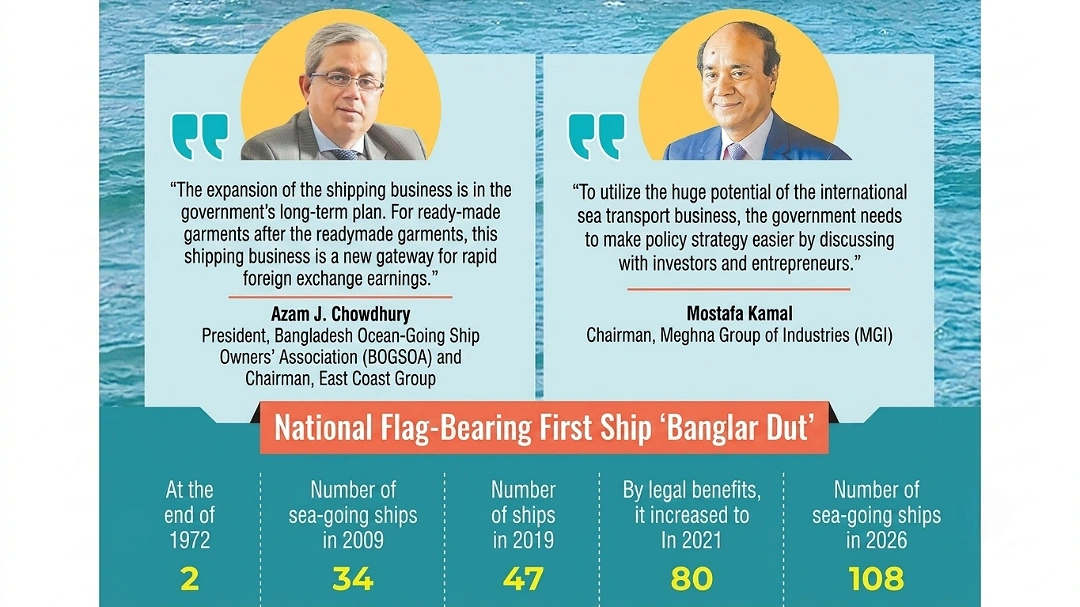
As recently as 2010, Bangladesh had only 35 ships in its fleet. In 2019, the Bangladesh Flag Vessels Protection Act was enacted. The government then introduced a policy giving priority to domestic ships for carrying commercial cargo from overseas. Taking advantage of this opportunity, major private industrial groups such as KSRM, Meghna Group, and Akij Group began expanding their fleets. As a result, the country surpassed the milestone of 100 registered ships by 2023. Each ship has a carrying capacity ranging from 55,000 to 100,000 tons.
Azam J. Chowdhury, President of the Bangladesh Ocean Going Ship Owners Association and Chairman of East Coast Group, said the expansion of the shipping business is part of the government’s long term plan. He said the shipping industry has become a new gateway for earning foreign currency after the ready made garment sector. The government has provided tax exemptions for the sector through 2030. As a result, entrepreneurs have invested heavily in ships. The sector earns $2 billion in foreign currency annually through freight income and seafarers’ wages.
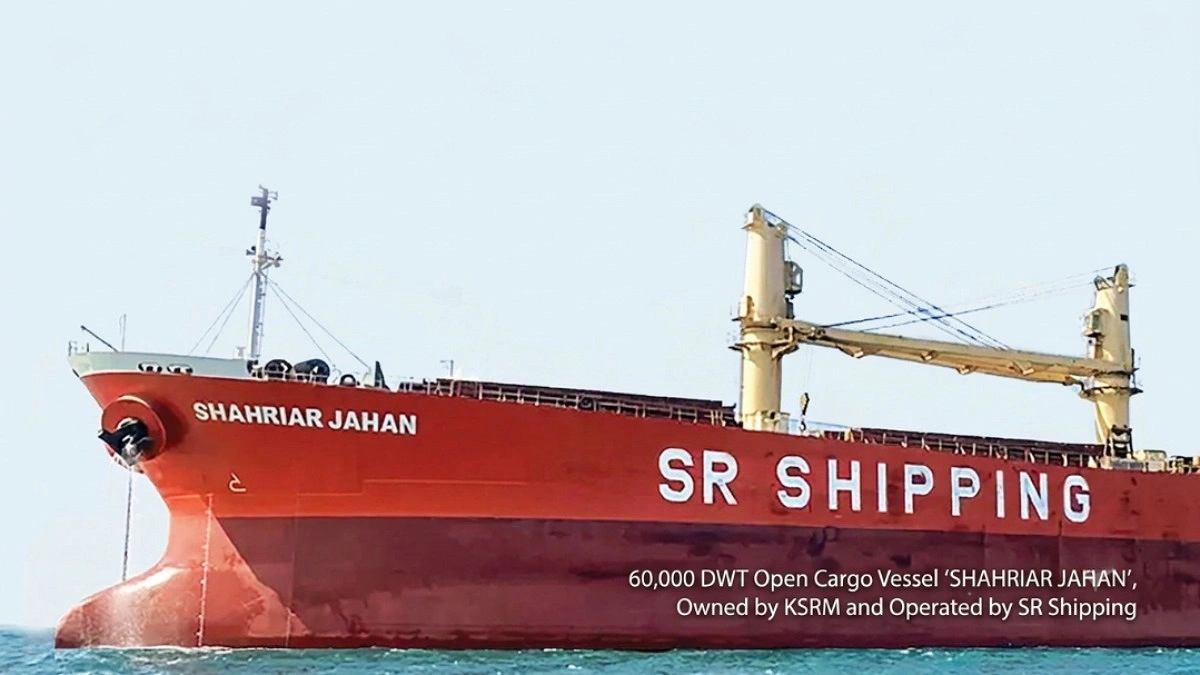
After successfully transporting their own cargo, domestic ship owners are now playing a role in international cargo transportation as well. As a result, there is an undeclared competition among major industrial groups to expand their fleets. Chattogram based KSRM Group pioneered private sector ocean going shipping in Bangladesh. The company began purchasing ships in 2009 and expanded its fleet gradually over one and a half decades. It remained the market leader for many years. It now owns 27 ships.
One of the country’s leading industrial conglomerates, Meghna Group of Industries, or MGI, entered the ocean going shipping business much later, in 2019. Its rapid and far reaching investment strategy changed the dynamics of the entire sector. Within seven years, the company caught up with KSRM. Both groups now operate 27 ships each, for a combined total of 54 vessels. MGI leads in terms of newer and more modern ships. In addition, once vessels awaiting registration are added, Meghna Group will move to the top of the list. One of its ships is awaiting approval, while three more are in the pipeline. Within the next few months, MGI will own 31 ships.
Mostafa Kamal, Chairman of Meghna Group of Industries, said, “It took us seven or eight years to convince the government that this sector has enormous potential. Now two industrial groups in the country own half of the ships. If other industrial groups come forward, the path to earning foreign currency will become even easier. Bangladesh has only 108 ships, whereas Indonesia has 11,500. The government should further simplify its policy framework through discussions with investors to take advantage of the huge potential in international maritime transport.”
According to data based website Visual Capitalist, Indonesia has the world’s largest commercial shipping fleet with 11,422 ships. China ranks second with 8,314 ships. Panama is third with 8,174 ships. Japan ranks fourth with 5,000 ships.
Captain Sheikh Jalal Uddin Gazi, Chief Officer of the Registrar of Bangladesh Ships, the government agency responsible for ship registration, said, “Once the three ships awaiting registration are added, Meghna Group will move to the top of the list. Because its ships are newer and more modern, they secure international cargo charters more quickly. They also consume less fuel. Since they meet international maritime safety standards, they receive greater commercial advantages.”
According to the Department of Shipping, the average economic life of Bangladeshi flag carrying ships is 17 years. The average age of Meghna Group’s 27 ships is about 10 years. More than 15 ships in its fleet were built in 2020 or later. Four of its ships were built in 2022 and 2023.
By contrast, the average age of KSRM Group’s ships is 16 and a half years. Most of its fleet consists of ships built between 2002 and 2008. KSRM’s 27 ships have a combined cargo carrying capacity of 1.534 million tons, while Meghna Group’s 27 ships have a combined carrying capacity of 1.515 million tons. All of KSRM’s ships are bulk carriers. Meghna Group operates 25 bulk carriers and two oil and gas tankers.
Akij Group ranks just behind these two industrial groups in the competition. It entered the business in 2010 by purchasing a used ship. Over 16 years, it has expanded its fleet to 11 bulk carriers.
Bangladesh has only one domestic flag carrying container ship operator. The business belongs to veteran shipping entrepreneur Saber Hossain Chowdhury. His company, HR Lines, operates a fleet of eight container ships. The company maintains exclusive dominance in container cargo transportation, with all of its ships operating on the Singapore, Colombo, and Chattogram route.
In addition, Vanguard operates seven bulk carriers. State owned BSC currently has seven operational ships, including four bulk carriers and three oil tankers.
Leading cement manufacturer Crown Cement operates three bulk carriers. Hanif Maritime has three bulk carriers. Doria Shipping owns two oil tankers. Azam J. Chowdhury’s MJL Bangladesh operates the country’s three largest oil tankers. Bashundhara, Pacific, Delta, Abul Khair, AMS Logistics, PNN, Sunshine, PH, TK, and Dorin Shipping each own one ship. Excluding KSRM and MGI, 16 private industrial companies operate a total of 54 ships transporting cargo.
Commenting on the budget notification announced this year, Chattogram Chamber President Mohammad Amirul Haque expressed disappointment, saying, “Under the previous budget, ships up to 25 years old could be imported, and there was no opportunity to sell them within 10 years. This time, ships older than 10 years cannot be imported. After import, they can be sold within five years. Entrepreneurs may lose interest under such strict conditions.”
