
Twenty years of searching for a cargo solution

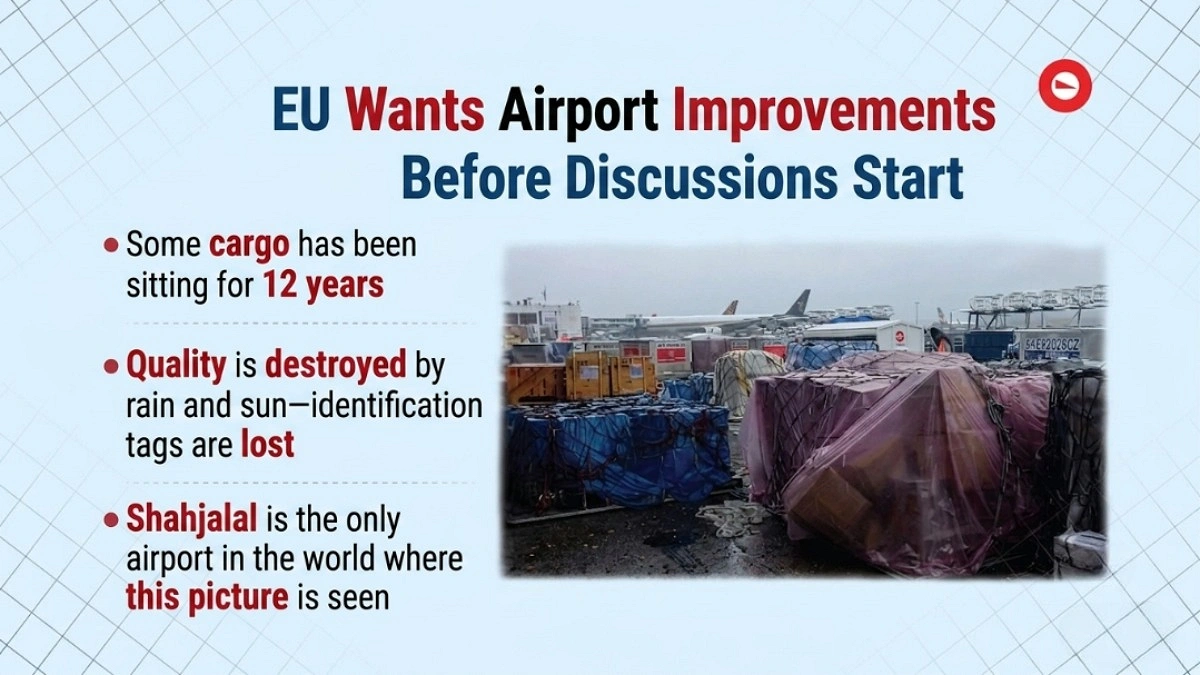
Graphics: Agamir Somoy
Twenty years ago, prime minister Khaleda Zia ordered a solution to the cargo crisis. Caretaker government chief Fakhruddin Ahmed followed the same path. Later, former prime minister Sheikh Hasina deployed everyone from ministers and principal secretaries to secretaries to address the cargo problem. One committee after another was formed and recommendations were made, but no progress followed. Cargo handling at Hazrat Shahjalal International Airport remains in the same state as before. The new government has also stepped in to solve the same problem. It can be said that it is being compelled to find a way out.
Recently, Bangladesh proposed to the European Union (EU) that discussions begin on signing a Free Trade Agreement (FTA). To start FTA negotiations, the EU informed the Ministry of Commerce that visible solutions are needed to address the problems of doing business in Bangladesh, including cargo handling issues at the airport. Following this, Commerce Minister Khandaker Abdul Muqtadir held a meeting on the issue on June 25. The entire cargo issue was raised there.
Cargo travels thousands of miles to Bangladesh at enormous cost. Yet, at Hazrat Shahjalal International Airport in Dhaka, these goods are stored under the open sky. Product quality deteriorates in the rain and sun, and identification tags are lost. Shahjalal is the only airport in the world where such a situation exists.
Officials at the meeting said there is not enough space inside the airport for cargo handling. As a permanent solution, emphasis is being placed on establishing bonded warehouses outside the airport. To this end, a new committee was formed at the meeting to identify land for constructing a temporary warehouse of 100,000 square feet.
The meeting was told that fires have made the problem even more complicated. A fire on Oct. 18 last year severely damaged two sheds at the import terminal. One of the four warehouses was completely destroyed and another was partially damaged. Then, on June 5, 2026, another fire broke out, making the situation even more critical. Although six or seven investigation committees were formed after these incidents, progress in implementation has been limited. Of the 11 decisions taken at various meetings following the fires, only two have been implemented. Although temporary arrangements have been made for storing courier goods, medicines and dangerous goods to keep cargo handling operational, they do not offer a permanent solution.
The minutes of the June 25 meeting were sent to various ministries the following week. It stated that although some progress had been made through temporary measures after the fire, the crisis had not been resolved. About 2,700 tons of cargo have been cleared. However, around 300 tons of goods are still awaiting clearance. Even the decision to quickly release 1,385 tons of uncleared goods at Gate No. 9 could not be implemented.
The cargo congestion began in 1985. During the first decade and a half after the cargo terminal began operations, the volume of imported goods at the airport was comparatively low. However, after cargo flights began operating in 2002-03, the volume of imported goods suddenly increased four to five times. But cargo warehouses were not expanded and alternative infrastructure was not developed accordingly, which is now seen as one of the main reasons behind the prolonged congestion. In addition, there are instances of some goods remaining at the terminal for as long as 10 to 12 years. Importers’ failure to clear goods on time, delays in uploading the Import General Manifest (IGM), and the limited cargo handling capacity of Biman Bangladesh Airlines have further complicated the situation.
Customs officials at the meeting said that about 90 percent of bills of entry are assessed on the same day they are submitted, and goods can be released the same day if duties are paid. However, although there is a provision to auction goods that remain uncleared after 21 days, the auction process is lengthy and complicated, resulting in a large accumulation of goods.
From 2011 to 2016, the total volume of auctionable (inventoried) uncleared goods stood at 359 tons, including 57 tons in 2011, 135 tons in 2012, 23 tons in 2013, 30 tons in 2014, 25 tons in 2015 and 89 tons in 2016. This data shows that the accumulation of uncleared goods has persisted for years. For this reason, emphasis has been placed on formulating a separate auction policy.
Meanwhile, initiatives have been taken to finalize cold storage infrastructure and standard operating procedures (SOPs) for ground handling to accelerate the import and export of medicines. Authorities have been instructed to finalize the SOPs within seven days, following the models of Malaysia and Singapore.
As an immediate measure to ease cargo congestion, a decision has been made to continue full-scale cargo clearance operations even on holidays, keep banks open and launch a ‘crash program’ in coordination with the relevant agencies. At the same time, Biman Bangladesh Airlines has taken the initiative to introduce an artificial intelligence (AI) model in cargo management so that importers can be notified quickly and goods can be identified.
In addition, an eight-member Joint Working Group (JWG) has been formed to address the problem. The group will review progress every month and submit reports to the relevant ministers. On the other hand, there are plans to reclaim excess land allocated to the Rapid Action Battalion (RAB) and construct warehouses there.
Aviation analyst Kazi Wahidul Alam told Agamir Somoy, “The airport’s cargo crisis is not a new issue; it is the result of long-standing structural and management limitations. Although cargo volume has increased, infrastructure and management have not improved accordingly. Despite repeated committees and directives, implementation gaps have prevented the crisis from being resolved. For a permanent solution, modern warehouses outside the airport, integrated logistics management and technology-based monitoring are essential.”
