

Who has the power to postpone exams?
Board holds supreme authority, but the Ministry imposes decision
- No legal requirement to seek ministry approval
- Board decisions held hostage by fear of transfers and postings
- 'Auto-pass' granted in 2020 using board authority
- A similar situation arose in the Milestone plane crash incident in 2025

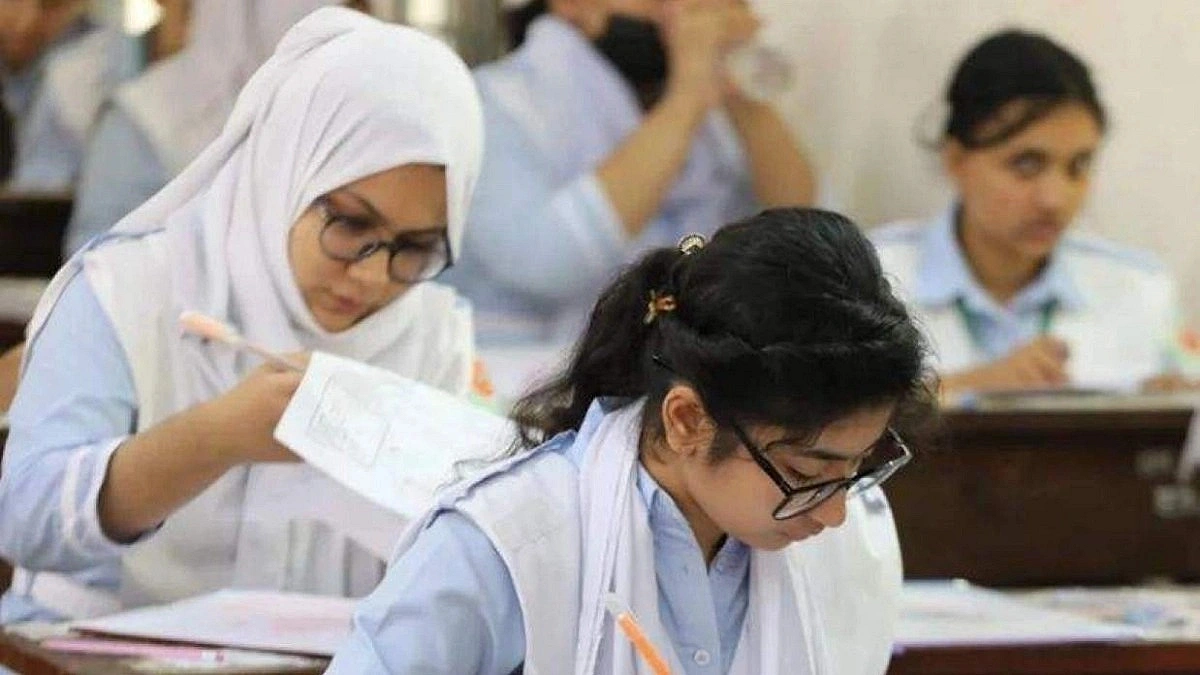
File Photo
As students continue their agitation demanding resignation of Education minister who imposed a decision to continue running the HSC exams, a question arises as to who enjoys the power to stop or not to stop board exams.
Due to continuous rainfall, waterlogging had developed in various places across the country. Overcoming that, wading through knee-deep water, and boarding boats, students had to go to take their HSC exams. Some images of such suffering confronted by examinees on their way to exam centers spread through mass media and social media. Discussions and criticisms began. Questions arose as to why the exams were not postponed due to the adverse weather, and students also became agitated over some comments made by the Education Minister.
They started demanding the resignation of Education Minister A N M Ehsanul Hoque Milon, holding him responsible for the entire situation. The students' allegation is that the Inter-Education Board was in favor of postponing the exam due to the adverse weather. However, the Ministry of Education decided to hold the exam. In such a situation, the question arises: who actually holds the ultimate authority to postpone or cancel a public examination? The Education Board or the Ministry?
A review of the laws and ordinances of the education boards reveals that they hold supreme authority over conducting exams, postponing them, canceling them, and even evaluating and publishing results without exams in special circumstances. But in reality, the boards' decisions effectively depend on the Ministry's consent. Although there is no legal obligation for the Ministry's approval in the law, administrative realities, coordination with field administrations, and matters like transfers and postings limit the boards' autonomous powers.
For the administration of education boards, the erstwhile government in 1961 created a Special Ordinance, designating the boards as autonomous bodies. There, the boards are legally given complete independent authority or autonomy regarding holding, postponing, publishing results, or canceling public examinations. The legal right to make their own decisions is provided in Ordinance 2, Sub-section (2-A). It states, "If due to an epidemic, natural disaster, or any other unavoidable circumstance determined by the government, it is not possible to hold examinations at the Intermediate and Secondary levels or any of its levels, those examinations may be postponed."
Regarding this matter, Agamir Somoy spoke with several examination controllers. They said that in a coordination meeting of the Inter-Education Board the previous day (Sunday), a consensus was reached not to hold Monday's exam due to adverse weather. After informing the Ministry of this decision, the Ministry held a virtual meeting with Divisional Commissioners, Deputy Commissioners, and Superintendents of Police and decided in favor of holding the exam on Monday. The question now is, why was the Ministry's approval needed when the Education Board holds sole authority?
Responding to such a question, a former chairman of the Dhaka Education Board said, "The Education Board is autonomous in name only. For any administrative decision, prior permission from the Ministry is required. Besides, the Ministry handles the transfers and postings of education cadre officers who come to the board on deputation. A chairman cannot simply make decisions as they wish. In matters of canceling or postponing exams, one always has to look towards the Ministry's decision."
An incident occurred in 2025 during the HSC examinations. That year, on July 21st, a training fighter jet crashed at the Millennium School in Uttara, Dhaka, causing extensive casualties. The government declared a one-day state mourning. The Inter-Education Board proposed postponing the HSC exam due to the day of mourning. The then Education Secretary, Siddique Zubayer, rejected that proposal and instructed the exams to continue as scheduled. Following this decision, intense criticism erupted on social media and various quarters that very night. Consequently, at 2 AM, the then Chief Advisor's Press Secretary, Shafiqul Alam, announced the postponement of the exam. The next day, when agitated students attempted to lay siege to the Secretariat, there was a fierce clash between the police and the students. The government immediately removed Siddique Zubayer from his post.
A responsible official of the board said that although the law grants the board the authority to postpone exams, it must still inform the Ministry as the 'controlling body' and obtain verbal consent. The same was done for Monday's exam, but the Ministry did not agree and instructed the exams to continue.
However, Professor Akhtaruzzaman, Chairman of the Dhaka Education Board and President of the Inter-Education Board Coordination Committee, told Agamir Somoy: "Even though the law grants the power, we do not have the manpower to conduct exams for hundreds of thousands of students across the country. We require the assistance of local administrations, such as the police and civil administration. That is why we have to take recourse to the Ministry. Everyone knows how autonomous bodies function in Bangladesh."
Professor Abdullah Al Mamun Chowdhury, Chairman of the Chittagong Education Board, said, "Even though the board has the power to conduct exams, its implementation must be carried out through field administration. The board makes decisions based on reports from the Deputy Commissioner (DC) and Upazila Nirbahi Officer (UNO). Since the Ministry is their controlling body, any decision must be reported to them."
What the law says:
A review of the laws and relevant ordinances governing the education boards (East Pakistan Ordinance No. XXXIII of 1961 and the amendment ordinance of 1977) reveals that the education boards operate under a special act and have been granted full authority over conducting exams and publishing results. According to Section 18(2)(6), concerning the conduct and control of examinations, the full authority to hold, conduct, and control examinations under the Secondary and Higher Secondary Education Boards rests with the boards. Under Section 12(6) of the ordinance, if an emergency situation arises in administrative work and requires immediate action, the Chairman can take any measure (such as postponing an exam) according to his discretion. However, this decision must be presented for approval at the subsequent board meeting. Nowhere does it state that the Ministry must be informed.
According to Section 12(6) of the ordinance, if an emergency situation arises in administrative work requiring immediate action as per the Chairman's decision, the Chairman may take any measure according to his discretion. However, after taking such emergency measures, he must submit or present them for ratification at the next board meeting.
The law under which 'Auto-Pass' was granted during COVID:
In 2020, due to the COVID-19 pandemic, holding the SSC and HSC examinations was not possible. Subsequently, without holding exams, the education boards utilized the power under Section 2(2A) of the amended ordinance of 2021 to evaluate students based on the results of SSC and JSC/equivalent examinations and published the results, which became popularly known as 'auto-pass'. The original 1961 ordinance, enacted during the British era, was amended in 2021. This amended law made it possible to conduct evaluations or grant auto-passes without holding exams.
Section 2, Sub-section (2-A) of the ordinance states— if due to an epidemic, natural disaster, or any other unavoidable circumstance determined by the government, it is not possible to hold examinations at the Intermediate and Secondary levels or any of its levels, those examinations may be postponed. Furthermore, evaluation without examinations and awarding of certificates can be done, or exams can be held on a shortened syllabus. It was using this legal authority that auto-passes were granted without exams during COVID, and in the subsequent two years, subject mapping and examinations on half the subjects were conducted. The ordinance also states that in situations like natural disasters, certificates can be issued through special evaluation without exams, or examinations can be held on a shortened syllabus.

