

From the blood that sparked
The day that turned the movement around

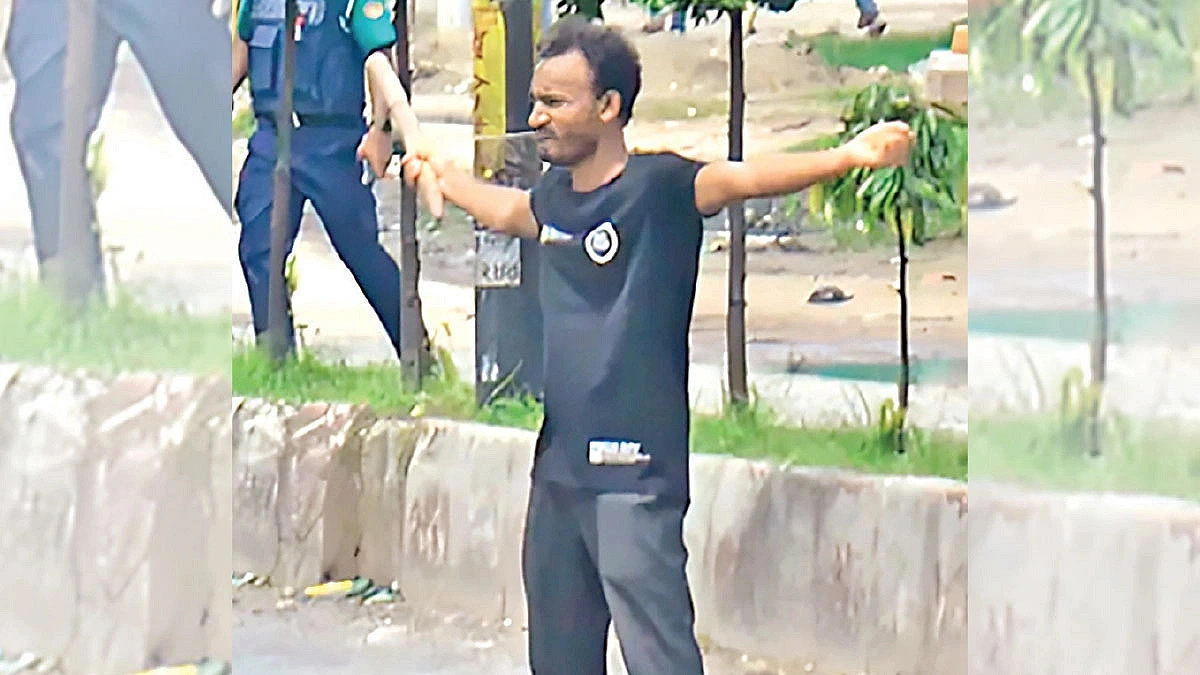
Abu Sayeed. File Photo.
The movement, which began with demands for quota reform, was still confined to the question of students' rights. It was July 16, 2024. Rangpur's Park Mor was tense at the time. Excitement had spread all around over the programs of the anti-discrimination student movement. In that afternoon, filled with police presence, students' slogans, and uncertainty, a young man's name was suddenly etched into the pages of history.
That day, Abu Sayeed, a student of Begum Rokeya University, stood with his chest bared and both arms outstretched in front of fierce police. He kept moving forward, repeatedly appealing to the police not to fire on the protesters. Moments later, he collapsed to the ground, hit by pellets fired by the police. The video footage of that scene spread across the country and abroad. In an instant, Abu Sayeed became a symbol of protest, courage, and sacrifice.
According to those concerned, that single afternoon changed Bangladesh's political reality. After Abu Sayeed's, death, the anti-quota movement rapidly transformed into a mass anti-government uprising. It spread to the remotest corners of the country. In small and large cities alike, students, parents, professionals, and ordinary people took to the streets everywhere.
Zeabin, a fellow student of Abu Sayeed, and a student at Begum Rokeya University, was saying, "When the police fired at Abu Sayeed, I was just a few yards away. He kept standing in front of the police, spreading his arms, and saying, 'Here's my chest, go ahead and shoot.' The courage Abu Sayeed, showed in embracing death is a rare event in history. His death turned grief into strength for the entire nation. People became more resolute against fascism. Abu Sayeed's sacrifice was the movement's primary turning point."
After July 16, Abu Sayeed's name was chanted on every campus and in every procession. Slogans rang out: "Who are you? Who am I? Abu Sayeed, Abu Sayeed,!" His portraits were painted on every wall. Social media was flooded with photos and videos of his final moments.
From July 16 to August 5, continuous clashes, repression, and political instability resulted in hundreds of deaths and thousands of injuries. Curfews, internet shutdowns, and harsh crackdowns by law enforcement agencies—nothing could stop the student-public movement. Finally, on August 5, Sheikh Hasina resigned and fled to India.
Later, after the formation of the interim government, from the Chief Advisers to various political leaders and analysts repeatedly cited that Abu Sayeed's sacrifice was the most powerful symbol and the spark of the movement.
Sarjis Alam, one of the coordinators of the July uprising and an NCP leader, said: "Abu Sayeed's blood supplied the strength that turned the entire mass uprising toward the fall of the government. His sacrifice didn't just energise a movement; it taught an entire generation the courage to stand against injustice."
Abu Sadik Kayem, VP of Dhaka University Central Students' Union (DUCSU), said: "In the July movement, Abu Sayeed's life sacrifice was a symbol of the courage of a generation that stood against oppression. The image of him standing with his chest bared was not just the death of a student; it shook the conscience of the entire nation."
Rakibul Islam Rakib, president of the Jatiyatabadi Chhatra Dal (JCD), said: "After July 16, when Abu Sayeed, Shaheed Wasim, and other ordinary students were killed, we became certain that the government could not last much longer. Before this, they had attacked opposition party activists, but this time they openly fired at ordinary students."
Muntashir Ahmad, president of the Islami Chhatra Andolan, said: "The events from July 14 to 16 changed the course of the movement. On July 14, Sheikh Hasina's comment about 'grandsons and great-grandsons of Razakars' sparked intense anger among students. After the Chhatra League attacks the following day and the killing of Abu Sayeed on July 16, it became clear to us that this was no longer just a quota movement; it had transformed into an anti-government mass uprising."
Dr. Ainul Islam, professor at Dhaka University, said: "In history, some deaths are not merely personal tragedies; they become part of a nation's consciousness. Abu Sayeed's death exploded the pent-up anger, deprivation, and protest within Bangladesh's youth. It was a historic turning point, a moment of change."
Various Programmes: To commemorate the martyrs of the July uprising, the government will observe today as "July Shaheed Day." At 6:01 AM, wreaths will be laid and Fatiha recited at the Rajarbagh July-Shaheed mass grave. Across all districts of the country, wreath-laying at memorials, special prayers, and discussion meetings will be held. Bangladeshi embassies and missions abroad have also arranged commemorative events.
In Rangpur, an extensive programme has been planned at "Shaheed Abu Sayeed Square." In Chattogram city, the foundation stone of a memorial plaque for Shaheed Wasim Akram will be laid. All educational institutions across the country have been instructed to hold memorial meetings at convenient times.
Messages from the President, Prime Minister, and Opposition Leader: On the occasion of the day, messages have been given by President Md. Shahabuddin, Prime Minister Tarique Rahman, and Opposition Leader Dr. Shafiqur Rahman. In commemoration of the turning point of the 2024 student-public uprising, they have conveyed the message of building the country following the path of sacrifice laid by Abu Sayeed, Wasim Akram, and others on "July Shaheed Day." These messages were delivered in separate statements yesterday.

