
Prime Minister
We are going through a terrible situation

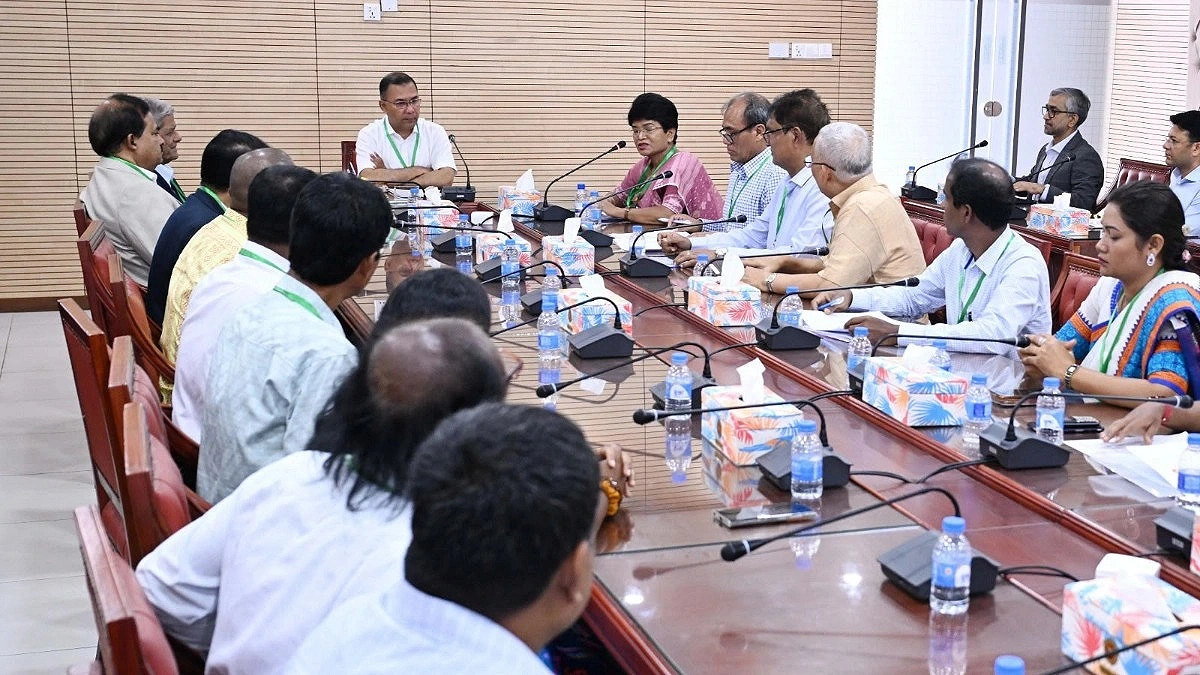
Prime Minister meets representatives of ethnic minority communities.
Prime Minister Tarique Rahman held a meeting with representatives of ethnic minority communities living in the plains of the country. The meeting was held at the Public Administration Conference Room of the Cabinet Division at the Secretariat on Thursday afternoon.
Local Government, Rural Development and Cooperatives Adviser Mirza Fakhrul Islam Alamgir, the Prime Minister’s Special Assistant on Ethnic Minority Affairs Bijon Kanti Sarkar, Anna Minj, the first female member of parliament from the reserved seat for ethnic minority communities, cultural activist Sanjeeb Drong, and representatives of 18 ethnic minority communities from 17 districts attended the meeting.
During the meeting, leaders of the ethnic minority communities demanded the formation of a separate land commission for them, a national convention for marginalized indigenous communities living in the plains, replacing the term ‘ethnic minority’ with identity based on ethnicity, constitutional recognition as indigenous peoples, legal ownership of land, the establishment of a central cultural center, loan facilities for small business owners, and an end to evictions of ethnic minority communities from their settlements in the name of various projects or reserved forests.
The prime minister listened to their remarks with great attention. During the meeting, he expressed his commitment to building a happy, prosperous and discrimination-free Bangladesh.
Describing ethnic minorities as an inseparable part of the country, Tarique Rahman said he and his government are working to build a country where no ethnic group faces discrimination. He said he wants to move forward together with everyone in building the Bangladesh people aspire to and does not consider anyone separate.
The head of government said, “We are going through a terrible situation. The fascist government destroyed all the country’s institutions and the economy. Every year, $16 billion was laundered. If this money had not been laundered, many of your (ethnic minorities’) problems would have been solved.”
“Our government is trying to resolve, in phases, those issues that can be addressed first.”
“The current battle is much bigger. To survive here, everyone must remain united. Everyone has to work together, and everyone has to come forward together. We have to see how we can put ourselves in a better position,” the head of government said.
Referring to the country’s existing problems, the prime minister said, “I am still surprised that so many problems still persist in the country. Because these issues should have been resolved in the last 17 years. If they had been resolved then, many problems would have been solved.”
“We used to hear so many stories about development, but where are they actually? Now all the pressure has fallen on our government. The people have high expectations of this government. We are trying to recover from that situation and stand back up.”
Mentioning that the fascist government had destroyed the country’s education and healthcare systems, the prime minister also outlined the initiatives his government has taken to overcome the situation.
The prime minister said, “They destroyed an entire generation. Martyred President Ziaur Rahman initiated the journey of the Upazila Health Complexes. During his tenure, 31-bed hospitals were established. After that, whenever our government came to power, those facilities were improved. After Begum Khaleda Zia came to power, they were upgraded to 50-bed hospitals. Now we have decided to upgrade them to 101-bed hospitals. Yet the previous government established community health centers at the union level. But they have no activities.”
The prime minister also spoke about increasing allocations for the health sector in the 2026-27 fiscal year and reducing taxes on essential medical supplies, including kidney dialysis equipment and heart stents.
