


Sunflower Cultivation Could Cut Edible Oil Imports

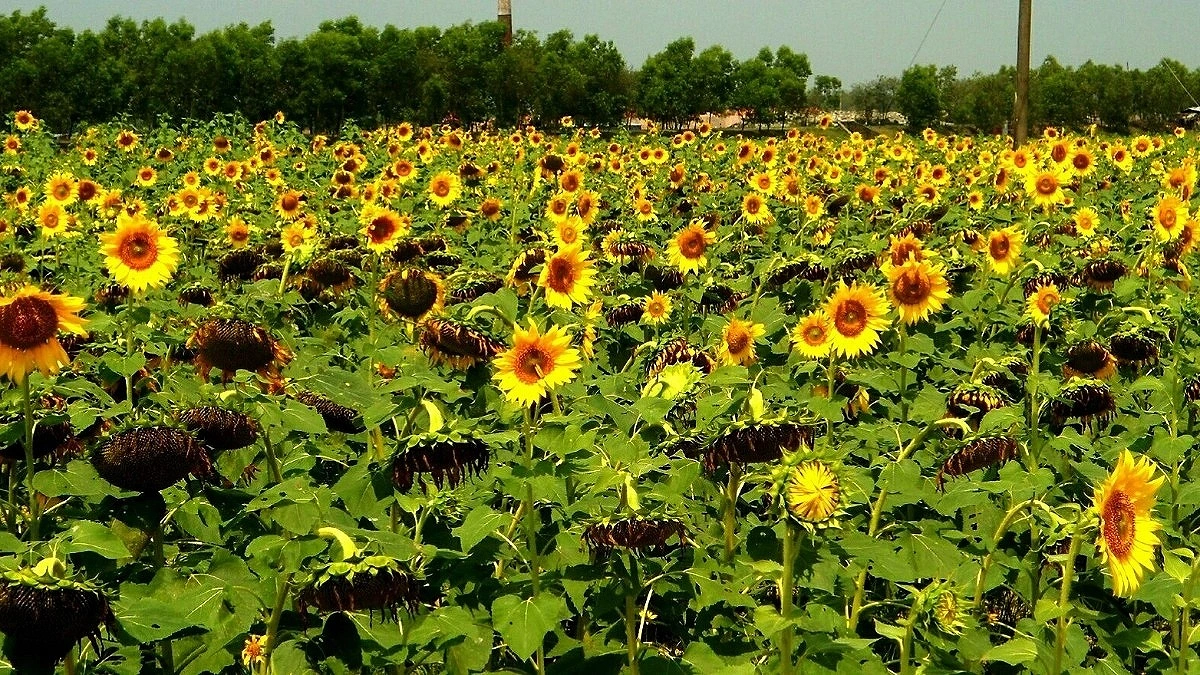
Photo: Agamir Somoy
Bangladesh could significantly reduce its dependence on imported edible oil by expanding sunflower cultivation. Experts said the crop has strong potential in saline coastal lands, but farmers are losing interest due to multiple challenges. Although Barguna still leads the country in sunflower cultivation, the acreage under the crop has declined steadily in recent years.
According to data from the Department of Agricultural Extension, 9,244 farmers cultivated sunflower on 2,272 hectares of land in the district in 2021, producing 3,480 tons. In 2022, cultivation expanded slightly to 2,753 hectares and production rose to 4,171 tons. Sunflower farming reached a record level in 2023, when cultivation covered 4,000 hectares and production nearly doubled to 8,059 tons. However, the trend began to reverse after 2023. In 2024, cultivation dropped to 3,385 hectares and production declined to 6,529 tons. The downward trend continued in 2025, with cultivation falling further to 3,376 hectares and production declining to 6,246 tons. This year, the situation worsened further, with sunflower cultivation taking place on only 3,202 hectares, according to the agriculture department.
Farmers said they are losing interest in sunflower farming due to low prices, marketing difficulties, the shortage of quality seeds and the absence of seed-separating machinery. Many said that despite good yields, the lack of guaranteed sales leaves them vulnerable to losses.
Farmer Naim Hossain of Taltali said he failed to make a profit because he did not receive a fair market price despite achieving good production. He expressed hope that farmers would return to sunflower cultivation if the government purchased seeds directly.
Another farmer, Abdur Rob, said separating sunflower seeds is labor-intensive, and the lack of machinery increases production costs. Farmer Bayezid from Thongpara said he stopped cultivating sunflower because poor-quality seeds reduced yields.
Experts said sunflower produces comparatively more oil and delivers good yields with less irrigation and fewer chemical fertilizers. As a result, they consider it an economically profitable and environmentally friendly crop.
Professor Dr. Md Abul Kaiyum of the Department of Agricultural Botany at Patuakhali Science and Technology University said weak market management, low-quality seeds and the shortage of modern machinery are the main reasons behind the decline in cultivation. He stressed the need for an effective market system and technological support to encourage farmers to grow sunflower.
“The government must work sincerely on these issues. If that happens, the agricultural economy of this region will see significant growth and dependence on imported edible oil will decline considerably,” he added.
Deputy Director of the Barguna Agricultural Extension Department, Rathindra Nath Biswas, said Barguna still remains the country’s leading sunflower-producing district despite a slight decline in cultivation. He said farmers are receiving improved seed varieties and incentives, while authorities have also taken initiatives to establish a subsidized oil processing plant in Taltali.

