
Bangladesh ranks top globally in sacrificing animals during Eid-ul-Adha

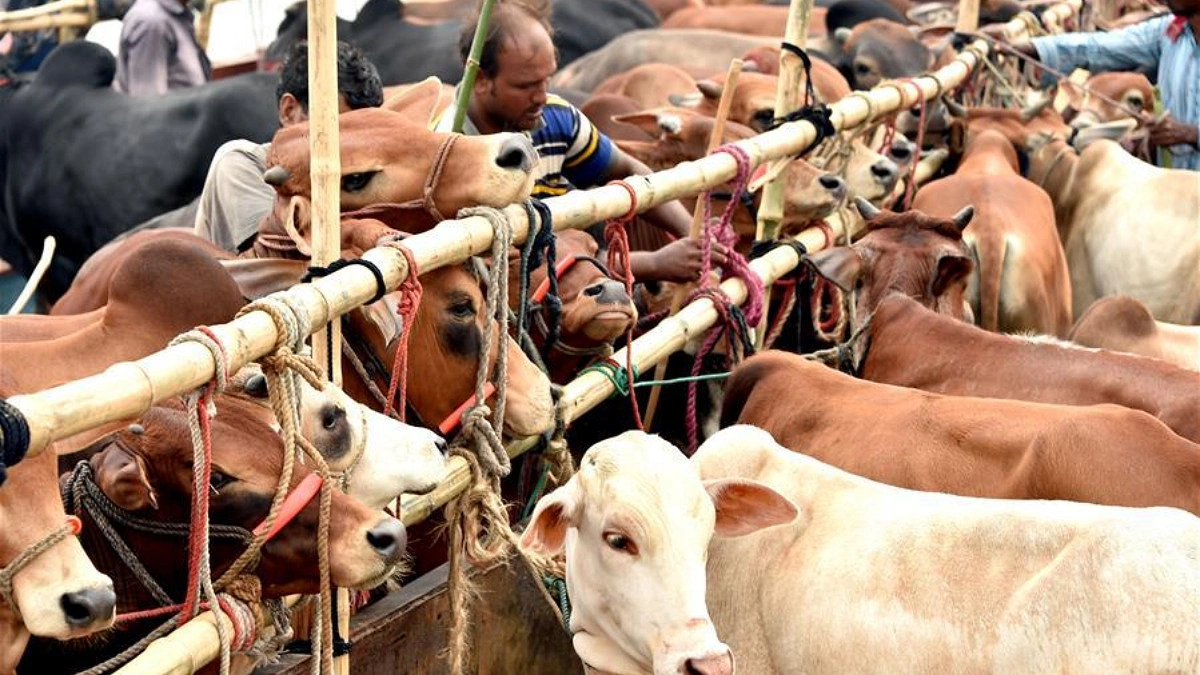
A cattle market in Dhaka. File photo, courtesy: Xinhua
In the world’s wealthiest Muslim country, Saudi Arabia, there is roughly one sacrificial animal for every 35 people. Contrarily, In Bangladesh, the ratio is one animal for every 15 people. In this sense, Bangladesh surpasses even Saudi Arabia in the scale of sacrifice.
It is not only Saudi Arabia. Globally, Bangladesh stands at the top in the number of sacrificial animals, leaving behind even Indonesia, the world’s most populous Muslim-majority country.
In Saudi Arabia, citizens are not only generally well-off but many are financially capable of sacrificing more than one animal. Yet only around 1 to 1.5 million animals are sacrificed there each year, a figure that includes animals sacrificed on behalf of pilgrims. The country’s population is about 35 million. Compared to this population size, the rate of animal sacrifice is relatively low. The main reason is that sacrifice in Saudi Arabia is done in a coordinated manner. Unlike Bangladesh, there is no widespread culture of each capable household performing an individual sacrifice at home.
Bangladesh, with a population of about 170 million, sees more than 10 million animals sacrificed each year. According to data from the Ministry of Fisheries and Livestock, a total of 9,136,734 animals were sacrificed in the country in 2025. Of these, 4.7 million were cows and buffaloes, while the remaining 4.4 million were goats, sheep, and other animals. The number was lower that year due to political changes. From 2021 to 2024, the number of sacrificial animals increased steadily. In 2021, about 9.093 million animals were sacrificed. This rose to 9.95 million the following year. In 2023, the figure crossed 10 million, and in 2024 it stood at 10.4 million.
Around 90 percent of Bangladesh’s population is Muslim. Based on current population figures, this means there are more than 150 million Muslims in the country. As a result, there is approximately one sacrificial animal for every 15 Muslims in Bangladesh.
When asked why the number of sacrificial animals is so high in Bangladesh, economist Abdul Bayes explained that while large-scale sacrifice contributes to the economy, social factors also play a major role. He said many people sacrifice animals not only out of religious belief, but also to display family status and economic dominance. Among the wealthy or bourgeois class, sacrifice has become a form of competition. In contrast, many Muslim countries follow religious guidelines more strictly and practice coordinated sacrifice, which keeps the total numbers lower. Citing examples from Malaysia and other countries, he also highlighted the importance of health and safety in sacrificial practices, emphasizing the need to perform sacrifices at designated locations rather than in scattered, unregulated spaces. He pointed out the positive aspects of coordinated sacrifice as well.
Turkey:
In Turkey, an estimated 3.5 to 3.8 million livestock animals are sacrificed each year. This information comes from the country’s Directorate of Religious Affairs and the Turkish Red Crescent. In numerical terms, this is about one-third of Bangladesh’s total.
Indonesia:
In terms of land area, Indonesia is about 13 times larger than Bangladesh and has a population of around 290 million. According to reports from Indonesia’s Ministry of Religious Affairs and the national news agency ANTARA, about 2 to 2.5 million animals are sacrificed annually in the country.
Saudi Arabia:
An analysis of data from the Jeddah Chamber of Commerce and Saudi Arabia’s Ministry of Hajj and Umrah shows that only about 1 to 1.5 million animals are sacrificed each year in the country.
India:
India has an estimated Muslim population of around 210 million. However, there is no official government data on the number of animals sacrificed. Various media reports suggest that the figure is close to that of Bangladesh.
Middle Eastern countries:
Countries such as Iraq, Iran, Qatar, and the UAE have relatively smaller Muslim populations compared to Bangladesh, and accordingly, the number of sacrificial animals is also lower.
Why the rate of sacrifice is lower in other Muslim countries
In Bangladesh, animal sacrifice is deeply linked to family prestige and personal religious sentiment. Almost every financially capable family prefers to sacrifice an animal individually—either in their own name or in the name of family members—rather than participating in a joint sacrifice. As a result, the total number of sacrificial animals increases. In addition, around 4 to 5 million goats and sheep are sacrificed individually every year, pushing the overall figure beyond 10 million.
In Indonesia, even many well-off families do not perform individual sacrifices, not even in front of their own homes. Instead, entire communities or neighborhoods contribute money to local mosque committees. These committees use joint funds to purchase a limited number of large animals, such as cattle, for sacrifice. Especially in the case of cows, the practice of seven people sharing one animal or participating in coordinated sacrifice is very common. As a result, the number of animals sacrificed is much lower than the number of people participating. Pakistan follows a similar pattern, where middle- and lower-middle-class families usually share a single cow or buffalo among seven households.
Although countries like Saudi Arabia and Turkey have smaller populations than Bangladesh, the rate of animal sacrifice relative to population size is significantly lower. The main reasons include stronger institutional governance, higher levels of urbanization, and differences in religious practice. In Turkey, slaughtering animals in public places, street corners, or home garages is strictly prohibited. Sacrifice is allowed only at government-designated, mechanized slaughterhouses operated by licensed butchers. Due to these strict regulations, most citizens prefer not to deal with the hassle of buying animals themselves. Moreover, many Turkish citizens choose to donate money to charitable organizations instead of purchasing animals. These organizations often perform sacrifices outside Turkey, particularly in poorer Muslim countries in Asia and Africa. As a result, the number of animals slaughtered within Turkey itself remains relatively low.
In Saudi Arabia, the total number of sacrifices is also lower partly because the country’s population is much smaller than Bangladesh’s. Many Saudi citizens do not buy animals directly; instead, they deposit money through charity funds or banks. In many cases, an entire extended family or clan offers only one or two animals collectively on behalf of all its members.
The picture of animal sacrifice in Bangladesh
Every year, an average of around 10 million animals are sacrificed in Bangladesh. About half of these are cattle or buffaloes—roughly 4.5 to 5 million animals. Under Islamic rules, up to seven people may jointly share one cow. In Bangladesh, an average of four to five people usually share a single cow. The remaining half consists of goats or sheep, which are sacrificed individually by one person each.
Based on this calculation, around 4.5 to 5 million people perform sacrifice through goats or sheep, while another 15 to 20 million people participate through shared cattle or buffalo sacrifices. This means that the number of direct sacrifiers in the country stands at roughly 20 to 25 million people. Each of these sacrifiers represents a household, indicating that about 35 to 40 million people in the country are directly involved in Eid-ul-Adha sacrifices. By this estimate, around 20 to 25 percent of Bangladesh’s total Muslim population directly participates in animal sacrifice.
Because such a large number of people are involved, Eid-ul-Adha has an economic impact that extends from the grassroots level to the state level. The widespread practice of individual sacrifice creates a large supply of meat during this period, helping meet the protein needs of people across all income groups. Speaking to Agamir Shomoy, Mohammad Shariful Haque, Deputy Director of the Department of Livestock Services, said that individual sacrifices generate employment for a vast segment of the population. He added that sacrifice has become deeply embedded in Bangladesh’s religious culture. As people place high importance on it, many try to perform a sacrifice even when facing financial pressure. This, he noted, is a key reason why the number of sacrificial animals is so high in the country.
This year, a total of 12,333,840 animals are available nationwide for Eid-ul-Adha. Against this, demand is estimated at around 10 million animals. According to the Ministry of Fisheries and Livestock, as the supply exceeds demand, there is no risk of an animal shortage during this year’s Eid-ul-Adha.
