
Finance Minister
Two Difficult Years Ahead as Government Seeks to Stabilize Economy

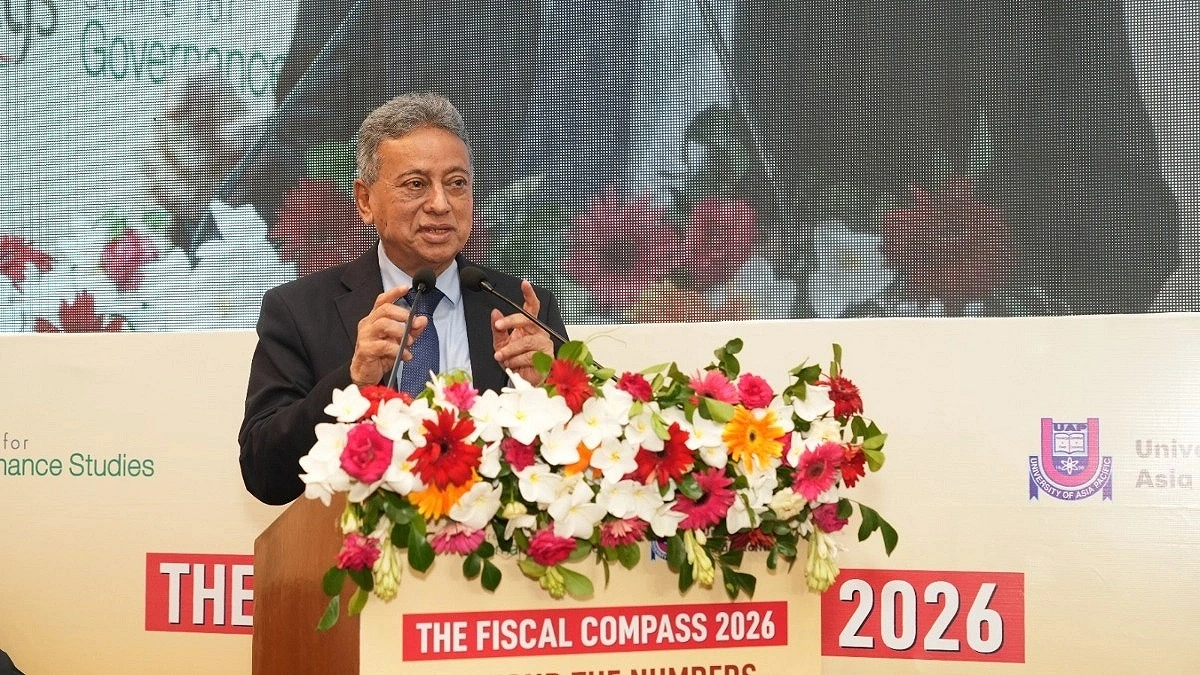
Finance Minister Amir Khasru Mahmud Chowdhury. Collected photo
Finance Minister Amir Khasru Mahmud Chowdhury has warned that the country will face a difficult two-year period as the government works to stabilize its fragile economy.
He said, “I will not promise that all problems will be solved overnight. It will take at least two years to stabilize the fragile economy. In the third year, the economy will recover, and the fourth and fifth years will bring a prosperous Bangladesh.”
He made the remarks on Monday at a budget discussion jointly organized by the Centre for Governance Studies (CGS) and the University of Asia Pacific.
On capital market reforms, the finance minister said, “A fully independent and professional commission has been formed to restore confidence in the capital market. Laws are being amended to ensure security for both international and domestic investors. Strict action will be taken if any obstacles arise in the process of deregulation or simplification of rules.”
He said preparing the budget had been highly challenging, noting that the government had only one and a half months to prepare it while public expectations remained high, particularly at a time when the country was under economic pressure and people were demanding meaningful change.
“The central idea of this budget is the democratization of the economy. Citizens will not remain passive observers; they must have the opportunity to contribute to and actively participate in the economy. This time, we have tried to present a new economic vision based on broader participation, inclusion, and opportunity creation. A key part of this vision is the creative economy,” he added.
He said Bangladesh has many talented individuals and communities across different regions whose work has not yet received proper recognition or support. “We want to support these groups through skills development, market access, and proper commercialization of products. Our goal is to bring local products to national and international markets,” he said.
The finance minister said the proposed budget would support the younger generation and create opportunities for their development. “We want to reduce unnecessary regulatory barriers, ensure greater freedom for citizens, and make participation in economic life easier,” he said.
At the event, Professor MA Baki Khalili presented the keynote paper. Criticizing the proposed tax structure for the upcoming fiscal year, he said, “If the tax burden increases, savings among low-income people will decline, which will negatively affect the economy.”
Describing the current income tax structure as regressive, he also called for a reduction in corporate tax rates for private universities.
