
Measles spreads in hill areas, vaccination poses challenge

Graphics: Agamir Somoy
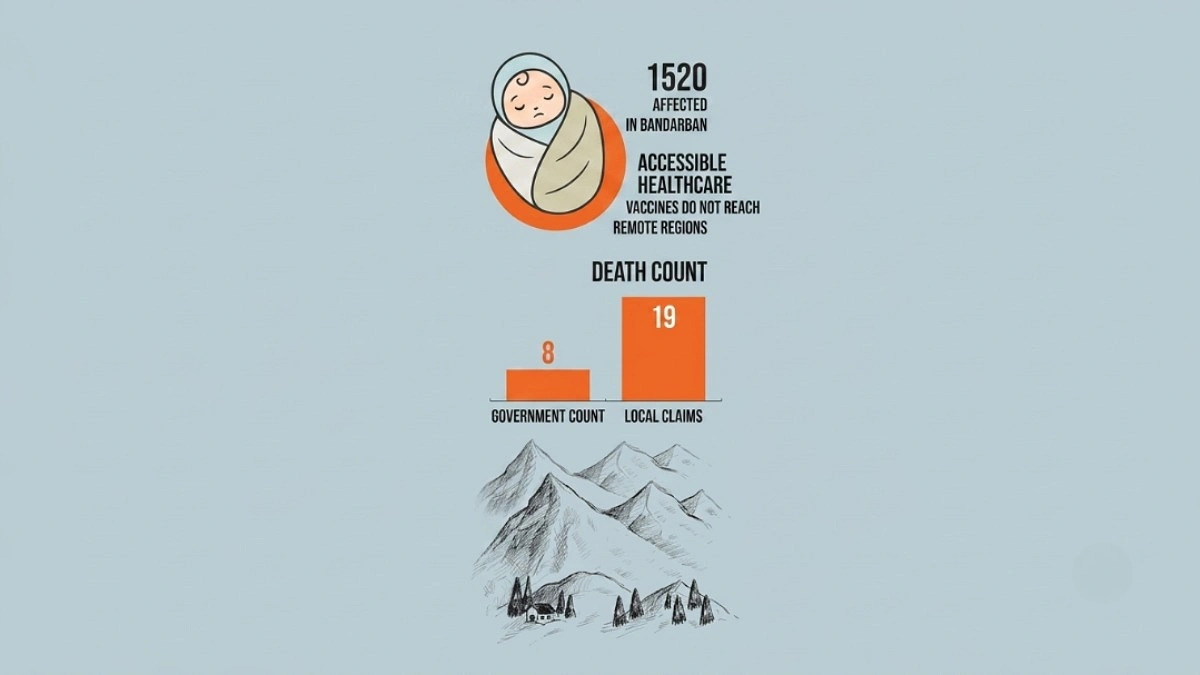
Providing basic healthcare to many communities is a major challenge because of scattered settlements and limited communication systems in remote hill areas. That crisis has intensified amid the measles outbreak in the country. The number of cases identified in just one district has crossed 1,500. The health department has reported eight deaths. However, locals claim the number is 19. Measles has spread to some areas of the hills where vaccination is extremely difficult. The rising trend in infections and deaths in those areas is causing growing concern.
At the beginning of the measles outbreak in the country, the disease spread to Alikadam, a remote area of Bandarban. From March this year until now, 1,520 people from the district have gone to hospitals. According to government figures, eight people have died. Locals claim the death toll is higher, at least 19. All of them belong to the Khumi and Mro communities. Currently, more measles patients are arriving from remote areas of Ruma upazila. However, comparatively fewer measles patients have been reported in Rangamati and Khagrachhari.
Public health expert Mohammad Iqbal said it is naturally difficult to deliver vaccines to remote areas, and in many places it is not possible to reach them at all. People in the hills also have somewhat less trust in vaccines and medical treatment. As a result, a significant number of children remain outside vaccination coverage. At times, information about patients from remote areas also does not reach health authorities quickly. This delays the detection and control of infections and creates a risk that the disease will spread throughout an area through a single infected child.
Discrepancy in death figures: According to information from the Bandarban Civil Surgeon, 1,520 people infected with measles have gone to hospitals this year. Of the district’s seven upazilas, 700 patients were reported in Alikadam, 150 in Lama and 151 in Ruma. As of Saturday, 60 patients were receiving treatment after being admitted to hospitals in the district. Of them, 25 were at the Sadar Hospital and 17 at Ruma Hospital. Meanwhile, 15 measles patients have been identified in Rangamati and 28 in Khagrachhari since March. However, there have been no reports of deaths in either district.
Three days ago, the Mro Para Measles Crisis Response Cell was formed in Bandarban. S E Tonoya Mro Raj, an executive member of the cell, said 19 people have died from measles since March. Their list contains the identities and ages of 15 people who died from measles. They range from a three month old baby to a 28 year old young man. All except two were children.
Regarding the discrepancy in the death figures, Bandarban Civil Surgeon Mohammad Shaheen Hossain Chowdhury said that after receiving information about measles related deaths in the community, people were sent to investigate, and it was found that the deaths had not been caused by measles. They had died from other diseases.
Former Chief Scientific Officer of the Institute of Epidemiology, Disease Control and Research, or IEDCR, and public health expert Mushtaq Hossain said, “Epidemiologists always say that the actual number of infections and deaths is always higher than what is officially recorded by the government. The same is true in the case of measles. If health workers are given the responsibility, it is possible to determine the actual number, which will make disease control easier.”
Various challenges in stopping measles: Local residents, doctors and development workers say the remote areas of the Chittagong Hill Tracts have become the biggest challenge in controlling the outbreak. Bandarban Civil Surgeon Mohammad Shaheen Hossain Chowdhury said teams involved in the regular vaccination program often have to walk for several hours to reach hill villages. Even then, it is not possible to reach every area. Maintaining vaccines at the required temperature through the cold chain and locating every child to administer vaccines are also challenges. Some families live so far from health centers that it is not possible to take sick children to hospitals quickly.
There are also places in Rangamati that health workers have been unable to reach, said the district’s Civil Surgeon Nuyen Khisa. He also considers the high cost of conducting programs in these remote areas to be an obstacle. Malnutrition is another major concern in remote areas.
At the same time, these communities do not believe in modern medical treatment and also lack trust in the healthcare system. As a result, they do not want to receive vaccines. Even when they become sick, they are reluctant to seek medical treatment. There are also many obstacles to coming to healthcare facilities.
S E Tonoya Mro Raj, former president of the Bangladesh Mro Students Association, said people in the hills generally seek treatment from traditional healers and religious leaders when they become sick. They do not come to hospitals unless their condition becomes very serious. However, local people have become more interested in getting vaccinated than before.
Public health expert Mohammad Iqbal said an infected person who is not vaccinated can infect 12 to 18 people. Therefore, to prevent transmission, at least 95 percent of children must be brought under coverage of two doses of the vaccine. For this reason, despite the challenges, vaccination arrangements must be made with the assistance of the police, administration and military. Technology can be used if necessary. A continuous supply system must also be maintained.
