
150,000 cases put to test before 22 tribunals

Graphics: Agamir Somoy
The country’s courts are burdened with a huge backlog of drug cases. The number of pending cases that have accumulated over the years has crossed 450,000. One case has been pending for 22 years. Its trial has remained stalled for years because witnesses have failed to appear in court. Against this backdrop, the government has established 22 Narcotics Control Tribunals in different parts of the country including Dhaka to reduce delays in drug cases. The Ministry of Law issued a notification in this regard last Thursday.
However, those concerned fear that establishing new tribunals alone will not clear the massive backlog. If regular hearings are not held and witnesses are not brought to court and if an efficient prosecution team and faster case file management are not ensured, the new system could also become trapped in the existing backlog. The major question now is how more than 166,000 cases will be transferred to the new tribunals quickly and how efficiently their trials will proceed.
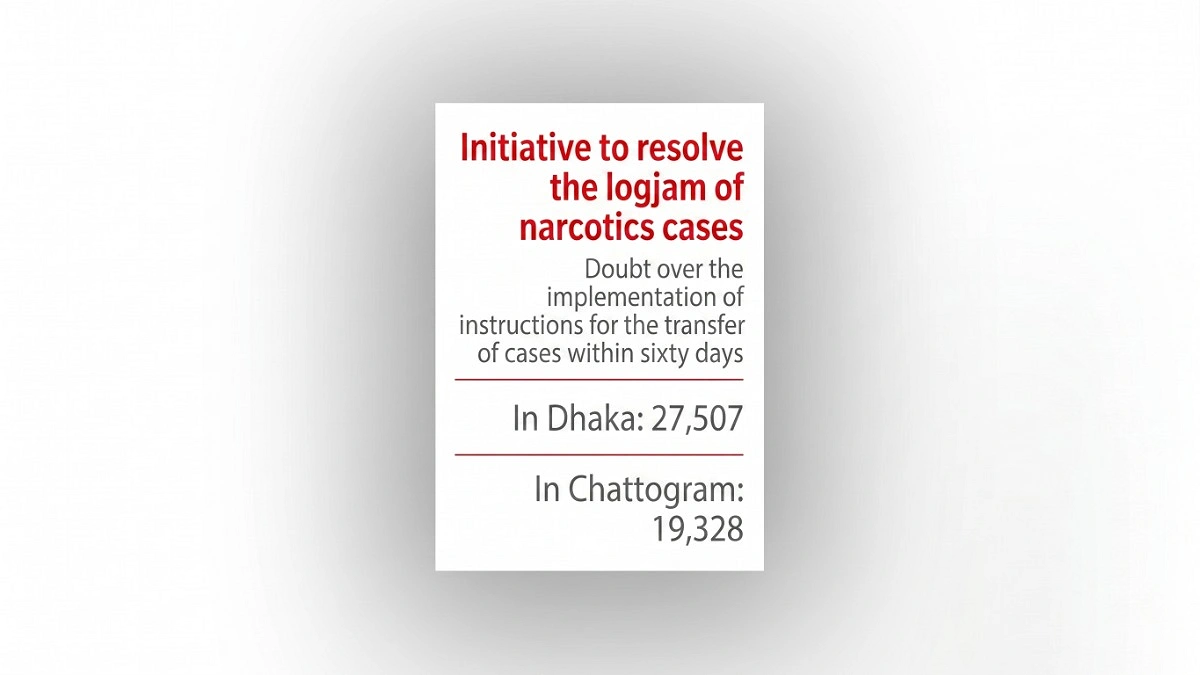
Ongoing cases involving offenses punishable by a minimum of five years in prison or more under the Narcotics Control Act will come under the jurisdiction of the new tribunals. Of the 463,836 drug cases currently pending trial, 166,333 cases or 35.86 percent will be transferred to these tribunals.
The notification states that the cases must be transferred from the existing courts to the new tribunals within the next 60 days. However, the cases will not have to start over. The trial proceedings will continue at the new tribunals from exactly the stage at which each case currently stands.
One case has not ended even after 22 years
A case in the capital’s Hazaribagh provides a picture of the prolonged delays in drug cases. On May 20, 2002, 25-year-old Rehena Begum was arrested with three grams of heroin. The charge sheet in the case was filed that same year. The trial began two years later in 2004.
There are five witnesses in the case. However, only three of them have been able to testify in more than 16 years. The trial has effectively been stalled since August 17, 2022 because witnesses have failed to appear. One of the accused in the case which has been continuing for nearly 22 years was released on bail and has been absconding for nine years. As a result, it is now uncertain when the case will end. The situation in this single case appears to reflect the prolonged delays in thousands of drug cases across the country.
Cases increased by 320,000 in eight years
According to data from the Ministry of Law, 143,654 drug cases were pending trial across the country in 2018. Eight years later, the number has risen to 463,836. This means the number of cases increased by 320,182 during this period. A total of 16,260 cases were disposed of in the past three months. However, another 236 cases remain stayed under orders from the higher courts.
The pressure of cases that could be transferred to the new tribunals is highest in Dhaka Metropolitan Area. There are 21,920 such cases here. Dhaka District has another 5,587. Combined, Dhaka has 27,507 such cases. Chattogram comes next. The metropolitan area and district together have 19,328 cases. Cox’s Bazar has 12,600 cases and Cumilla has 10,464.
Narayanganj has 7,431 cases. Brahmanbaria has 5,927. Rajshahi has 5,126 and Jashore has 3,982. Joypurhat has 2,917. Naogaon has 2,861. Mymensingh has 2,780 and Lalmonirhat has 2,682 cases.
Gazipur Metropolitan Area has 2,623 cases. Pabna has 2,591. Sirajganj has 2,509. Rangpur has 2,425. Kurigram has 2,408. Bogura has 2,326. Chapainawabganj has 2,283 and Natore has 2,013 cases.
Pressure of cases along border and trafficking routes
The pressure of drug cases is also evident in important drug trafficking routes and border areas. Lalmonirhat has 2,682 cases. Kurigram has 2,408 and Chapainawabganj has 2,283. Bandarban has 629. Rangamati has 592. Khagrachhari has 217 and Panchagarh has 167 cases.
Elsewhere, Faridpur has 1,791 cases. Sherpur has 1,513. Dinajpur has 1,448. Jhenaidah has 1,375. Tangail has 1,368. Satkhira has 1,242. Khulna Metropolitan Area has 1,187. Barishal has 1,144 and Munshiganj has 1,135 cases.
Kishoreganj has 1,121 cases. Gazipur has 1,113. Barishal Metropolitan Area has 1,021. Thakurgaon has 1,012. Habiganj has 987. Jamalpur has 953. Sylhet has 863. Rajshahi Metropolitan Area has 821. Sylhet Metropolitan Area has 814 and Sunamganj has 704 cases.
The number of cases is comparatively lower in Magura with 461. Barguna has 445. Patuakhali has 403. Gopalganj has 393. Bagerhat has 289. Shariatpur has 279. Pirojpur has 200. Narail has 149. Madaripur has 136. Lakshmipur has 108. Bhola has 79. Khulna has 74 and Netrakona has 67 cases. The lowest number of cases is in Jhalokathi with only eight.
Not just tribunals, efficient prosecution needed
A senior official of the Department of Narcotics Control who wished to remain unnamed said that merely establishing tribunals would not produce the desired results. If prosecution teams are formed based on political considerations while excluding qualified lawyers, there will continue to be concerns about irregularities.
Those concerned say the biggest challenge for the new tribunals will be disposing of the large number of cases quickly. Although cases are scheduled for hearings year after year, testimony does not conclude in many cases because witnesses fail to appear. As a result, trials remain pending.
Barrister Nasir Uddin Ahmed Asim told Agamir Somoy that establishing special tribunals for the trial of drug cases is a good initiative. However, to reap its benefits, an efficient and responsible prosecution team must be formed. At the same time, an effective witness protection system must be ensured.
According to him, regular testimony will not be possible if witnesses do not feel safe or if their transportation costs for attending court are not ensured. He said it is unfortunate that the 1908 law is still in effect in this regard.
He also pointed out that speedy trials are possible by citing the example of the child Asiya rape case. According to him, the trial of that case was completed within 21 working days and set an example.
Initiative for separate tribunals had been taken before
This is not the first time that an initiative has been taken to establish separate tribunals for the speedy disposal of drug cases. The Narcotics Control Act passed on November 14, 2018 included provisions for establishing separate Narcotics Control Tribunals. Section 44 of the law provided for establishing the necessary number of tribunals. Section 45 provided for determining the formation, jurisdiction and functions of these tribunals. The law also included provisions granting them powers similar to those of a sessions court.
However, that initiative was not implemented in practice. Later, under an amended law dated November 26, 2020, the words “Magistrate Court or Tribunal” were removed from the provision concerning the trial of drug cases and replaced with “court having jurisdiction.”
Now, by establishing 22 tribunals, the government is once again moving toward implementing that initiative.


