
Water hyacinths transform from hazard to rural boon in Chandpur

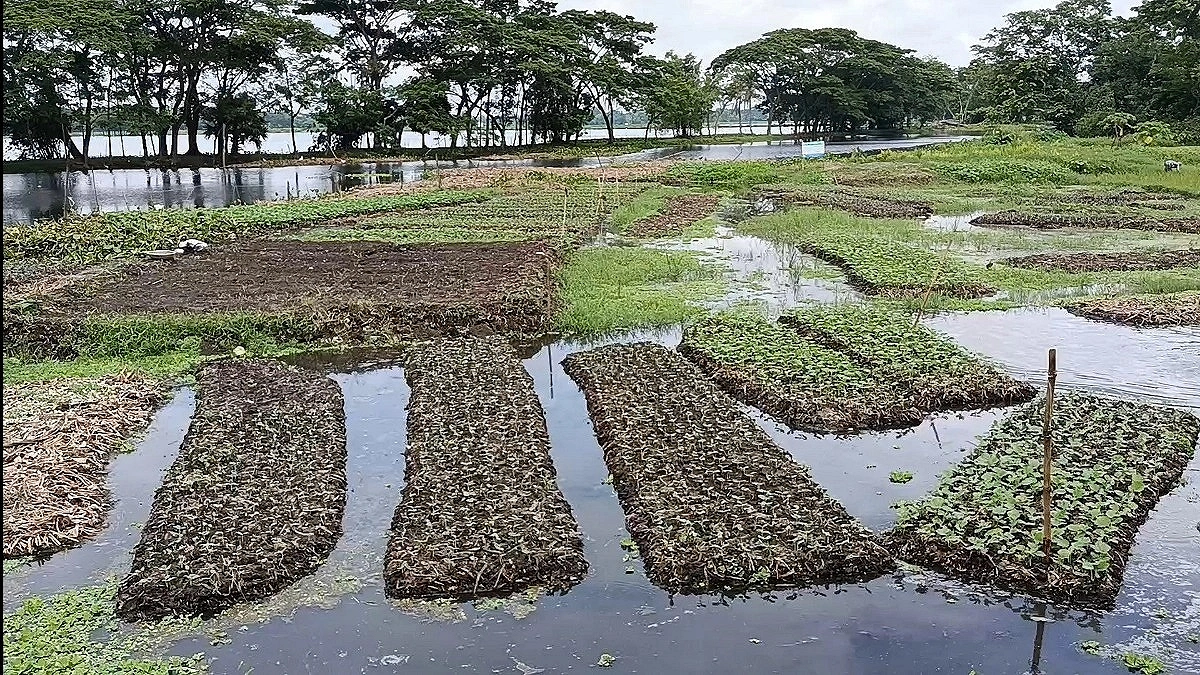
Photo: Agamir Somoy
Once a major navigational hazard and cause of severe waterlogging, water hyacinths in the Dakatia River and adjacent waterbodies are now opening new economic horizons for rural communities in Faridgonj, Chandpur.
Hundreds of farmers are achieving financial self-reliance by cultivating toxic-free vegetables and seedlings on floating organic beds crafted from decomposed water hyacinths.
Commercial floating agriculture has been thriving for several years in Shobhan. Farmers cultivate a wide variety of vegetables, including bottle gourd, sweet pumpkin, red amaranth, cucumber, and snake gourd.
After satisfying local market demands, traders supply these vegetables to the neighboring districts of Lakshmipur and Cumilla.
Discussions with farmers reveal that farmer Shahid Talukdar first pioneered vegetable cultivation on floating beds. Inspired by his success, other farmers adopted the farming method. Around 110 farmers are commercially producing vegetables and seedlings on these floating beds.
Shahid said he has prepared 60 floating beds on his own during the ongoing season. He spent around Tk 3.5 lakh on bed preparation, labor, and other associated costs. He expects to earn at least Tk 10 lakh from selling his vegetables and seedlings by the end of the season.
Farmer Mizanur Rahman added, “The water hyacinth that used to rot and spread foul odor is now being collected to make rows of beds. This is bringing extra income. Alongside, it is meeting the family’s nutritional demands. When the beds rot at the end of the season, they can also be used as high-quality organic fertilizer on the land.”
However, amidst this promising growth, marginal farmers harbor deep resentment. Local farmers Md Rabbi and Md Rajiv complained that they have been farming through this method on their own initiative for many years.
Yet, they do not receive any necessary assistance or incentives from the Department of Agricultural Extension (DAE). They alleged that agricultural officers selectively distribute government facilities and benefits to a chosen few.
Faridgonj Upazila Agriculture Officer Kollol Kishore Sarkar said from July to December, the department provides assistance to various farmers through demonstration plots in the low-lying and waterlogged areas of Faridgonj.
He added that the seedlings produced in Faridgonj are highly popular in neighboring districts as well. They are regularly informing the authorities to expand the scope of government support. If the authorities expand the project’s scale, they can bring more farmers under the umbrella of government benefits.


