
Marine Academy earns Tk 17,000 crore in revenue annually
- 6,000 seafarers trained over 64 years
- International recognition as ‘White Listed’
- Monthly salary of a skilled seafarer: 2.5 million Taka

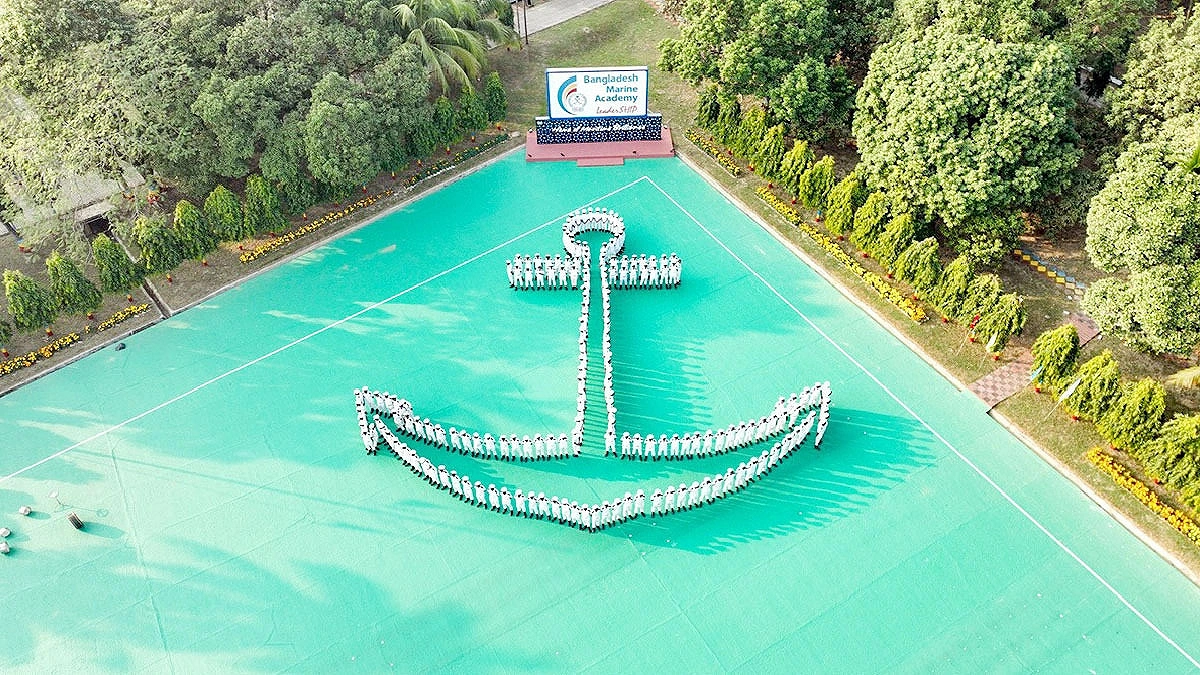
Agamir Somoy photo.
As dawn breaks on the southern bank of the Karnaphuli River, the parade ground vibrates with the sound of disciplined boots. No, it is not a cantonment. From a distance, one might easily mistake it for a military training camp. But that illusion shatters as soon as you step inside!
This is actually a unique school that produces the technicians who operate the giant vessels of international maritime trade that roam the oceans. From the icy waves of the Atlantic to the Suez and Panama Canals—many of the skilled hands steering the world's mega-ships and keeping global trade moving daily have received their education and training from this very premises. The Bangladesh Marine Academy is the craftsman of six thousand skilled seafarers who conquer the seas. Shining as a lighthouse for producing world-class mariners, this traditional institution in Chattogram continues to blaze bright.
Established in 1962 at the mouth of the Karnaphuli River, the Bangladesh Marine Academy was built on 100 acres of land. For 64 years, the institution has not just produced sailors for sea voyages but has built internationally competent human resources strong in discipline, leadership, and technical skills. Run under strict military-style discipline, this academy teaches Nautical Science to produce ship Captains, and Engineering to produce Chief Marine Engineers.
Nestled in the lush, green secluded area of Anwara Upazila, the Bangladesh Marine Academy has a worldwide reputation. It is a 'White Listed' institution recognized by the United Nations' International Maritime Organization (IMO). It has formal recognition as a 'branch institution' of the Sweden-based World Maritime University. The UK's maritime organizations—the Institute of Marine Engineering, Science and Technology (IMarEST) and The Nautical Institute—have jointly awarded the Marine Academy the prestigious 'Certificate of Excellence' as the first academy in the world. Additionally, the Australian Maritime Safety Authority, the UK's Maritime and Coast Guard Agency (MCA), and the Singapore Port Authority have already recognized the Marine Academy's pre-sea training as equivalent to their own standards. World-class nautical and engineering simulators, internationally standardized IMO model courses, and the ability to regularly pass international audits have made this academy one of the best maritime educational institutions in South Asia. This high level of 'brand value' ensures jobs for the academy's students effortlessly.
International organizations also recognize the graduates of this academy as being of exceptionally high quality—what is termed 'Tier-1'. The Philippines, India, and China together supply more than one-third of the world's mariners (sailors and officers). The Bangladesh Marine Academy produces seafarers of equivalent quality to these three countries.
One hundred percent English-medium military-style training, operation of modern ships' automated engine rooms, control of Electronic Chart Display and Information Systems (ECDIS), and realistic training on engine simulators place this academy's cadets ahead of those from other countries.
However, if certain infrastructure facilities, experienced teachers, solutions to visa complexities, and the implementation of specific government policies can be ensured, this sector could contribute significantly to Bangladesh's GDP, much like the Philippines. Expressing this opinion, the head of the Marine Academy, Commandant Captain Kazi A B M Shameem, said, "In line with the global market, we have included decarbonization, digitalization, and cyber security as additional subjects beyond the syllabus. To enhance cadets' capabilities for the vast Chinese shipping market, we have abolished Saturday holidays and introduced basic Mandarin language training. By capitalizing on the academy's brand value and showcasing it to the world's top shipping lines and port operators, it is possible to harness the immense potential of this sector."
Bangladeshi Master Mariners and Chief Engineers are commanding giant container and bulk carriers of the world's top shipping lines—MSC, Maersk Line, CMA CGM, Hapag-Lloyd, NYK, and Evergreen. At least 1,500 commercial vessels across the globe are being steered skillfully from one ocean to another by Bangladesh's competent mariners. Their presence is not limited to sailing alone; alumni of the Marine Academy are also serving in top positions in major port management in Denmark, Dubai, and Singapore, ship-breaking firms in London, the UK Maritime and Coast Guard Agency, offshore rigs in Bermuda, and even the policymaking desks of the IMO. For their significant contributions to international maritime forums, several Bangladeshi mariners have received prestigious international accolades, including the 'IMO Bravery Award'. Beyond working on ships, experienced senior mariners are also earning handsome salaries as chief executives or consultants in the country's Department of Shipping, seaports, private logistics, and freight forwarding sectors, carrying a reputation of excellence.
Nazmus Sakib, a student of the 50th batch of the Marine Academy, works for 'Sea Span Corporation', the world's largest independent container ship owner and charter operator. While sailing as Second Officer on the 'Cosco Thailand' container vessel from Alaska to Shanghai, he told Agami Samay, "The brand value that academy cadets are skilled, competent, and courageous has already been established. Alumni have spread that reputation. Now is the time to leverage that value to create milestones."
The Marine Academy spends an average of Tk 5–7 lakh per cadet for the three-year training program. But the returns on this investment are extraordinary and unimaginable. After completing training, they start their careers as Junior Officers or Fourth Engineers with a monthly salary of $2,500 to $4,000 (approximately Tk 3–5 lakh). Within 12 years, when promoted to Captain or Chief Engineer, their monthly salary ranges from $10,000 to $15,000, which is Tk 12–18 lakh. For those working on gas and oil tankers, monthly salaries exceed $20,000 (Tk 25 lakh).
In terms of remittances, Bangladeshi mariners are also far ahead. Compared to ordinary expatriate workers, a mariner sends nearly ten times more foreign currency to the country. Through 100% legal channels, they remit Tk 17,500 crore annually (at $1 = Tk 125). As the number of mariners increases, these remittances will also skyrocket.
Captain Anam Chowdhury, President of the Bangladesh Merchant Marine Officers' Association and a graduate of the 12th batch, expressed regret, saying, "To make this profession—which earns substantial foreign currency with low investment—successful, the government needs specific policies, planning, and implementation. Filipino and Indian mariners are quickly grabbing opportunities worldwide with faster visa facilities. We are not able to capitalize on our opportunities properly."
Currently, on the 108 commercial vessels flying the national flag, almost all Master Mariners and Chief Engineers are Bangladeshis. As the country's economy grows, the number of our own vessels on international routes is increasing. The time has come to align this sector accordingly.
Three factors—high salaries on ships, the thrilling experience of traveling from continent to continent and port to port, and the opportunity to earn big in a short time—are why young people aspire to become mariners. Every year, approximately 700 mariners are produced in the country. Of these, 160 come from this academy, while the remaining 540 come from seven other academies across the country, three of which are private. Meritorious students from the Science group of SSC can apply to these institutions. Out of 3,000 applicants, 700 are selected through written, oral, and physical tests. Among them, the top 160 in the merit list get admission here.
But the story does not end here; there are more feats to tell. Since 2012, female cadets have also been getting the opportunity to be proudly part of sea voyages alongside their male counterparts. Each batch now produces 20 female cadets with mariner certificates. This profession beckons with immense courage to face risks, conquer the turbulent waves of the world's oceans, and earn substantial foreign currency, along with recognition from renowned global institutions. The 'Bangladesh Marine Academy', such a glorious educational institution, now stands proudly by the coast of the Bay of Bengal and the banks of the Karnaphuli River. It is indeed a unique pride of Bangladesh.
This green, shady, and exquisitely beautiful campus not only opens doors to the economy but also offers immense potential and dreams to young people. All in all, it naturally evokes a feeling reminiscent of the timeless patriotic lyrics of the iconic singer Sabina Yasmin—"Beautiful, golden, youthful, graceful / A wondrous beauty, unparalleled in splendor!"
