

Today is World Refugee Day
Rohingya Couple has 11 Children!

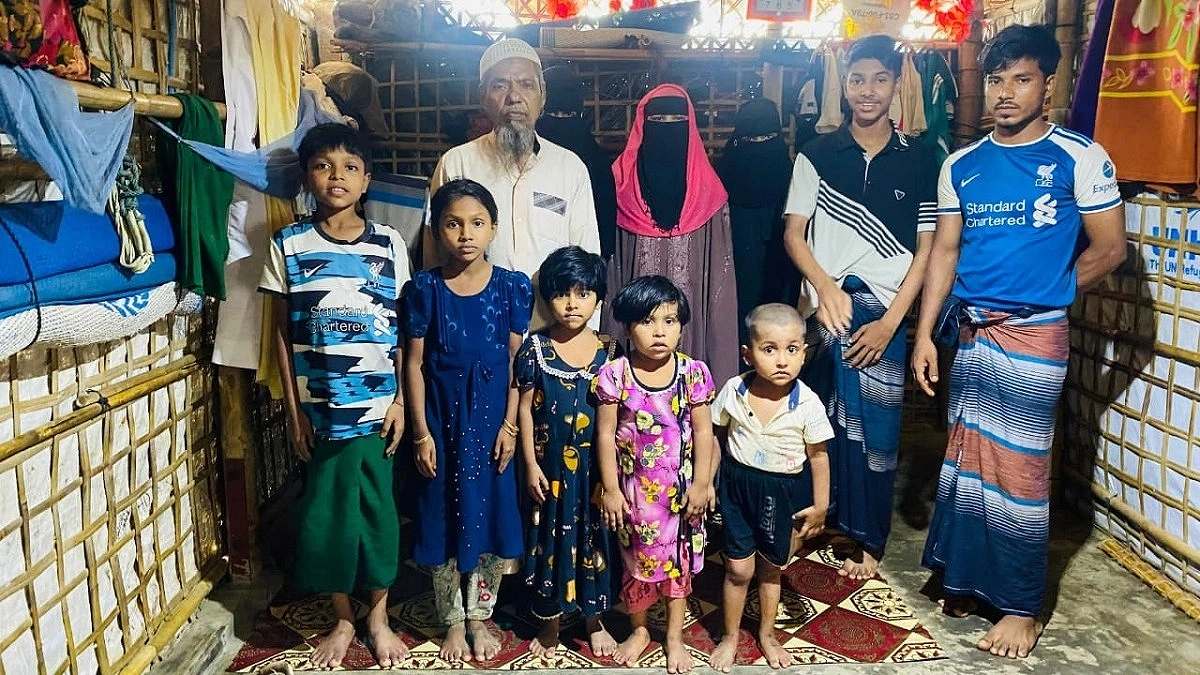
Photo: Agamir Somoy
A couple named Syed Ahmed and Rabeya Khatun, fled Myanmar’s Rakhine State on the night of August 28, 2017. Carrying nine children, they walked for seven days through hills, forests, and rivers before reaching the Kutupalong Rohingya refugee camp in Ukhiya.
They now live in Camp-3, Block F, in a 110-square-foot shelter. Since arriving in Bangladesh, Rabeya Khatun has given birth to two more children, bringing the total number of children in the household to 11. Including one grandchild, the family now has 14 members, four of them young children.
Syed Ahmed said the family’s situation has become increasingly difficult despite its growth. “We had nine children in Myanmar. After coming to Bangladesh, we had two more. The family has grown, but food assistance has decreased and there are no income opportunities,” he said.
Their eldest son, Omar Faruk (35), has been ill for a long time and has no children. Their second son, Mohammad Taib (33), works as a day laborer inside and outside the camp. Another son, Mohammad Harun (30), reportedly left for Malaysia via sea migration. Some daughters are married, while others are either studying in learning centers or managing households.
The family receives $156 per month in food assistance about 19,500 Bangladeshi taka, but they say it is not enough for a household of this size. They also receive a 12-liter gas cylinder monthly, which does not last the entire month, forcing them to rely on firewood.
Similar conditions are seen in neighboring blocks. Another Rohingya couple, Jamal Hossain and Sakhina Khatun, who arrived in 2017 with nine children, now have 12 children after three more were born in the camps.
According to the Office of the Refugee Relief and Repatriation Commissioner (RRRC), Mohammad Mizanur Rahman, births outside formal health facilities, often assisted by traditional birth attendants—suggest an average of 72 children born per day in the camps. That equals nearly three births per hour, adding around 26,000 new children each year.
Humanitarian conditions have further tightened due to global funding shortages. The World Food Programme (WFP) has introduced a revised assistance structure, setting monthly food aid at $7, $10, or $12 per person depending on the category. Previously, all refugees received a uniform $12 per month.
For many healthy adolescents and young adults, assistance has dropped to as low as $7, an amount residents say is insufficient to meet basic food needs.
Former physician of Friendship Hospital, Dr. Wasif Kamal Nadim, said that despite family planning efforts, many refugee households have not moved away from large-family patterns.
On World Refugee Day, the broader question remains unresolved: each new child represents not only a new life but also additional pressure on food, education, healthcare, safety, and the future of an already overstretched system.
Cox’s Bazar Civil Society President Abu Morshed Chowdhury Khoka said, “Nine years ago, a persecuted population was given shelter on humanitarian grounds. Over time, that temporary shelter has turned into one of the world’s largest and most complex protracted refugee crises.”

