

Nine Years Have Passed
Work Yet to Begin on Three Government Schools Near Dhaka

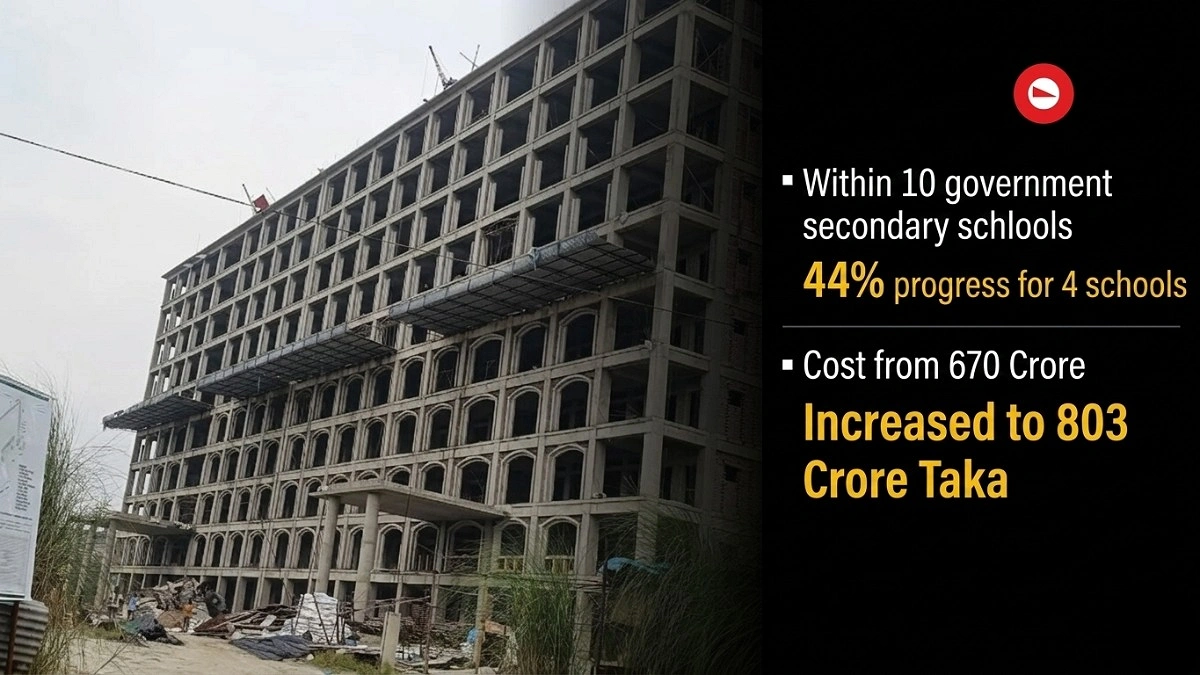
Graphics: Agamir Somoy generated by AI
The government had undertaken an initiative to establish 10 government secondary schools in various areas adjacent to Dhaka in an effort to ease the pressure on the capital's prestigious schools. However, the failure to conduct a feasibility study for the project proved to be a fundamental flaw from the outset. As a result, nearly nine years have passed, and work has yet to begin on three of the schools. Three others have achieved only 10 to 33 percent progress, while four have reached 88 percent implementation.
Under these circumstances, the project's cost has escalated from 670 crore to approximately 803 crore taka, an increase of about 133 crore taka. Additionally, the timeline has been extended by seven years, now set to run until June 30, 2027. Beyond the financial and temporal setbacks, students are being deprived of the project's benefits in a timely manner. The initiative is now being regarded as a severely failed project.
These findings emerged in the draft of the intensive monitoring report by the Implementation Monitoring and Evaluation Division (IMED).
In this context, the report has recommended high-level review through the Ministry of Education and the implementing agency.
The report stated that the obstacles to project implementation must be identified and swiftly resolved. Furthermore, for future projects of this nature, feasibility studies must be made mandatory to identify land selection, land acquisition, project costs, and implementation risks in advance.
Abul Mansur Md. Faizullah, former secretary of IMED, told Agamir Somoy: "IMED's recommendations should certainly be taken into consideration. Delays in project implementation are wasting both time and money, while the benefits of a well-intentioned initiative are not being realized. Strengthening project monitoring is essential. There is no room for wasting taxpayers' money through the negligence of those involved. Those responsible must be identified and held accountable."
According to IMED sources, the project was originally scheduled for implementation between July 2017 and June 2020. The deadline has since been extended in three phases, now pushed to June 2027. Yet project progress remains disappointing.
The report noted that no feasibility study was conducted before the project was initiated. Had such a study been carried out, many of the land acquisition challenges and adversities could have been largely avoided. However, the absence of a feasibility study led to an abnormally prolonged period for land identification and acquisition. Consequently, the desired progress according to the project's work plan could not be achieved, necessitating multiple extensions of the project timeline.
Additionally, while the Revised Development Project Proposal (RDPP) includes project descriptions, objective verification indicators, verification means, critical assumptions, goals, objectives, outputs, and inputs, it lacks year-specific time indicators. For instance, there are no specified numbers for computer and computer equipment procurement, laboratory equipment, office equipment, educational materials, furniture, electrical equipment, or other procured items. This constitutes a significant deficiency in the DPP's formulation.
The report further states that overall, the secondary school establishment project can be considered a complete failure due to its slow pace, unplanned site selection, and the inefficiency of the implementing unit. The administrative incompetence of project officials and the lack of proper oversight are the project's fundamental weaknesses. Failure to acquire land on time, sluggish tender processes, and inadequate monitoring have continuously extended the project's duration. Nearly nine years have passed since the project's approval as of mid-2026, yet not a single school's construction has been fully completed, and the physical progress of this high-cost project is truly disappointing.
The project is being implemented by the Directorate of Secondary and Higher Education. Officials from the directorate said that the project document only specified areas for school establishment, without identifying specific plots of land. This has led to various complications.
Work Yet to Begin on Three Schools
Construction has not yet commenced on Khilkhet Government Secondary School and College in Khilkhet, Eastarchal Government Secondary School and College in Rupganj, and Purba Norasinghpur Government Secondary School and College in Savar.
Three Schools at 10-30 Percent Progress
Jalkuri Government Secondary School and College in Signboard area of Narayanganj, Khoddaghoshpara Government Secondary School and College on Chittagong Road, and Satarkul Government Secondary School and College in Badda remain at just 10-30 percent implementation progress.
Four Schools at 88 Percent Completion
Bilamalia Government Secondary School and College in Hemayetpur, Savar; West Dhi Government Secondary School and College in Keraniganj; Lakuria Para Government Secondary School and College in Dhamrai; and Banshbari and Pathalia Government Secondary School and College in Nabinagar have achieved 88 percent progress.

