
From Hostility to Harmony: US and Iran Edge Toward Peace

Graphics: Agamir Somoy
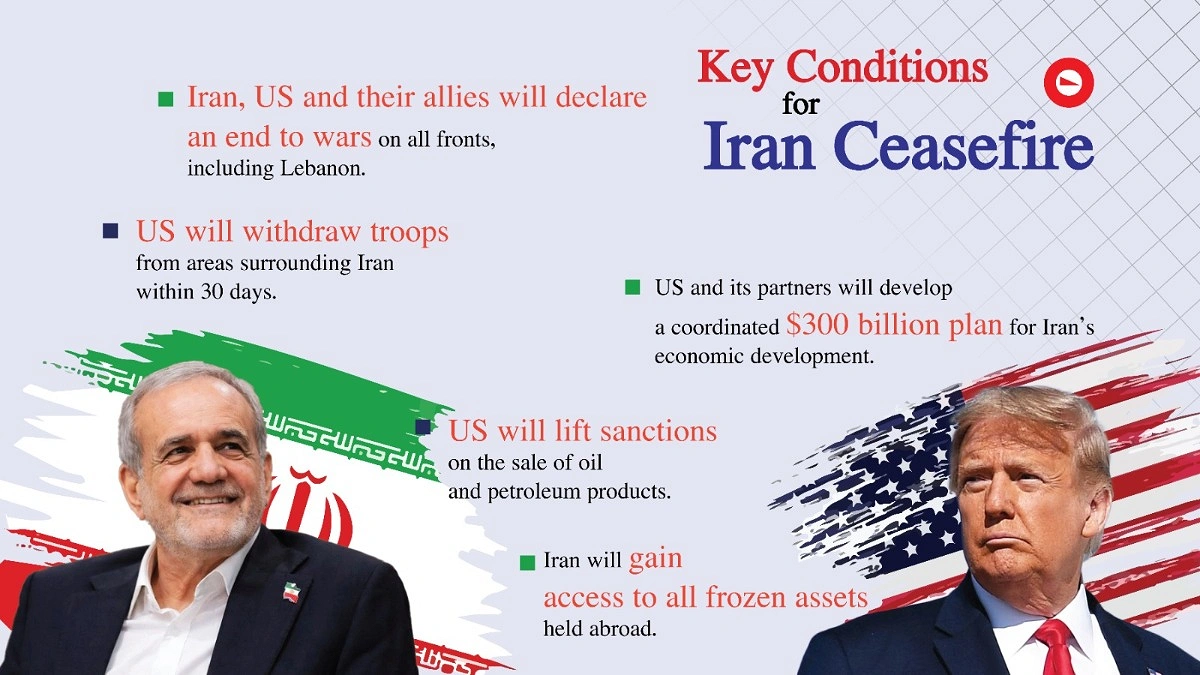
After decades of hostility, proxy wars, disputes over Iran’s nuclear program, and ultimately direct military confrontation this year, Iran and the United States have moved to the threshold of a historic peace agreement. Both the US president and the Iranian president have initially signed a memorandum of understanding through electronic means. The final talks and formal signing of the agreement will take place in Geneva on Friday. The United States has released 14 key points of the proposed agreement.
Key Provisions in the 14-Point Agreement
The agreement includes the reopening of the Strait of Hormuz, a permanent end to military hostilities, easing of certain sanctions on Iran, and the establishment of a future negotiation mechanism on Iran’s nuclear program.
Following the signing of the memorandum on Friday, a 60-day negotiation process will begin to finalize the terms of the agreement. Under the understanding, the United States will gradually lift its naval blockade on Iran, while Iran will ensure the security of commercial shipping routes.
The document also outlines a plan worth at least $300 billion for Iran’s reconstruction and economic development. Discussions will also cover the lifting of existing sanctions and the use of Iran’s frozen assets.
On the nuclear issue, Iran has pledged not to develop nuclear weapons. Both sides have agreed, under the supervision of the International Atomic Energy Agency (IAEA), to convert highly enriched uranium into low-enriched material.
Until the final agreement is reached, Iran will not expand any new nuclear activities, and the United States will refrain from imposing new sanctions or deploying additional troops. The framework also includes the formation of a joint mechanism to monitor implementation, with plans to seek approval from the United Nations Security Council.
History of the Conflict
The roots of the current US-Iran conflict stretch back even before the 1979 Islamic Revolution. In 1953, after the United States and the United Kingdom backed the overthrow of Iranian Prime Minister Mohammad Mossadegh, the rule of Shah Mohammad Reza Pahlavi was strengthened. At the time, Iran maintained close ties with the United States and also held security and economic relations with Israel. However, following the 1979 Islamic Revolution, which toppled the Shah, the newly established Islamic Republic adopted an anti-US and anti-Israel policy.
Over the following decades, tensions escalated over Iran’s nuclear program, its expanding regional influence, and support for proxy groups. Several diplomatic efforts were launched at different times to reduce tensions. The most significant among them was the 2015 Joint Comprehensive Plan of Action (JCPOA), under which Iran agreed to impose limits on its nuclear program in exchange for relief from international sanctions.
However, relations deteriorated rapidly after the United States withdrew from the agreement in 2018. Subsequent rounds of talks in Vienna, Doha, and Oman failed to produce a lasting settlement. Even the latest indirect negotiations held in Oman in February 2026 ended without success, effectively closing the door on a diplomatic resolution. The long-standing hostility ultimately escalated into direct military confrontation involving the United States, Israel, and Iran.
Timeline
• Domestic
Unrest in Iran and Diplomatic Failure (January-February)
Widespread anti-government protests erupted across Iran amid a prolonged
economic crisis marked by high inflation, unemployment, and fuel and
electricity shortages. Protesters demanded economic reforms, political
freedoms, and government accountability. At the same time, indirect talks
between the United States and Iran in Oman on limiting Iran’s nuclear program
collapsed due to rigid positions from both sides. As diplomatic efforts failed,
the risk of military confrontation rose rapidly.
• Final
Green Light for War (February 27)
The US ambassador to Israel, Mike Huckabee, ordered non-essential embassy staff
to leave the country, citing security concerns. On the same day, a high-level
meeting in Washington finalized plans for a joint military operation. President
Donald Trump approved Operation ‘Epic Fury’ and instructed US and Israeli
forces to complete preparations for strikes. US bases across the Middle East
were placed on maximum alert.
• Operation
Epic Fury and Killing of Khamenei (February 28)
From early morning, US and Israeli forces launched extensive strikes targeting
Iran’s military headquarters, missile bases, air defense systems, and nuclear
facilities. Nearly 900 air and missile strikes were carried out within 12
hours, marking one of the largest coordinated military operations in Middle
Eastern history.
The attack killed Iran’s Supreme Leader Ayatollah Ali Khamenei along with several senior military and political officials. To prevent a power vacuum, Mojtaba Khamenei was quickly appointed as the new Supreme Leader. On the same day, a missile strike near a girls’ school adjacent to a naval base in Minab killed numerous students and civilians, drawing widespread international condemnation.
• Iran’s
Retaliation and Regional War (March 1-3)
In retaliation, Iran launched hundreds of drones and ballistic missiles toward
Israel and U.S. bases across the Middle East. Multiple attacks targeted
American troops stationed in Qatar, Kuwait, and Iraq. On March 2, Hezbollah
joined the war in full force, launching rocket attacks across northern Israel.
In response, Israel carried out large-scale airstrikes on Beirut and southern
Lebanon. The conflict quickly expanded beyond an Iran-Israel confrontation into
a full-scale regional war. The United Kingdom deployed additional Royal Air
Force units to protect bases in Bahrain and Cyprus.
• United
Nations Condemnation and Resolution (March 11)
As the war spread, Arab countries called for an emergency session of the United
Nations Security Council. The adopted resolution condemned the attacks carried
out by Iran and its allied groups. It also reaffirmed the right to free
navigation in international waterways. Russia and China did not directly oppose
the resolution but abstained from voting, signaling a cautious stance.
• Economic
Warfare and Strait of Hormuz Blockade (Mid-Late March)
Iran disrupted shipping in the Strait of Hormuz, triggering major volatility in
the global energy market. Oil prices surged, raising fears of a global economic
recession. On March 25-26, Iran threatened missile strikes against US allies
such as Jordan and Bahrain. The United States deployed additional naval fleets
and aircraft carriers to the Gulf region. President Trump declared that no
agreement would be possible unless Iran accepted ‘unconditional surrender.’
• Trump’s
Stern Warning (April 1)
Trump claimed that Iran was becoming desperate for a ceasefire under military
and economic pressure. He warned that further military action would follow
unless the Strait of Hormuz was fully reopened. His remark about ‘sending Iran
back to the Stone Age’ sparked widespread international debate. Iran dismissed
the statements as propaganda and declared that surrender was not an option.
• First Temporary
Ceasefire Mediated by Pakistan (April 7-8)
Diplomatic efforts by Pakistan and China led both sides to agree to ceasefire
talks. A two-week ceasefire took effect on April 8, significantly reducing
military operations. Iran pledged to reopen the Strait of Hormuz and
participate in formal peace talks in Islamabad. Although both sides accused
each other of violations, the negotiation process did not collapse. On April
21, Trump announced an extension of the ceasefire indefinitely.
• Draft
of Final Peace Agreement (May-June)
After several rounds of difficult negotiations, mediators moved closer to an
agreement on post-war security architecture, missile programs, and regional
stability. On June 14, a historic memorandum of understanding was released, serving
as the foundation for a potential peace treaty. According to the plan, if
implemented, the war is expected to end completely within the following 60
days.
