


Nepal flood deaths hit 475 as lake threatens breach

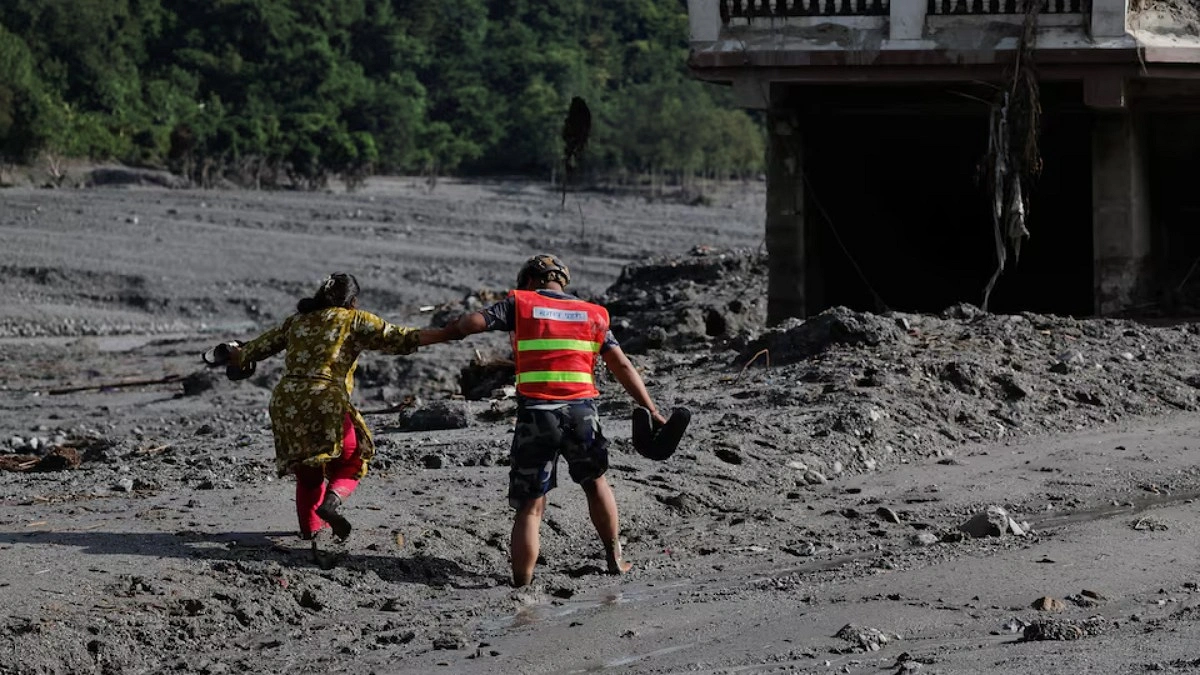
Photo: REUTERS
Rescue teams operating heavy machinery dug through thick layers of mud and debris across devastated Nepalese towns on Friday. As the golden window for finding survivors rapidly closes, government officials scramble to avert another looming flooding catastrophe.
By Friday morning, Nepalese authorities confirmed that the death toll had surged to 475 people, with nearly 1,000 others missing across Nepal and neighboring Tibet.
The colossal disaster began on Wednesday morning when a massive glacier collapse unleashed a violent torrent of rock, ice, and soil into the fragile Himalayan mountain river systems.
The furious wall of water pulverized scenic villages and valleys, wiping out key power stations, roads, and bridges. The destruction severed the vital transport link connecting Kathmandu with Lhasa in Tibet, a route that thousands of trekkers and pilgrims travel each year. Out of the massive pool of missing persons, foreign nationals account for at least 540 individuals.
To reach those stranded, the Nepalese government deployed helicopters to drop critical relief supplies and scan isolated valleys. On the ground, emergency workers and sniffer dogs combed through the plains, pulling dozens of swept-away bodies from the mud.
Military teams airlifted Dibga Tamang and three other survivors from the severely battered town of Rasuwa to an army base in Nuwakot on Thursday. Devastated by the loss of his community, Tamang shared his grief, “All of our people have gone. They are dead. I have no one left waiting for me. Everything and everyone are gone. The end.”
The immense volume of accumulated water and silt now threatens to trigger a second wave of disaster. Nepal’s disaster management authority issued an urgent warning that debris has blocked the Bhotekoshi River, creating an unstable lake that could breach its banks at any moment.
Across the border, Chinese officials estimated that some 3 million cubic meters of water - equivalent to around 1,200 Olympic-sized swimming pools - will pour into an already dammed lake over the next three days.
Chinese water resources ministry expects the lake’s peak water flow to hit around 1 September, warning of an extremely high risk of a catastrophic breach. In response, Beijing mobilized a specialized eight-member engineering team to conduct aerial surveys and produce advanced 3D modeling of the unstable barrier.
However, the rugged terrain makes physical access nearly impossible.
Explaining the precarious situation, engineer Chen Hanxiao told state broadcaster CCTV, “After the glacier collapse created the lake, many isolated cliffs and steep cliffs appeared along it.”
To mitigate the threat, the engineering team plans to dig a drainage channel at a lower section of the natural dam.
However, they must first calculate the exact width and depth of this channel based on expected water flow and the lake’s filling speed. The team’s immediate priorities involve monitoring weather patterns and collecting data from the lake floor.
The disaster has also crippled key border infrastructure. Enormous torrents of mud and water swept through the Gyirong border crossing on Wednesday, engulfing fleeing civilians within seconds.
By Thursday night, Chinese rescue teams had still not reached this hard-hit area as road crews worked tirelessly to clear heavy debris blocking the primary access route.
CCTV reported that 558 people remain missing in Tibet’s Gyirong County, including 260 foreign nationals. So far, authorities have confirmed three deaths on the Chinese side of the border. Highlighting the extreme gravity of the situation, Chinese Premier Li Qiang personally arrived at the disaster zone in Gyirong on Thursday afternoon, signaling that Beijing has classified the crisis as a top national priority.
Around the globe, frantic families are desperately seeking news of their missing loved ones. Sneha Sudhir is among ten women from northern Virginia whose husbands disappeared while trekking toward Tibet’s sacred Mount Kailash. The missing American trekkers, who are mostly from Chantilly, Virginia, are currently unaccounted for.
Crying from her Virginia home on Thursday, Sudhir asked, “Where are they?” She described how the wives are banding together to lobby American and Indian politicians, officials, and friends for any shred of information. “Everybody is taking turns in shedding their tears, wiping it off and getting back to work,” Sudhir said.
In Washington, President Donald Trump announced that the United States has offered emergency assistance to Nepal.
Trump remarked, “Nobody’s ever seen anything quite like that, where very powerful, strong, well-built buildings were wiped out like they were toothpicks. It’s a terrible thing. We are sending aid and we’ve spoken to the leadership and we let them know anything they want, they’ll have.”
Meanwhile, the scale of death continues to unfold downstream. Ganesh Aryal, the administrator of Chitwan district, confirmed that local teams recovered 103 bodies from the river network in his region, situated in the low plains roughly 100 kilometers (62 miles) away from the devastated Trishuli area.
With local morgues and hospitals completely overwhelmed, district authorities set up emergency tents to allow grieving families to identify and claim their deceased relatives.
Visiting the flood-ravaged district of Nuwakot on Thursday, Nepal’s Prime Minister Balendra Shah acknowledged the severe challenges. “All the state agencies are operating at full capacity. Our first priority now is to save life of each citizen, search and rescue of the missing, treat the injured and provide immediate relief to the affected families,” Shah said.
This massive environmental disaster presents a formidable test for Shah’s five-month-old administration. However, experienced state officials remain confident in their disaster response capabilities, pointing to lessons learned during the devastating 2015 earthquake that claimed nearly 9,000 lives.
Source: Reuters (adapted)


