


Nepal-Tibet border glacier collapse kills 177

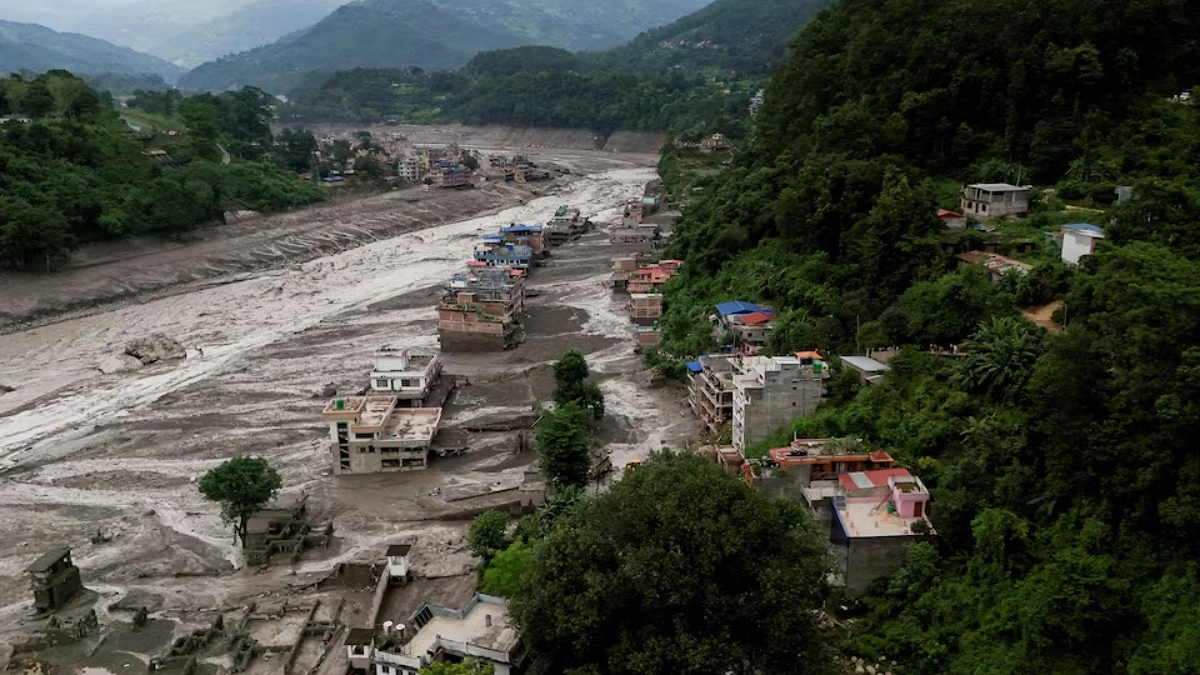
Photo: REUTERS
Search and rescue operations intensified along the Nepal-China border as emergency crews looked for hundreds of missing people following a catastrophic deluge that swept through multiple communities on Wednesday.
A massive glacial collapse triggered the sudden and deadly torrent of water and mud. Nepal’s police said the disaster claimed 177 lives, left nearly 1,500 people missing - including many foreign tourists and religious pilgrims - and displaced hundreds of residents throughout the mountainous region.
Videos captured the fast-moving water swallowing fleeing victims and tearing down buildings and bridges, while drone footage captured in Nepal on Thursday revealed the immense scale of the destruction.
The region’s sheer valleys function as vital trade paths and economic lifelines, but they turn highly precarious when natural disasters strike. Visuals showed mud completely covering what appeared to be the entire second floors of buildings in the Nuwakot district.
Debris clung to tree branches and overhead wires, mud buried vehicles, and caked survivors walked around in a state of shock. The flooding halted all local transit and gave residents almost no time to flee to safety.
The Himalayan Mountain range, which spans several nations in South Asia, contains some of the tallest peaks and largest remaining glaciers in the world.
These steep mountainsides and fertile valleys beneath are exceptionally vulnerable to sudden landslides, floods, and extreme weather systems. Human-caused climate change has accelerated global warming, making glacial melt a far more frequent occurrence.
Earlier this year, scientists in Kathmandu reported that glaciers throughout the Hindu Kush Himalaya region are melting at a rapidly increasing pace, with ice loss rates doubling since the year 2000.
In Nepal, the raging waters demolished dozens of bridges and damaged nearly 40 kilometers (25 miles) of key roads, severely hindering the ongoing search efforts.
To aid the survivors, the Nepalese military launched extensive helicopter rescue missions on Thursday morning, airlifted more than 100 people from the affected areas, and evacuated individuals trapped inside facilities of the Trishuli hydropower project, according to Army Spokesperson Brigadier General Raja Ram Basnet.
Basnet noted that military flights evacuated at least eight foreign nationals directly to the capital city of Kathmandu. Downstream, search teams recovered bodies in the Chitwan district, which lies roughly 100 kilometers (60 miles) away from the disaster zone.
Meanwhile, emergency vehicles transported dozens of injured survivors to Kathmandu to receive advanced medical treatment.
Bishal Kumar Bhandari, the chairman of the Nepal Red Cross Society, announced that the organization shifted its focus from search-and-rescue to massive relief operations in the flood-ravaged districts.
Bhandari added that the deluge displaced approximately 1,200 people from at least three different villages. Across the border in Tibet, Chinese state broadcaster CCTV reported that a major mudslide struck near the Gyirong Port land border crossing on Wednesday.
The slide deposited heavy mud averaging more than 1.5 meters (5 feet) deep, with some sections of road buried under more than 2 meters (6 feet) of debris. The disaster damaged all transit routes leading to the port, and continuing rainfall threatens to trigger secondary landslides and slope collapses in the area.
CCTV also reported that authorities discovered a newly formed barrier lake near the port, which presents a significant obstacle to rescue operations. In response, the Chinese government deployed a massive military transport aircraft to airlift a specialized response team to the region.
While utility crews successfully restored power and communications in downtown Gyirong, the infrastructure serving the port area remains completely offline.
Although initial reports from Nepali officials pointed to an earthquake triggering a glacial collapse, the United States Geological Survey (USGS) later clarified that the falling glacial ice and rock hitting the valley floor actually generated the recorded seismic activity.
Climate experts at the Kathmandu-based International Centre for Integrated Mountain Development concluded that an avalanche from a glacier likely triggered Wednesday’s sudden deluge.
In an emailed statement, the organization explained, “Hydrological observations indicate the exceptional speed and magnitude of the flood wave,” and pointed out that water levels at one point along the Trishuli River surged by 9 meters (27 feet) in a span of just thirty minutes.
The scientists noted that the Lhende Khola River, a tributary of the Bhotekoshi, bore the brunt of the maximum flooding. Experts warn that this tragedy is not an isolated event; the decaying stability of the Himalayan ice systems poses a constant threat to communities, infrastructure, and critical water supplies across one of the most heavily populated regions on the planet.
Indeed, the region suffered a similar disaster in August 2025, when high summer temperatures caused a glacial lake in Tibet to overflow, killing nine people and destroying a vital border bridge connecting Nepal and China.
Source: Reuters, BBC and AP (adapted)

