


The Widow


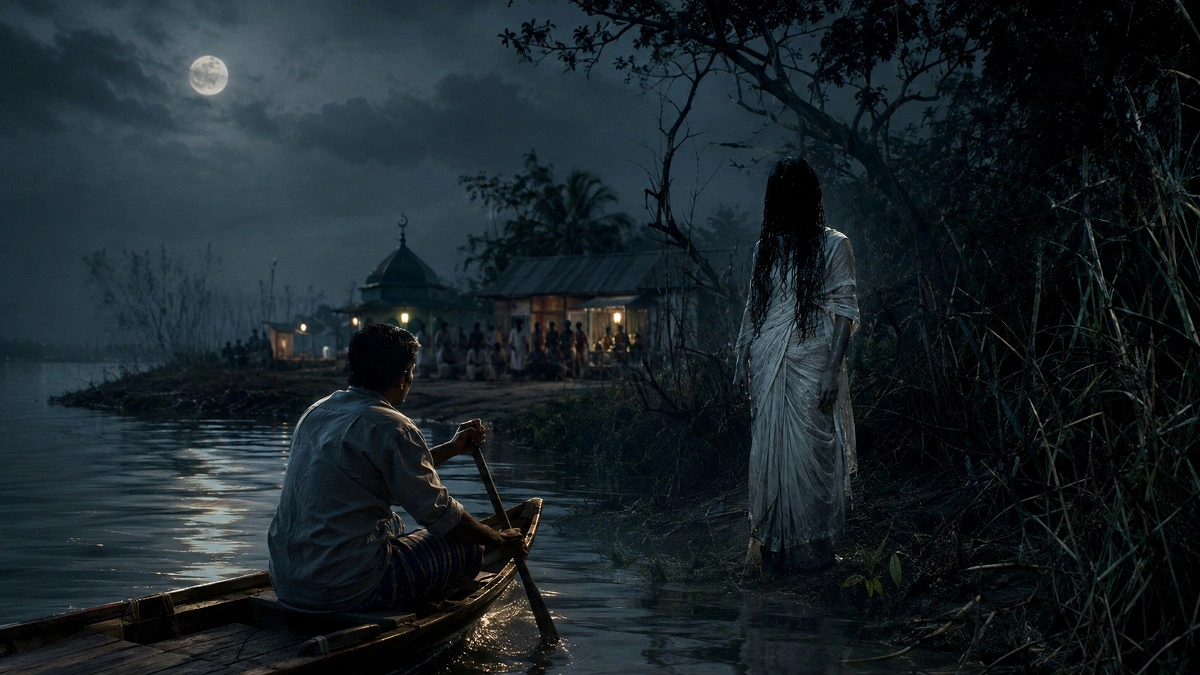
Graphics: Generated By AI
I.
The char had not existed ten years ago. Rafiq remembered this clearly, because he had been the one to first walk its silt when it broke the surface of the Meghna like a wound healing over. A new island, born from sediment and stubbornness, the way all chars in Bangladesh are born: reluctantly, and never for long.
He was forty three now, a boatman by trade and a farmer by necessity, and he had built his home on Notun Char with his wife Amena and their daughter Rupa, who was seven and afraid of nothing except the water at night. The island sat two hours by engine boat from the nearest market town in Bhola district, close enough to buy kerosene and rice, far enough that no one came unless they had a reason.
In the third week of Ashwin, when the monsoon was supposed to be retreating and instead lingered like an uninvited guest, a fisherman named Sokal Mia disappeared. He had gone out at dusk to check his nets near the southern bank, where the char thinned into reeds and the current ran fast and brown. His boat was found the next morning, empty, turned gently in an eddy as though someone had parked it and stepped out for tea.
The village of forty families gathered at the small tin mosque to discuss what should be done. Most agreed it was the river. The Meghna took men every year, quietly and without ceremony, and grief in these places had long since learned to travel light.
But Sokal Mia’s mother, an old woman named Johura, stood in the doorway of the mosque and said something that made the men uncomfortable enough to look away.
“She has come back,” Johura said. “The Bhutore Bou. I told him not to go near the reeds after sunset. I told all of you.”
The younger men laughed, not cruelly, but with the practiced ease of people who did not want to believe something and so decided instead to find it amusing. The older ones did not laugh. They simply grew quiet, the way people do when a name from childhood surfaces unexpectedly in adult company, carrying with it a smell of old fear.
Rafiq had heard the story before, from his own grandmother, decades ago in a different village that the river had long since swallowed. The Bhutore Bou. A spirit said to inhabit the deep chars of the delta, appearing as a woman in a wet white sari, calling out in the voice of a man’s own wife or mother, luring him toward the water until the water no longer needed to lure him at all.
He had not thought of her in years. He did not want to think of her now.
II.
Amena noticed the change in Rupa before Rafiq did.
It began three nights after Sokal Mia vanished. Rupa woke crying, insisting that someone had been standing at the window of their tin-roofed house, a woman with her hair undone, dripping onto the mud floor though there had been no rain that night. Amena checked the window herself and found nothing but the black smear of the char stretching toward the river, the way it always did, indifferent and enormous.
“It was a dream,” Amena told her daughter, and believed it, because believing anything else meant admitting that the char, this small unstable piece of earth they had built their whole life upon, might not want them there.
But the dream repeated. Each night the woman came closer to the house, and each morning Rupa described her in greater detail: the sari clinging wet and heavy though the ground beneath her was dry, the face turned slightly away as if shy of being seen fully, the voice that called Rupa’s name in a tone so exactly like Amena’s own that the girl sometimes answered before realizing her mother was asleep beside her.
On the fifth night, Rafiq stayed awake to watch.
He sat outside on the wooden bench beneath the tin awning, a kerosene lamp turned low beside him, and told himself he was being foolish, a grown man frightened by an old woman’s superstition and a child’s bad dreams. The char at night had its own sounds: the constant murmuring hush of the river, the rustle of kaash grass along the banks, the distant call of some water bird disturbed from sleep. He had heard these sounds a thousand nights before and never once felt what he felt now, which was the unmistakable sensation of being observed by something that had been patient for a very long time.
Near midnight, the sound of the river changed. It was subtle at first, a shift in pitch, as though the water itself had drawn a breath. Then he saw her.
She stood at the tree line where the char’s few stunted keora trees marked the boundary between cultivated land and the wilder reeds beyond, and she was exactly as Rupa had described, and worse, because description cannot carry the particular wrongness of a human shape that moves without displacing air, that stands in wet cloth beside dry grass that does not bend beneath her feet. Her hair hung across her face. Rafiq’s lamp threw no light on her at all, as though she existed in a darkness of her own that the world had agreed to respect.
She called his name. Not Rupa’s.
The voice was Amena’s, precisely, down to the small catch she had in her throat when she was tired, and for one terrible moment his body moved to answer it before his mind caught up and forced his feet still. He gripped the edge of the bench until the rough wood bit into his palms and did not look away, because some old instinct, older than the fear itself, told him that looking away was what she wanted.
She stood there until the call to fajr prayer rose faint and metallic from the mosque across the water, carried strangely far in the pre dawn stillness, and then she was simply not there, the way a shadow is not there once the sun has fully risen, without any moment of actual departure.
Rafiq did not sleep again that week.
III.
He went to see the imam, a thin serious man named Maulana Ismail who had come to Notun Char two years earlier and who Rafiq trusted more than he trusted most people, because the maulana had never once pretended to have easy answers.
Ismail listened without interrupting, and when Rafiq finished, he was quiet for a long moment, turning his prayer beads slowly between his fingers.
“There are stories older than this land remembers,” Ismail said finally, “and I will not tell you they are only stories, because I have lived on these chars long enough to have learned humility about what I do not understand. But I will tell you what my own teacher told me. These presences, whatever they are, feed on something. Grief. Guilt. A debt unpaid between the living and the dead. She does not come to a family for no reason. Search your own house, Rafiq bhai. Search what has not been said.”
Rafiq walked home turning the words over like stones in his pocket, and that night, unable to sleep, he asked Amena directly whether there was anything from before, from the years before he knew her, that she had never told him.
Amena’s silence lasted long enough that he understood the answer before she spoke.
She had been married once before, she admitted, years before Rafiq, to a man on a different char further south, a man named Barek who had drowned within their first year of marriage under circumstances the village had called an accident and which Amena, even now, was not entirely certain deserved that word. She had left that place soon after, ashamed and grieving in equal measure, and had never spoken of it again, not even to her own mother, believing that silence was its own kind of mercy, a way of letting the dead stay dead.
“Did you love him,” Rafiq asked, not out of jealousy but out of a need to understand the shape of what they were dealing with.
“I was young,” Amena said. “I do not know what I felt. But I know that I did not weep for him the way a wife should, and I have wondered since whether that failure follows a person.”
Rafiq thought of the Bhutore Bou standing at the tree line in a voice that was Amena’s own, and wondered whether the spirit was not simply borrowing his wife’s voice at random, but calling to him as Amena herself might have once called to her first husband, on some night neither of them had ever described to anyone, a night the river alone remembered.
IV.
The visitations grew bolder. Twice more that month, men from the village reported seeing the woman in white near the water after dark, always at the edges, always calling a name. A young husband named Kobir followed her voice nearly to the riverbank before his brother tackled him bodily into the mud, weeping and cursing and afraid in a way none of them had words for. The village elders debated whether to abandon the char entirely, but abandoning a char meant abandoning land, and land, however unstable, however haunted, was the only thing between these families and complete destitution. They decided instead to hold a collective prayer, an oorosh of sorts, asking whatever peace could be offered to whatever remained unsettled beneath their soil.
Rafiq did not believe the prayer alone would be enough. Something in Ismail’s words about debts unpaid had lodged itself in him and would not let go. On the night of the gathering, while the rest of the village sat together in the mosque’s courtyard reciting verses beneath hurricane lamps, he took his boat alone out onto the black water, toward the southern reeds where Sokal Mia had vanished and where Rupa’s window visitor had first been seen.
He told himself, paddling silently through the dark current, that he was doing this for Amena, to settle whatever account existed between her past and this river, though some more honest part of him suspected he simply needed to see the thing clearly, without a child’s fear or a mother’s guilt distorting it, to understand what exactly haunted his family’s new and fragile home.
He found her waiting for him at the reeds, as though she had known he would come.
Closer now, in the moonlight, he could see what the distance had mercifully hidden before. Her sari was not merely wet but rotted in places, the fabric clinging to a form that was not entirely whole, and where her face should have been visible beneath the curtain of hair there was instead a suggestion of features, half formed, as though the river had tried to sculpt a woman from silt and memory and had not quite finished the work.
“You are not Barek’s wife,” Rafiq said, forcing steadiness into his voice, addressing the thing directly, because he had decided that whatever courage he had left would be spent honestly rather than hoarded uselessly. “You did not know her. You wear her voice like borrowed cloth.”
The thing tilted what might have been a head. When it spoke, the voice was no longer Amena’s, no longer any voice he recognized, but something older, wetter, a voice like water moving over stone for a thousand years.
“I do not borrow,” it said. “I remember. Every voice that has called across this water while drowning, I hold. Your wife’s first husband called her name as the current took him, and she was not there to hear it, and so I heard it instead, and I have kept it since, because someone must.”
Rafiq’s hands went still on the oar. “Then it was not an accident.”
“It does not matter to me what it was,” the thing said. “The river keeps what is given to it. Grief. Names. Unfinished love. I only give it voice again, so that it is not entirely lost.”
“And Sokal Mia. Was his death not an accident either.”
“He heard his dead father calling from the reeds one evening some months past and never told a soul, ashamed of the fear it gave him, and the shame festered into a debt, and I collect what is owed.” The thing’s not quite face turned fully toward him now. “You have come to bargain, boatman. Speak your bargain.”
V.
Rafiq had not, until that moment, known that this was what he intended, but standing there in his small boat with the current pulling gently at the hull, he understood it clearly for the first time.
“Take nothing more from this char,” he said. “Not my daughter, not my wife, not one more soul from these forty families. In exchange I will give you what you actually want, which is not death. It is witness. I will speak the name of every drowned voice you carry, here, aloud, so that the debt is paid in memory rather than in blood.”
The reeds around them stirred though there was no wind. For a long moment the thing said nothing, and Rafiq understood that he had either offered something genuinely valuable or something meaningless, and that he would not know which until it was too late to take the offer back.
Then, in a voice like water finally finding a level, it began to speak names.
Names Rafiq did not know, men and women from generations of chars long since dissolved back into the Meghna’s hungry current, names spoken in the exact voice each had used in their final moment, some calling for mothers, some for children, some simply crying out wordlessly in the particular way of the drowning. Rafiq repeated each one aloud across the water as it was given to him, his own voice growing hoarse, and Barek’s name came near the end of the recitation, spoken not in fear but in something closer to apology, and Rafiq spoke it back with the same gentleness, understanding that this, whatever it cost him, was the closest thing to a funeral rite the man had ever been given.
When the recitation ended, the moon had shifted considerably across the sky, and the thing in the reeds had grown thinner, less substantial, as though the act of naming had drawn something out of it that it could not easily replace.
“You have paid,” it said, the voice fading now toward something almost peaceful. “The char is yours until the river reclaims it, as all chars are eventually reclaimed. I will not call your women’s voices again.”
“And if another debt is owed,” Rafiq asked. “Another shame unspoken.”
“Then it will come to me as all such things come to me,” the thing said, already dissolving into mist above the black water, “and you will know, because someone in your village will begin to dream of a woman standing at their window, wet in dry grass, calling a name they thought no one else remembered.”
VI.
Rafiq rowed home before dawn and told no one what had passed except Amena, who wept for her first husband properly for the first time in eight years, a grief long delayed finally permitted to arrive.
No one on Notun Char vanished into the river again that season, nor the season after. The story of Sokal Mia was folded gently into the char’s small collection of sorrows and eventually spoken of only during long evenings when the older men wanted to frighten the younger ones into respecting the water properly.
But sometimes, when Rupa played too near the southern reeds as the light began to fail, Amena would call her back with a sharpness that startled even herself, and would stand afterward at the tree line a moment longer than necessary, listening to the particular hush of the current, before returning to the house where the lamp was already lit and the rice already cooling, as though something out there might still be listening for whether she remembered, and whether she was still willing, if asked, to say the names.

