


Five-Year Framework targets Metrorail for metropolitan cities

Graphics: Agamir Somoy
Government plans to establish metro rail, elevated rail, circular commuter lines, and monorail systems not only for Dhaka but also for other metropolitan areas to ease public transportation system.
There are 12 metropolitan areas in the country. Once the Bogura City Corporation is added, a total of 13 metropolitan areas’ public transport will experience modernizing touches.
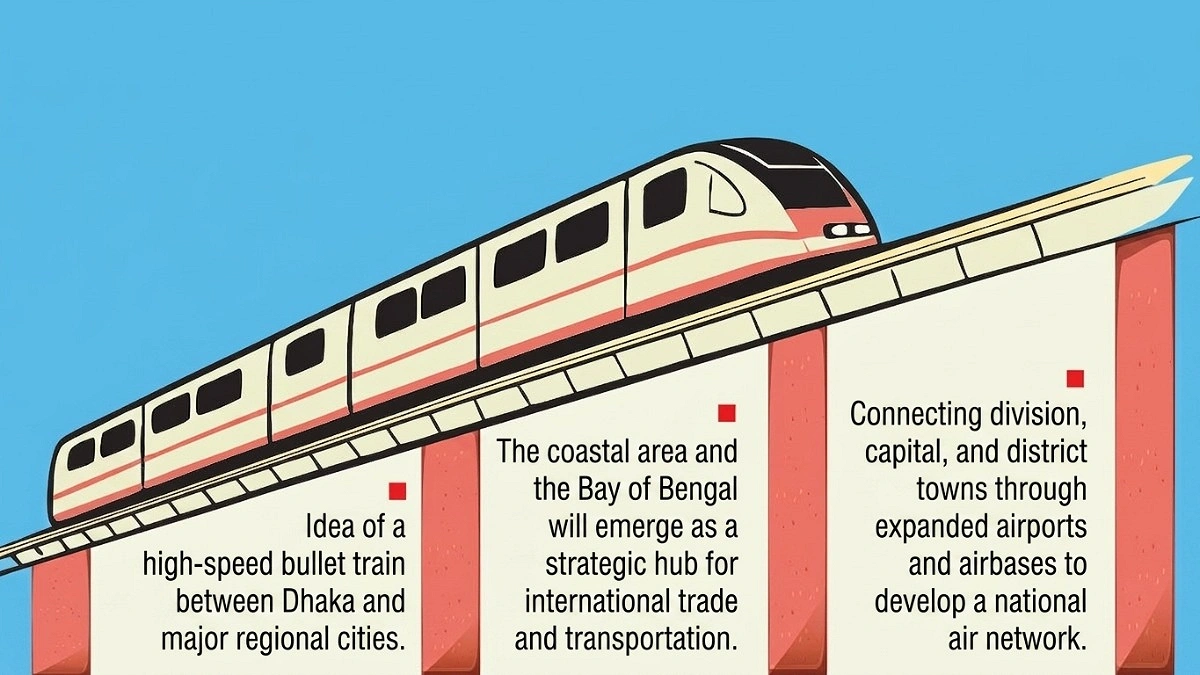
Moreover, plans will be formulated to establish high-speed bullet train connections between Dhaka and major regional cities. Alongside this, an integrated national railway network will be developed to connect all districts and major cities.
At the same time, a national air connectivity system will be established to link divisions, capital city, and district towns through expanded airports and airbases. These plans are outlined in the Five-Year Strategic Framework developed by the General Economics Division (GED) of the Planning Commission. The target has been set to implement the plan between 2026-27 fiscal year and the 2030-31 fiscal year.
Planning Secretary SM Shakil Akter told Agamir Somoy, “This five-year plan is not just a document written on paper. A monitoring system has been integrated to ensure it moves to the implementation phase. A committee will be formed under the leadership of the Prime Minister, which will meet twice a year. There, the progress of the plans assigned to respective ministries for implementation will be asked. If the progress is not good, they will be brought under accountability.”
According to the framework, electrification and double-track construction will be carried out on major rail corridors, including Dhaka-Chattogram, Dhaka-Panchagarh, and Dhaka-Chapainawabganj. Regional rail connectivity, including Myanmar-based routes and the Dhaka-Kunming rail link, will receive priority.
To ensure safety and operational efficiency, more express intercity rail services will be introduced, and a smart monitoring system will be implemented. A system of free travel and discounted fares will be introduced for students, senior citizens, and persons with special needs.
Railway connections will be established with all economic zones, regional economic corridors, industrial zones, airports, seaports, land ports, and ICDs in the country. There will be scheduled freight train services, modern signaling systems, rolling stock maintenance facilities, and improved arrangements for emergency rescue operations.
Public-Private Partnership (PPP)-based development will be encouraged for passenger, freight, and urban rail systems. Free high-speed internet connectivity will be available at all railway stations. The movement of passenger trains will be increased for the effective use of railways by increasing the number of locomotives and passenger coaches.
Regarding air connectivity, the goal is to transform Bangladesh into one of the main aviation hubs of South and Southeast Asia by 2034. This transformation will center on creating a national air connectivity grid, which will connect divisional capitals and district cities through an expanded network of airports and airbases, establishing the country as a strategic regional gateway.
Alongside this, Cox’s Bazar, Jashore, Rajshahi, and Syedpur will be developed as new international gateways. Efforts will be made to ensure passengers’ rights at airports, prevent ticket black-marketing and counterfeiting, and reduce harassment of expatriate passengers.
GED Member (Secretary) Manzur Hossain, who was responsible for preparing the framework, said, “The overall goal of the framework is to increase national productivity by prioritizing the most cost-effective and sustainable transport modes. Specific objectives include strengthening inter-regional connectivity to ensure safe and affordable movement for all citizens.
“In this regard, the coastal region and the Bay of Bengal will be developed as strategic international trade and transport hubs. In addition, major bridges, flyovers, and underpasses will be constructed for economic mobility.
“Major ports and airports will be transformed into global hubs for passenger and freight transport. An integrated logistics hub will be established centering on Chittagong and Mongla ports by integrating sea, road, rail, and waterway networks.”
According to GED data, road buses accounted for around 88 percent of travel in the country. In contrast, the railway’s contribution to passenger transport was around 4 percent. Due to the lack of a single development authority, over-emphasis has been placed on road development, resulting in its share as a mode of freight transport increasing from 35 percent in 1975 to 77 percent in 2021.
On the other hand, during the same period, the contribution of rail and inland waterway transport significantly decreased from 28 percent to 16 percent and 37 percent to 7 percent, respectively.
For sustainable development, a balanced multimodal transport system is required, which can leverage the immense potential of the riverine geography connected to the sea and the opportunities of railway intermodal container services.

