One year on, scars remain as families of Dhaka school jet crash victims still await justice

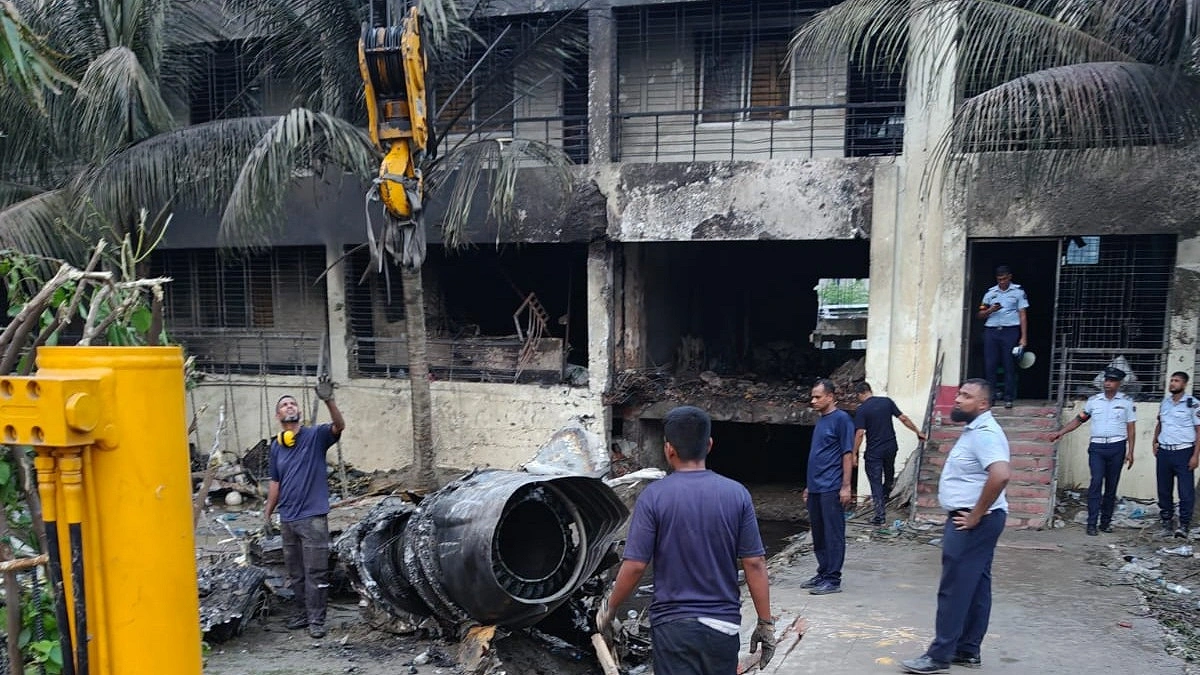
Photo courtesy: Wikipedia
A year has passed since a Bangladeshi military aircraft plunged into a crowded school in Dhaka, killing 36 people—most of them children—but for survivors and grieving families, the wounds are far from healed. On the anniversary of the country's deadliest aviation disaster in decades, they gathered once again, demanding transparency, accountability, and answers that have yet to come.
For 12‑year‑old Nure Jannat Yusha, the nightmare is still vivid. That July afternoon in 2025, she was a normal sixth‑grader at Milestone School and College when a training jet from a nearby air force base crashed into the building, turning a bustling private school into a blazing inferno. She was among more than 160 injured. Today, she cannot look at an airplane without terror. "Even now, if I go to school and see a plane, I feel afraid. I can't sleep at night. In my dreams, someone is throwing me into the fire," she told BBC Bengali at a memorial service held at a Dhaka hospital on Tuesday.
Her mother, Yasin Akter, watches helplessly as her daughter's former dreams—of becoming a dancer—have been replaced by constant anxiety. "My daughter screams all day and is afraid," she said. "Earlier she was interested in studies. Now she does not want to study any more."
The crash occurred around 1 p.m. on 21 July 2025, shortly after the training aircraft took off from a Bangladesh Air Force base in the capital. It came down in the Uttara neighbourhood, and emergency workers spent hours sifting through charred wreckage for survivors. The government quickly formed an investigation commission, but its findings—reportedly submitted to authorities last November—have never been made public.
A copy of the full report obtained by BBC Bengali, however, has raised serious concerns. It noted that Milestone School was not compliant with building codes and revealed that more than 600 structures, including schools and hospitals near Dhaka's international airport, violated height restrictions. Crucially, the report found no technical fault with the aircraft—contradicting an early military statement about a mechanical failure—and instead pointed to inadequate flight training and poor ground supervision for the pilot. The armed forces have not responded to requests for comment.
At Tuesday's memorial, Mansur Helal, whose wife—schoolteacher Mahreen Chowdhury—died from severe burns she sustained while rescuing students, voiced the anguish shared by many. "No one can give a guarantee that another plane will not fall onto this school in the future," he told the crowd. "Every day around 2,500–3,000 students go to that school. The building in which this accident happened had only one door. How can there be only one door for 800‑900 students?" He and other relatives are pressing the government to release the full report and implement the committee's recommendations—including enhanced compensation and better medical support for survivors and victims' families.
Health Minister Sardar Sakhawat Husain, who attended the event, promised that the state would cover further treatment for survivors, while Prime Minister Tarique Rahman's wife, Zubaida Rahman, praised their resilience as "a source of inspiration for the nation." Yet for many of the young survivors—some still bearing visible burn scars—daily life is a struggle.
Fifth‑grader Mehreen, for example, can no longer attend school because of her injuries. "If I get a little sunlight, my whole body burns," she said. "Earlier, if I read something, I would memorise it in two minutes. Now I can't memorise a line in two hours. I can't sleep at night. When I do sleep, I often have strange dreams. I still can't forget that incident."
One year on, the physical and psychological wreckage remains—and with no official report in sight, the call for justice grows louder, even as the scars continue to ache. (Source: BBC)