


World’s first live AI brain surgery success in London

Graphics: Agamir Somoy
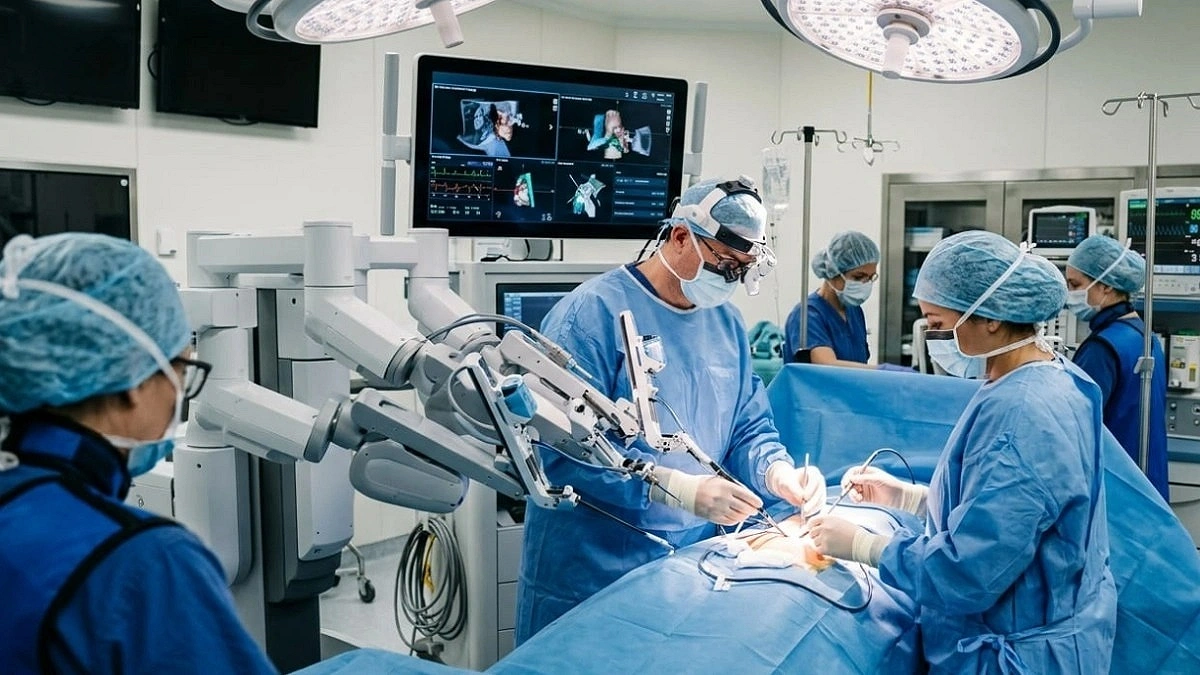
Surgeons at University College London Hospital have made medical history by successfully extracting a brain tumor using real-time artificial intelligence assistance. The groundbreaking procedure saved the sight of Rhys Hibbert, a 48-year-old father of two and customer services manager from Bedfordshire.
During the operation, an advanced AI algorithm analyzed a live video feed, guiding the surgical team away from highly critical, obscured nerves and blood vessels to maximize the safe removal of the growth.
Reflecting on the innovative technology, Hibbert remarked, “From a patient safety perspective, I can see absolutely the benefit. There are no road signs inside our head.”
A shadow in the skull
Until about a year and a half ago, Hibbert enjoyed an active and healthy lifestyle, regularly taking a two-mile walk during his lunch breaks. His life changed abruptly during one of those routines when he collapsed onto the road and began experiencing seizures.
A brain scan then identified an 11-millimeter (0.433-inch) non-cancerous tumor developing on his pituitary gland, a tiny, marble-sized organ located at the base of his skull.
The pituitary gland regulates essential bodily functions by releasing vital hormones that control growth, metabolism, blood pressure, and temperature. Crucially, the gland sits in extremely close proximity to the carotid arteries - the primary vessels delivering blood to the brain - as well as the optic nerves that facilitate vision.
As the tumor expanded, it pressed against Hibbert’s optic nerves, severely restricting his peripheral vision. The condition left him dizzy, extremely exhausted, and prone to tripping over household objects.
Despite these physical setbacks, Hibbert fought to maintain his daily routine. “For 18 years of married life I’ve always got out of bed and made my wife a cup of coffee and I wasn’t going to let this tumour stop that.”
The diagnosis triggered significant emotional and psychological challenges for the family. “Though I had a lot of people kindly offering help, you don’t want to be a burden on people,” he explained.
As a result, when medical professionals proposed using their custom-built AI tool for the very first time on a human patient, Hibbert accepted without hesitation. “If patients are not prepared to join research how can doctors ever learn and how can medicine ever progress?” he said.
Navigating the brain with ‘surgical ChatGPT’
The intricate surgical procedure required doctors to guide an endoscope - a specialized thin camera mounted on a rod - through Hibbert’s nose to access the base of his skull.
Because the tumor remained concealed behind layers of bone and dense membrane, identifying a safe extraction route presented a major challenge, especially given the natural anatomical variations between individual patients.
Under normal conditions, these operations carry a 25-50 percent chance of leaving part of the tumor behind, alongside a 0.5-2 percent risk of damaging a vital blood vessel.
To mitigate these dangers, the team deployed the AI assistant, which functioned on a secondary monitor alongside the main surgical feed. Dubbed a “Surgical ChatGPT,” the software tracked the movements of medical instruments and highlighted the boundaries of vital nerves and blood vessels in real time, signaling the safest pathways for tissue removal.
The tool operates on principles similar to mobile facial recognition technology, but focuses instead on mapping hidden human anatomy.
Typically, a surgeon in the United Kingdom conducts only 10 to 20 of these specific procedures annually, relying primarily on static pre-operative scans to navigate the patient’s brain structure. To build a more robust system, researchers trained the AI on hundreds of recorded pituitary tumor operations, meticulously mapping out the boundaries of nerves and blood vessels across every video.
Hani Marcus, who helped perform the milestone surgery, highlighted the tool’s unmatched preparation. “It is trained on more operations than most surgeons see or do in a lifetime and can act like an expert second pair of eyes,” he explained, noting that the system operates live in the operating room.
Reclaiming a life
The development team stresses that the technology remains strictly advisory, leaving final decision-making power entirely in human hands.
Developers from University College London (UCL) built the system over several years of rigorous laboratory testing, receiving funding from the National Institute for Health and Care Research and Google.
The team hopes to establish a permanent digital consultant in operating theaters globally. Marcus outlined this vision, stating they hope to create “another expert in the room they can turn to for advice if they want it - or leave if they disagree with it.”
Following the success of this initial live procedure, the team is now preparing to launch a broader clinical trial. For Hibbert, the results of the surgery were immediate and transformative. “When I opened my eyes after the operation it felt like I had got 360-degree vision - I hadn’t seen that clearly for a year,” he recalled.
In the two months following the operation, Hibbert’s eyesight has continued to improve steadily. “I also have my energy back and all of the side effects I was suffering before surgery have gone. It’s given me my life back,” he said.
James Frith, the Health Innovation Minister, welcomed the success of the government-funded research project. “AI needs proper safeguards and we will always ensure that safety is taken seriously. But we will also ensure we benefit from the opportunities it brings,” Frith added.
Source: BBC (adapted)


