
10 Pythons and cobras rescued in 18 days as snake sightings frighten coastal residents

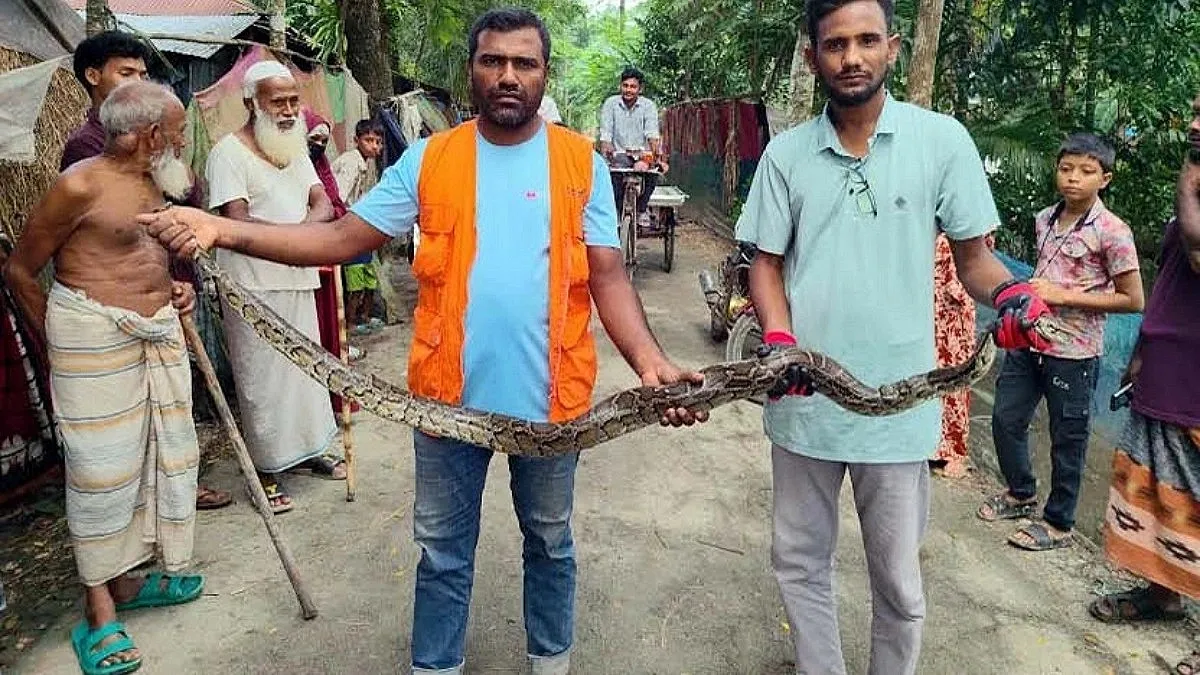
Photo: Mahidul Islam.
Residents of several coastal villages in Bagerhat, adjacent to the Sundarbans, are growing increasingly concerned after repeated sightings of large pythons and other venomous and non-venomous snakes. Most of the reptiles have been found inside homes, fish enclosures, poultry sheds, and paddy fields.
On Saturday morning, an approximately eight-foot-long python was rescued from the home of one Abdur Rahman at Bakultala village of Sharankhola upazila. The snake was later released safely into the Sundarbans.
The latest rescue brings the total number of snakes recovered from Sundarbans-adjacent areas to 10 in the 18 days since July 2.
Environmentalists say the snakes are not entering villages to attack people but they are searching for foods.
Mohammad Alam Hawlader, Field Facilitator of WildTeam in Sharankhola, said 10 snakes have been rescued so far this month. They include seven pythons measuring between 8 and 12 feet, one five-foot monocled cobra, one two-foot black-banded sea krait, and one three-foot non-venomous striped snake. All of the rescued snakes were released back into the Sundarbans through the Forest Department.
Local residents Alamgir Sharif and Abdur Rahman said they had rarely seen snakes entering villages in the past, but reports of snake rescues have become increasingly common. They said the large pythons have been swallowing goats, ducks, and chickens whole, raising concerns about the safety of children and domestic animals.
Explaining the reasons behind the increase in snake sightings, Mohammad Nur Alam Sheikh, chief coordinator of the environmental group We for Sundarbans Conservation, said climate change has increased tidal flooding in the Sundarbans. As a result, the natural habitats of snakes and other wildlife are being disrupted, while food sources have become scarcer, forcing the animals to move into nearby human settlements in search of food and shelter.
He stressed that snakes play a vital role in maintaining ecological balance and urged people not to kill them. Instead, they should be safely returned to their natural habitat. He also called for stronger initiatives by the Forest Department to conserve and rehabilitate snakes and other wildlife while raising public awareness. He added that environmental organizations are also working toward that goal.
Shariful Islam, Assistant Conservator of Forests (ACF) at the Sharankhola Range of the East Sundarbans, said snake activity typically increases in areas bordering the Sundarbans during the monsoon season. Heavy rainfall and tidal flooding inundate low-lying forest areas, prompting snakes to seek food and safe shelter in nearby villages.
He noted that while people once killed snakes on sight, many now contact the Forest Department or trained rescuers instead. In some cases, local residents rescue the snakes themselves and hand them over to forest officials. He emphasized that snakes are beneficial to the environment and called on everyone to help protect them in order to preserve ecological balance.
