
Players, fans wonder if Messi could play 2030 World Cup

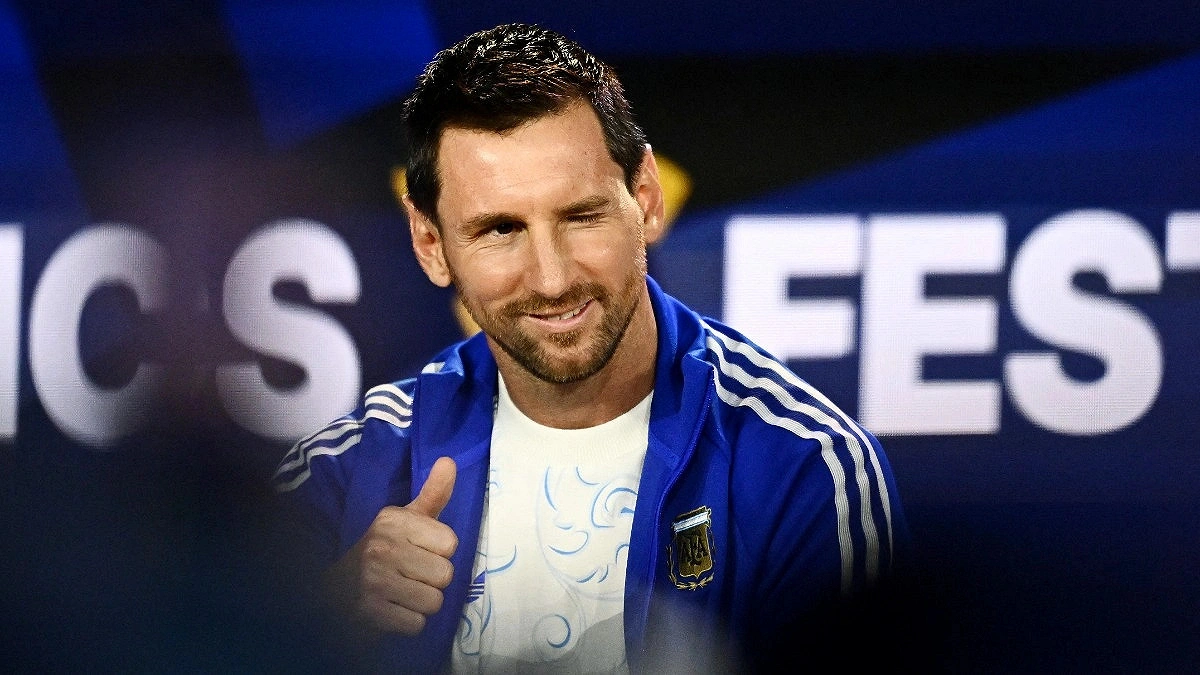
Lionel Messi. Reuters photo.
It started as a joke: will Messi play in the 2030 World Cup? His teammates lightheartedly mentioned that they want him in the squad for the next World Cup. Just casual talk. Mere devotion. Nothing to be taken seriously.
However, looking at the 39-year-old Messi’s performance in this World Cup, the discussion has begun to take a serious turn. The way he has left the tournament's young prodigies behind in the race for the Golden Ball and Golden Boot, and how he has been dribbling like an 18-year-old, has led many to believe that age is leaving no mark on him. Consequently, what was said in jest no longer sounds so lighthearted.
Former England center-back Rio Ferdinand even said on his blog that Messi could easily play as a holding midfielder or a number 8 in the 2030 World Cup. Messi's longtime friend Luis Suárez mentioned having spoken with Messi about the next World Cup, noting that Messi has not made a final decision. Javier Mascherano also chimed in, saying that when it comes to Messi, nothing should be considered impossible.
The 2030 World Cup holds a symbolic significance. It will mark the centenary of the World Cup, hosted across six countries in three continents, including Argentina. If Messi steps onto the pitch for that tournament, it will not just be another World Cup; it will become a unique moment in football history.
The catch is that Messi will be 43 years old during that World Cup. There are very few records of players participating in the World Cup at such an advanced age. Granted, Egyptian goalkeeper Essam El-Hadary was 45 when he took the field in the 2018 World Cup, and Colombian goalkeeper Faryd Mondragón put on his gloves at the age of 43 in the 2014 World Cup. However, it is worth noting that both were goalkeepers, not outfield players who need to run across the entire pitch. The oldest outfield player in World Cup history so far is Cameroon's Roger Milla, who played at the age of 42 in 1994 and even scored a goal. Furthermore, a 41-year-old Cristiano Ronaldo is right before our eyes in this World Cup, and Luka Modrić is now 40.
Situations suggest that despite a wave of requests, Messi will unlikely agree to step onto the pitch again at 43 after achieving so much in football. Yet, it can be said without a doubt that the discussion will happen. The demand will rise, and loudly so. Especially if Messi lifts the World Cup trophy once more, football pundits will definitely sit down to analyze which position would be the most suitable for a 43-year-old Messi.
Lest we forget, even the older Messi's participation in this 2026 World Cup was uncertain. He did not want to. After lifting the World Cup trophy in 2022, Messi had practically said goodbye to the Argentina jersey. At most, it seemed he could be persuaded to stay until the Copa América. In the interim, not once could a clear message be extracted from him confirming he would play. Even last year, when asked about the possibility of playing in this World Cup, his reply was: "Because of my age, the most logical thing is that it won't be possible for me." It goes without saying that convincing that same Messi to participate for a seventh time, skipping past a sixth, will not be easy.
Why Age Becomes an Insurmountable Wall for Footballers Past Forty
For a long time, an unwritten rule regarding age has prevailed in football. It is said that the ages of 27 to 30 represent a footballer’s peak performance time. From 30 to 32, a gradual decline in performance begins. Playing at a high level remains possible between the ages of 33 and 35, but it is highly conditional, requiring immense care and peak physical conditioning. However, after the age of 35, most outfield players either transition to less competitive leagues or retire altogether. For generations, 35 has been viewed as the unwritten glass ceiling of elite football—an inviolable boundary. Just because extraordinary players like Messi or Ronaldo have crossed that threshold does not mean the limit does not exist; they are merely the exceptions, not the rule.
But why exactly 35? This is where physiology and science come into play. Statistics show that after the age of 35, several biological changes occur simultaneously. From this age onward, a person's VO2 Max, or the body’s maximum capacity to utilize oxygen, begins to decline. As a result, sustaining long runs, recovering quickly, and executing high-intensity pressing become incredibly difficult. Furthermore, as age advances, fast-twitch muscle fibers begin to atrophy, making sudden bursts of explosive acceleration nearly impossible.
In football, recovery time—the duration it takes to prepare for the next match after exhausting the body in a previous ninety minutes—is a critical factor. At 20 years old, complete recovery can be achieved within 72 hours. At 43, however, the body requires significantly more time. Yet, in a tournament like the World Cup, players must take the field for their next match within just three to four days.
Data reveals that a top-tier midfielder runs an average of 10 to 13 kilometers per match, which includes 50 to 100 high-intensity sprints. Studies have shown that the frequency of these high-intensity sprints declines fastest with age. On top of that, maintaining the stamina to deliver 30 to 40 identical sprints across a full 90-minute match is no small feat for an aging body.
Football also presents a unique structural challenge. For instance, a professional tennis player might participate in 18 to 20 tournaments a year, and a golfer even fewer. In contrast, a top-flight footballer plays between 50 and 65 club and international matches per season. Combined with extensive travel and daily training, they remain in a state of elite physical exertion for nearly 11 months of the year. Consequently, playing in a World Cup does not just require being fit for a single month; a player must endure this grueling schedule for the three to four years leading up to it.
These demanding factors explain why we rarely see older outfield players at the sport’s highest level. This principle applies not just to football, but to any sport requiring immense physical power and agility. Consider tennis: though Roger Federer played until the age of 41, he did not win another Grand Slam after turning 37. Novak Djokovic similarly saw his historic run slow down after winning the US Open at 37 years and 3 months of age.
On the other hand, it is true that we have seen many cricketers play Test matches up to the age of 40, and excellent golfers can still be found well past 50. This is because these sports prioritize precision and concentration over raw physical endurance. Other sports that share this characteristic include shooting, archery, and equestrian events.
Since chess is a game of the mind, we often think that we would at least find older champions in this sport. Yet, in the modern era of chess, the ages between 20 and 35 appear to be the golden period. Almost all world chess champions have won their first title between the ages of 22 and 34. Viswanathan Anand is the sole exception, wearing the crown at the age of 37. Apart from him, there is no world champion over forty in this era.
Why is this so? It is because crucial factors in chess include pattern recognition, or the ability to identify patterns quickly, which begins to decline with age. Additionally, the capacity for rapid calculation and the ability to maintain intense concentration for extended periods also diminish.
However, it must be remembered that everything discussed so far applies to average players. Messi has proven that he is far from average; he is the exception. If he breaks all records and precedents to step onto the World Cup stage at 43, it will undoubtedly be a stupendous event in the history of sports, but not entirely impossible. Nevertheless, there is no room for doubt that the playing style of Messi at that age will change significantly. Truth be told, Messi has been continuously adapting his style over the last decade. A new trend in football, often termed "walking football," is emerging directly through him as he ages. He is steadily increasing the use of his brain on the pitch.
Yet, it can be said with certainty that the Messi who takes the field in 2030 will not be placed in the starting lineup for every match by the coach. Even in the matches where he does play, we will likely see him on the pitch only for the final 20 to 30 minutes. We will see him as a set-piece specialist. Messi's role will be to alter the course of the game, much like the veteran impact players in America's premier basketball league, the NBA, who come onto the court for 15 to 20 minutes to change the momentum of the game.
Human creativity and capability have no fixed age. The French poet Rimbaud transformed literature by the age of twenty. On the other hand, Rabindranath Tagore began writing a new genre of poetry and painting strange, wondrous pictures after crossing seventy. In sports, however, one cannot simply bypass the physical body. If Messi plays in the World Cup at the age of 43, he will certainly not be the 22-year-old Messi. But on the football pitch, he will surely innovate a path of his own.


