

Tsunami on March 11, 2011
The Entire Japan Moved in 15 Minutes – Is That Even Possible?

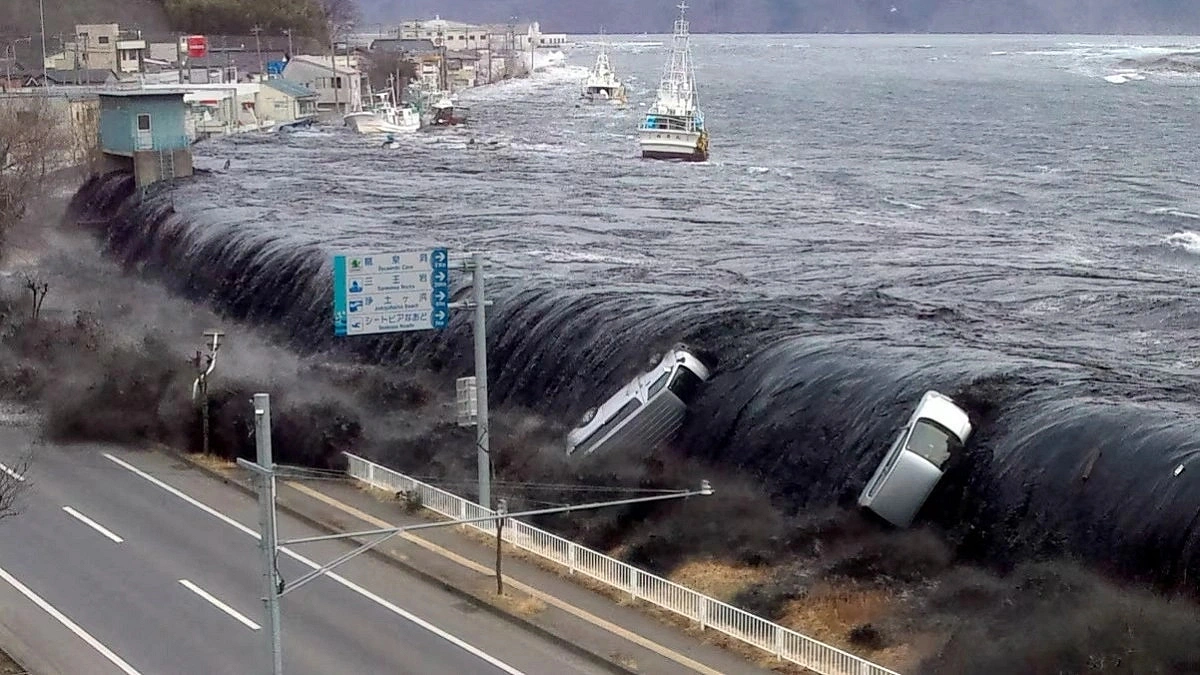
Collected Photo
It was March 11, 2011. At 2:46 PM local time in Japan, a massive magnitude-9.0 earthquake suddenly struck off the country's northeastern coast.
Within minutes, a gigantic tsunami was generated, and the Fukushima nuclear disaster began. The event, which claimed the lives of nearly 20,000 people (dead and missing), is still remembered today as one of the most catastrophic disasters in Japan's history.
But that earthquake held another mystery – one that scientists have only unraveled 15 years later.
Approximately 15 minutes after the earthquake began, almost the entire Japanese archipelago shifted slightly eastward simultaneously. The shift was minuscule – only about 5 to 6 millimeters. So small that, at the time, many dismissed it as a GPS instrument error or a data glitch.
However, Sun-young Park, a geophysicist at the University of Chicago, took the matter seriously. He felt that there must be a real physical reason behind this signal. He and his colleagues spent years analyzing GPS and seismic data. Eventually, they discovered a phenomenon that had never been observed before.
According to the researchers, the most astonishing part was that such a vast area of Japan moved at the same time, in nearly the same way. This shift was observed across a distance of about 3,000 kilometers, from Hokkaido in the north to Kyushu in the south. Yet, it did not occur during the main shock, nor was it related to any major aftershock.
So, what actually happened?
According to the researchers' explanation, certain powerful seismic waves generated by the earthquake traveled deep into the Earth. They reached the outer layer of the Earth's core and then bounced back. When these waves, having completed their round trip through the deep Earth, struck the crust again, they caused simultaneous movement at the junctions of various tectonic plates across Japan.
Scientists already knew that waves from large earthquakes could travel deep into the Earth and be reflected to the outer core. But until now, it was believed that the energy would have largely dissipated before returning, having little to no effect on the surface. This new research suggests that, at least in the case of the 2011 Japan earthquake, that wasn't the real scenario.
According to Sun-young Park, 'This is the first time we have proof that seismic waves returning from the Earth's deep interior can cause simultaneous movement across such a large area.'
Typically, large earthquakes cause the ground to rupture, land to shift, or changes in the crust of a specific area. In the 2011 earthquake, the two tectonic plates beneath Japan shifted by about 10 meters. This also caused Japan's main island, Honshu, to move about 20 centimeters eastward.
But the displacement highlighted in the new research was of a different type. Although it was only a few millimeters, its extent was vast. According to the researchers, such a simultaneous movement across such a large area has never been recorded before. Even the energy released was roughly equivalent to a magnitude-7.5 earthquake.
Scientists believe this discovery could be significant for the future. Unlike aftershocks, the path of these waves that travel to the Earth's core and back can be calculated to some extent. It takes about 15 minutes for these waves to reach the deep Earth and return. Therefore, it might become possible to get early warnings about the risk of such events in the future.
However, the researchers caution that this phenomenon shouldn't be directly compared to a regular magnitude-7.5 earthquake. Because its energy was spread over a vast area, it did not cause the intense, localized destruction that a normal earthquake of that magnitude would.
The study found that various junctions of the Pacific, Okhotsk, Philippine Sea, and Eurasian plates felt the effect of this movement at that time. Scientists speculate that the violent tremors of the main earthquake had already destabilized these faults. Later, the waves returning from deep within the Earth reactivated those faults.
Vedran Lekic, a geoscientist at the University of Maryland, believes that this event was captured due to Japan's advanced observation system. Such events may have occurred elsewhere in the world, but they might not have been detected due to a lack of adequate instruments.
Researchers also examined several other possibilities, such as underwater landslides. But the effects of such events are usually confined to specific areas. Therefore, it couldn't explain the uniform displacement observed across Japan.
According to Amanda Thomas, a geophysicist at the University of California, this research delivers an important message. The impact of a major earthquake does not end immediately with the main shock. Rather, the waves returning from the Earth's deep interior can also create new movements much later.
In her words, scientists still don't know everything about how faults or fracture lines work on Earth. However, this new discovery has provided another important clue to that complex mystery.

