


Contractor vanishes leaving Tk 177-crore bridge project stalled on the Meghna

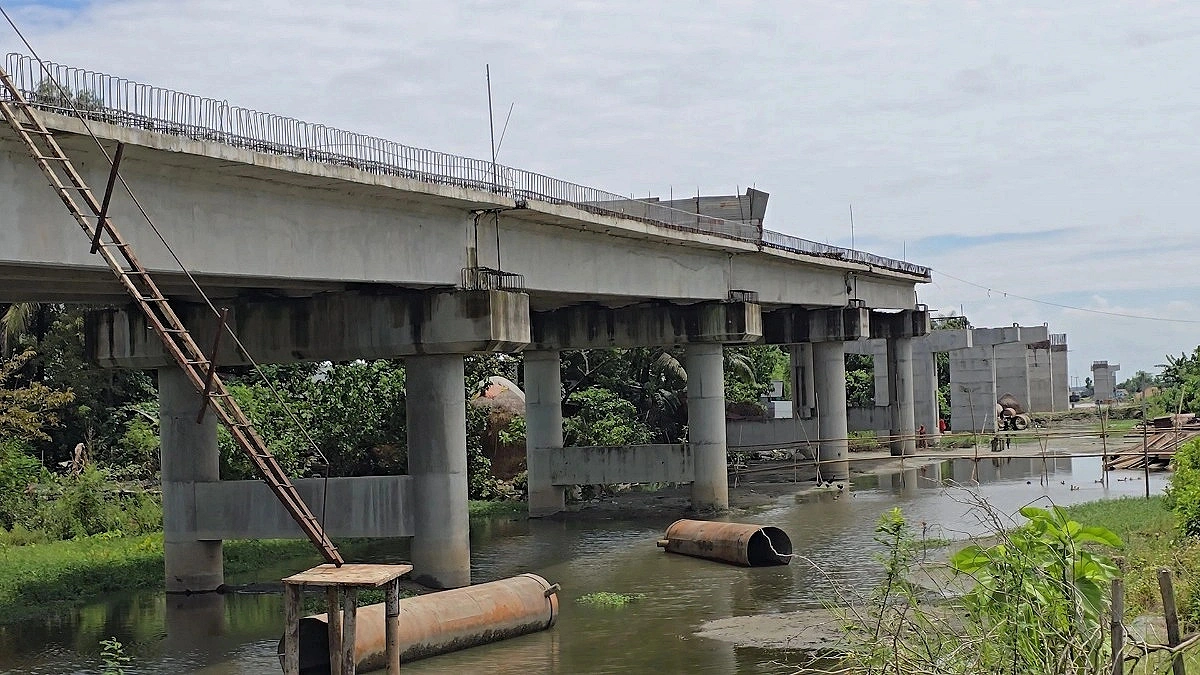
Photo: Agamir Somoy
A bridge over the Meghna was supposed to change the lives of the Haor residents. The people of Astagram, Itna, and Mithamain in Kishoreganj had nurtured this dream. Construction of the Bangalpara-Chatalpara Bridge began at a cost of Tk 177 crore. One by one, pillars rose from the riverbed.
But just as about 40 percent of the work was completed, construction came to a halt. Now, the incomplete pillars standing in the Meghna bear witness to the stalled dreams of the Haor people.
Work on the under-construction Bangalpara-Chatalpara Bridge, connecting Astagram in Kishoreganj and Nasirnagar in Brahmanbaria, has been stopped for nearly five months. No personnel from the contractor firm are present at the site. Millions of taka worth of construction materials and equipment lie abandoned. Locals fear that these materials may be damaged due to prolonged exposure to the open sky.
According to LGED sources, the bridge was planned to be 1,000 meters long over the Meghna River, extending from Noagaon in Bangalpara Union of Astagram Upazila to Durgapur in Chatalpara Union of Nasirnagar Upazila. In 2023, the contractor firm Toma Construction was awarded the project for Tk 177 crore.
After work began, construction progressed rapidly. Pillars emerged one after another on the Meghna. This instilled hope among the people of Astagram, Itna, and Mithamain. They began dreaming of breaking free from the long-standing water-dependent transport system and gaining direct road connectivity with various regions of the country.
However, following the change in the country's political landscape, the project's situation changed. After the owner of the contracting firm went into hiding, construction slowed down. Eventually, work stopped completely.
Locals claim that no work has been carried out at the site for the past five months. Personnel from the contractor firm have also left the site.
If the bridge were completed, locals hoped it would ease road communication from Astagram, Itna, and Mithamain to Dhaka, Sylhet, Chattogram, and other parts of the country via Nasirnagar in Brahmanbaria. This would reduce travel time and suffering, while creating new opportunities in agriculture, education, healthcare, and trade.
Haor farmers would be able to easily transport paddy and other agricultural products to larger markets. Emergency patients could be taken to cities more quickly for advanced treatment. Students' commuting would also become easier. At the same time, the scope of business and commerce in the Haor region would expand.
Local resident Anisur Rahman said that the people of the Haor have many dreams tied to the bridge. If the bridge is completed, they will be able to connect with the city by road throughout the year. Agricultural products could be easily marketed. Critical patients could be taken to hospital quickly, and educational opportunities would also increase. But with work stalled for five months, those dreams have also remained frozen.
Another resident, Usman Mia, said the bridge has been a long-cherished dream for the Haor people. He has given up a lot of his land for the bridge. He is uncertain whether he will live to see the bridge operational, given his age. However, he hopes that the next generation will be able to connect with the city by road all year round.
Jahangir Alam Bulbul, an engineer from the contractor firm that was in charge of the construction, said he left his job about a month and a half ago and moved elsewhere. He is not aware of the current status of why the project work is stopped. He no longer has any contact with the contractor firm.
Mozammel Haque, the LGED Upazila Engineer of Astagram, stated that out of the Tk 177 crore project, the contractor firm has so far withdrawn Tk 35 crore in bills. Toma Construction has violated the contract and left the work incomplete.
He further mentioned that after the fall of the government, the owner of the contractor firm went into hiding, causing the work to slow down. For the past five months, work has been completely stopped. Personnel from the contractor firm have left, abandoning construction materials and equipment at the site.


