

Invasive Sucker Fish Overtake the Shitalakshya

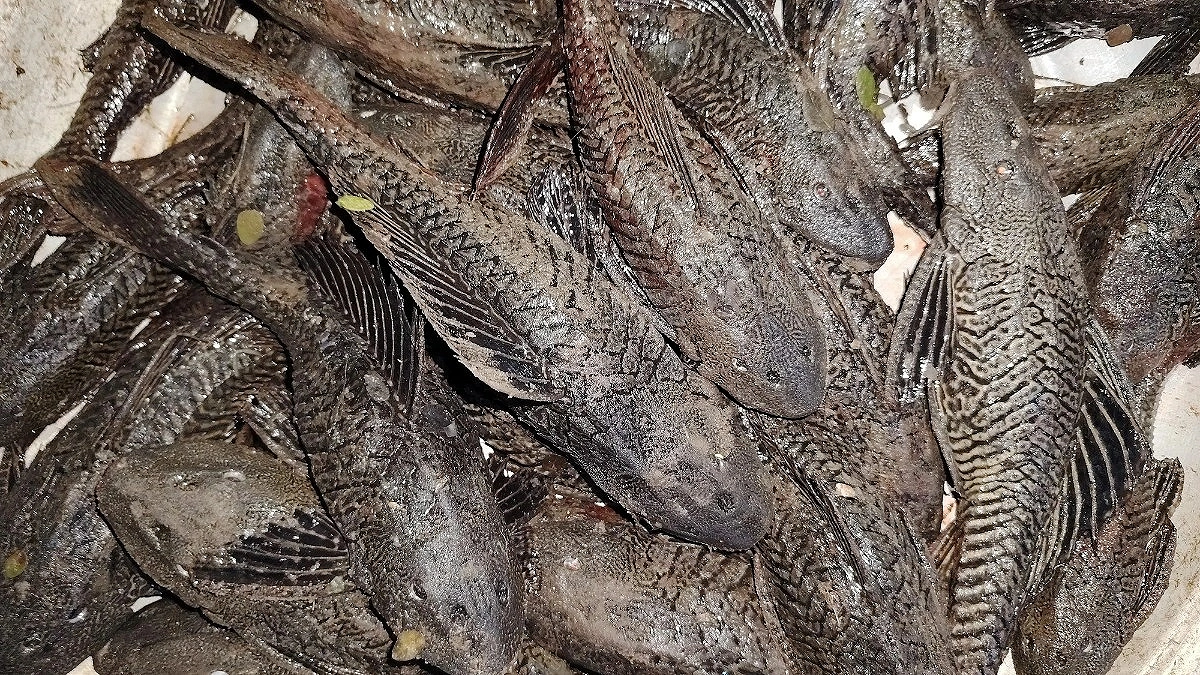
Photo: Agamir Somoy
The first light of dawn had yet to fully break. A thin blanket of mist floated over the Shitalakshya River in Kaliganj, Gazipur. Standing on the riverbank, fisherman Liton Mia slowly arranged his old fishing net. His eyes reflected memories of years spent on the river, days when casting a net into the Shitalakshya would bring up rohu, catla, boal, tengra, and shoal fish in abundance.
After casting his net, Liton waited for a while. When he slowly pulled it back, disappointment spread across his face. No silvery native fish shimmered in the net. Instead, it was filled with strange, dark-colored fish covered in hard armor-like shells and sharp spines, creatures that looked like monsters from beneath the water.
Letting out a sigh, Liton Mia said, “This river once supported our families. Now every time we cast a net; we catch only sucker fish. Native fish seem to have disappeared.”
For the past week, he has caught between 5 and 20 kilograms of sucker fish in his nets every day. Yet no one wants to buy them. Looking at piles of the fish lying along the riverbank, he said in frustration, “I am catching fish, but I can’t sell them. It feels like all my effort is going to waste.”
Scenes like this have now become a daily reality along the banks of the Shitalakshya. Aman Mia, another resident of the area, often fishes recreationally with a cast net. He, too, entered the river with his net recently but failed to find the native fish he was hoping for.
“Wherever I throw the net, these spiny fish come up,” he said. “A single haul can bring in three to four kilograms of sucker fish.”
According to him, the fish are not only hurting fishermen but also altering the river’s natural environment. Even after people remove them from the river and leave them on the bank, they remain alive for hours.
Aman Mia voiced his concern, saying, “People do not eat them, and there is no market for them. But they are so resilient that they are taking over the river.”
Saifur Rahman, a resident of Bhadartti Dakshinpara village along the Shitalakshya in Kaliganj, sees a vast difference between the river of his childhood and the river today.
“Schools of small native fish used to be visible in the river,” he said. “Now we see almost nothing except sucker fish.”
He alleged that the fish consume the eggs of native species and compete for food resources needed by other fish.
Standing nearby, his friend Al Amin Sarkar Sumon added, “Just looking at them is frightening. They seem like underwater monsters. Since these fish arrived, small native fish have become increasingly rare.”
Another villager, Monir Hossain, fears an even greater threat.
“Industrial waste has already made the river sick,” he said. “If these fish wipe out native species as well, no native fish will remain in the Shitalakshya in the future.”
Locally known as “sucker fish,” the species is native to South America. Many people keep them in aquariums because they feed on algae and help keep tanks clean. However, after being released into natural water bodies, the fish spread rapidly.
Experts say sucker fish are highly resilient and invasive. They can survive in waters with low oxygen levels, reproduce quickly, and feed on aquatic plants, algae, fish eggs, and small aquatic creatures. As a result, they significantly disrupt the food supply and breeding systems of native fish species.
Kaliganj Upazila Fisheries Officer Abu Sama said, “Sucker fish are an invasive foreign species. They pose a threat to the river’s natural ecosystem. Native fish populations are declining rapidly because these fish consume their eggs and food sources.”
He noted that the spread of sucker fish is no longer limited to the Shitalakshya and is now visible in rivers and canals across the country.
Local representatives of the river conservation volunteer organization Bangladesh Nodi Poribrajok Dal said expressing concern alone is not enough and that practical measures are now needed. Local leaders of Bangladesh Poribesh Andolon (BAPA) echoed the same view.
Discussions with experts and local residents highlighted several possible solutions.
Authorities should launch special operations to remove sucker fish from rivers through coordinated efforts between the Fisheries Department and local administrations. Incentives could encourage fishermen to catch larger quantities of the fish.
Although local communities do not traditionally consume sucker fish, some countries use them in animal feed and fish feed production. Researchers believe identifying alternative uses for the species could help reduce fishermen’s losses.
Experts also noted that sucker fish thrive in polluted, low-oxygen waters. Effective measures to control industrial waste and restore the river’s natural environment are therefore essential.
Public awareness campaigns should discourage people from releasing non-native aquarium fish into rivers, canals, and wetlands. In many cases, human negligence has contributed to the spread of the species.
Stakeholders also believe that releasing native fish fry into rivers and creating protected breeding grounds could gradually restore ecological balance.
The Shitalakshya was once a river of hope for fishermen. Today, it seems to be silently calling for help. Across its pollution-stricken waters, an unwelcome invader, the sucker fish, now reigns.
Yet every dawn, Liton Mia, Aman Mia, and others still walk toward the river with nets on their shoulders. Perhaps they still hold on to a small hope that one morning they will pull up their nets and once again see the shimmer of native fish.
But one question now echoes across the waters of the Shitalakshya, will the dominance of the ravenous sucker fish drive the river’s familiar native species into disappearance?

