
What the PoJK Protests Tell the World

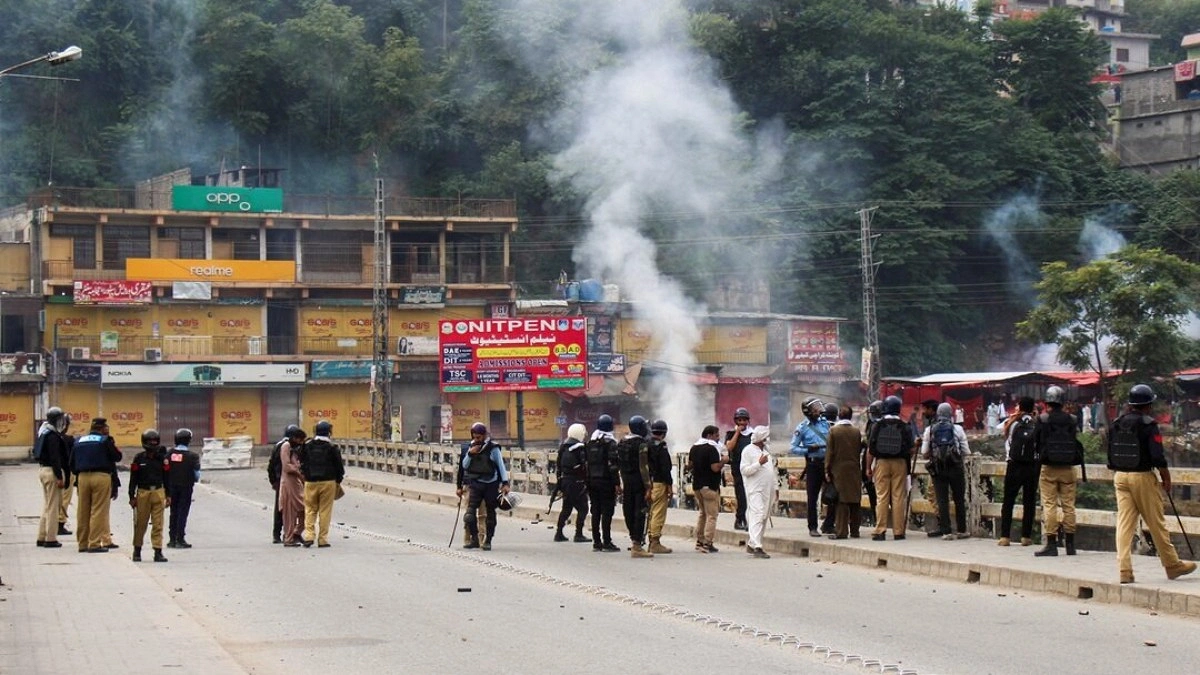
Photo: Reuters
Pakistan has spent decades telling the world that Kashmir is a disputed territory under Indian occupation and that the Kashmiri people are denied their rights, their voice, and their future. It is a narrative Pakistan has rehearsed at the United Nations, in bilateral conversations with Western governments, and in every available multilateral forum. What is happening right now in Pakistan-occupied Jammu and Kashmir tears that narrative apart in the most public way imaginable.
Since early June, Pakistani security forces have clashed with protesters across PoJK in scenes that have drawn international attention and condemnation. Official figures place the death toll at seven, with over seventy injured. Multiple credible media reports put the numbers considerably higher, around 27 dead and nearly 200 injured.
A Movement Rooted in Ordinary Grievances
The protests did not emerge from nowhere, and understanding their origins matters. Their roots go back to 2023, when residents first took to the streets over electricity bills they could not pay and flour they could not access. These were not political provocations; they were the frustrations of ordinary people who cannot pay their electricity bills and cannot hold their government accountable because that government ultimately answers to Rawalpindi rather than to the people it administers.
By 2025, the Joint Awami Action Committee (JAAC), a broad coalition of traders, lawyers, transporters, students, and civil society groups, had formalised those frustrations into a 38-point charter of demands: economic subsidies, governance reforms, accountability for corrupt officials, fairer political representation. Ordinary asks, by any reasonable measure.
Pakistan's response was to designate the JAAC a prohibited organisation under anti-terror legislation. Its leaders were arrested. Bounties were placed on their heads. Communications blackouts were imposed. Security forces were deployed against people marching for subsidised wheat and lower utility bills. Amnesty International described the crackdown as unlawful and disproportionate, accusing authorities of using excessive force and suppressing fundamental rights ahead of upcoming regional elections. These are not the hallmarks of an administration responding to a genuine security threat. They are the hallmarks of one that has run out of legitimate answers to legitimate questions and reached for the only tool it had left.
The View from New Delhi
From India's standpoint, what is happening in PoJK carries a weight that goes beyond geopolitical calculation. In India's constitutional and legal framework, Jammu and Kashmir, including the portions administered by Pakistan, is an integral part of the union. The people of PoJK are not, from New Delhi's perspective, someone else's citizens caught in someone else's crisis. India has condemned the violence, and that condemnation reflects something more than strategic positioning. It reflects a view, consistently held and constitutionally grounded, that these are people India regards as its own.
India has argued for decades that Pakistan's relationship with PoJK is one of control rather than stewardship and that behind the language of Kashmiri solidarity lies a more uncomfortable reality of political marginalisation, economic extraction, and an administration whose real loyalties lie with the Pakistani establishment, not with the population it governs. That argument has always been difficult to land internationally, not because it lacks substance but because Pakistan has been adept at shaping the broader Kashmir narrative on its own terms, in its own language, through its own channels.
What is different now is that India does not need to make the argument at all. The people of PoJK are making it more powerfully and more visibly than any diplomatic note or UN statement ever could. Thousands gathered in Rawalakot carrying banners calling for accountability and civil rights. British MPs expressed concern. The Kashmiri diaspora organised protests in the United Kingdom. Human rights organisations arrived at their own conclusions independently. None of this was orchestrated from New Delhi. It emerged from what people around the world observed directly, on their screens, in real time.
There is a quiet but significant weight to that. Arguments that must be made loudly and repeatedly are always more fragile than those that simply become self-evident.
The Contrast That Speaks for Itself
In Jammu and Kashmir, elections have recently been held. Democratic institutions are functioning. Civil society operates with a degree of freedom that was unimaginable a decade ago. In PoJK, a grassroots organisation has been banned under anti-terror laws for demanding flour subsidies, its leaders are being hunted, its protesters have been shot, and its communications severed. The international community is looking at both sides of that picture and drawing its own conclusions, without anyone in New Delhi having to guide them there.
Pakistan's Kashmir narrative has always rested on a particular self-image: the aggrieved advocate, the principled voice of a people denied their fundamental rights. That image is considerably harder to sustain when your security forces are opening fire on those very people in Rawalakot and placing bounties on the heads of their elected representatives. The gap between the narrative and the reality on the ground has rarely been this visible, this well-documented, or this widely reported.
What This Moment Reveals
The people of PoJK are demanding affordable electricity, accountable governance, and the right to organise peacefully without being labelled terrorists. That is the self-determination Pakistan promised them for decades, and that is precisely what they are now trying to exercise, against Pakistan itself.
The Kashmiri people on both sides of the Line of Control share a cultural inheritance that predates the political lines drawn around them. Language, tradition, shared history, these connections have never gone away, regardless of the arrangements imposed over decades of conflict and partition. The events of June 2026 are a reminder that political narratives, however carefully maintained and however fluently delivered to international audiences, eventually have to answer to the people they claim to represent.
The world is watching what is happening in PoJK. It is forming its own view. And that, perhaps more than anything that could be said from New Delhi, is what makes this moment matter.
The author is a geopolitical analyst based in Canada and holds a PhD in International Relations from the Centre for the Study of the Americas at Jawaharlal Nehru University.
The views and opinions expressed in this article are those of the author and do not necessarily reflect the views or editorial position of this publication.
