
The magic of power that transforms 10 share prices

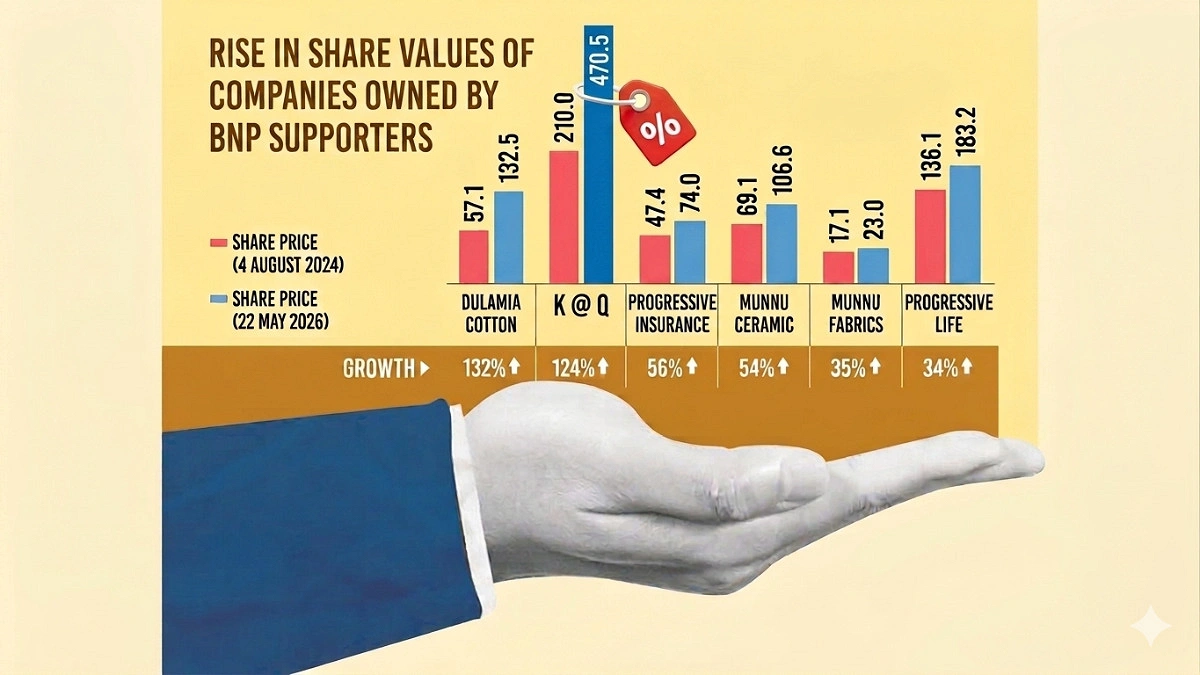
Graphics regenerated by AI.
Stock Price Surges of Companies Owned by BNP Supporters
Following the fall of repressive Alami League government that was ousted on 5 August 2024.
After Awami League government's fall, BNP gradually began to taste the power again. That trajectory culminated formally at the peak of power through the national election held on February 12 this year. However, in the stock market, share prices of various companies linked to BNP leaders began rising immediately after the fall of the Awami League government.
Commenting on the issue, Professor Al-Amin of the Department of Accounting at University of Dhaka told Agamir Somoy: “Even before the election, we observed abnormal price hikes in the shares of some companies identified as BNP-leaning. Such increases are not normal market behavior. A manipulation syndicate is actively at work here. The regulatory bodies—Bangladesh Securities and Exchange Commission (BSEC) and the surveillance system of the Dhaka Stock Exchange (DSE)—have the capacity to identify who is involved in these trades. Yet the lack of effective action raises serious questions. Steps should be taken before investors suffer major losses.”
According to available information, companies owned or operated by several BNP leaders are listed on the stock market. These include Environment, Forest and Climate Change Minister Abdul Awal Mintoo; Civil Aviation and Tourism Minister Afroza Khanam; BNP Standing Committee member Mirza Abbas Uddin Ahmed; former minister Mizanur Rahman Sinha; Member of Parliament Saeed Ahmed; and Member of Parliament Mohammad Fakhrul Islam.
Among the listed companies under Abdul Awal Mintoo’s control are K&Q Bangladesh, Dulamia Cotton, National Bank, Pragati Insurance, and Pragati Life Insurance. Afroza Khanam is associated with Munno Ceramics, Munno Agro and General Machinery, and Munno Fabrics. Mirza Abbas Uddin Ahmed is linked to Dhaka Bank; Mizanur Rahman Sinha to Acme Laboratories; MP Saeed Ahmed to Global Insurance; and MP Mohammad Fakhrul Islam to Far East Islami Life Insurance.
Out of these companies, 9—about 75 percent—have seen their share prices rise since the fall of the Awami League government. The sharpest increase was recorded by Dulamia Cotton: its share price jumped 132 percent, from Tk 57.10 on August 5, 2024, to Tk 132.50 as of Monday. K&Q Bangladesh followed, with its share price rising 124 percent from Tk 210 to Tk 470.50. Pragati Insurance ranked third, with a 56 percent increase from Tk 47.40 to Tk 74.
Additionally, Munno Ceramics rose 54 percent from Tk 69.10 to Tk 106.60; Munno Fabrics increased 35 percent from Tk 17.10 to Tk 23; Pragati Life Insurance climbed 34 percent from Tk 136.10 to Tk 183.20; Dhaka Bank rose 13 percent from Tk 10.70 toTk T 12.10; Acme Laboratories gained 12 percent from Tk 67.60 to Tk 75.80; and Global Insurance advanced 12 percent fromTk 28.10 to Tk 31.40.
Regarding the matter, Minhaj Mannan Emon, a director of the Dhaka Stock Exchange (DSE), told Agamir Somoy:“During political transitions, the share prices of companies owned by such individuals are influenced primarily by psychological factors. Investors tend to believe that companies linked to opposition political figures face various difficulties, but once those figures come to power, their companies receive advantages and facilities. For these reasons, investors assume that companies owned by newly empowered political figures will perform well, invest in them, and as a result share prices rise.”
He added: “It is not always the case that companies owned by political figures who come to power will perform well in business. In such situations, investors themselves must remain cautious before investing. There are certain groups that wait not only for changes in political power but also for various issues to engage in manipulation.”
The validity of the DSE director’s remarks is reflected in the abnormal price increases of Dulamia Cotton and K&Q Bangladesh. DSE investigations have found that the share prices of these two companies rose at unusually high rates without any fundamental justification. Even the authorities of both companies expressed surprise and concern over the surge in their share prices, which was published on the DSE website.
It is learned that in August last year, the DSE authorities sought explanations from the managements of Dulamia Cotton and K&Q Bangladesh regarding the rise in their share prices. In response to the DSE’s query, the companies stated that they themselves were surprised and concerned by the increase, as there had been no operational or structural changes in their businesses that could justify such a rise.
Moreover, although the board of K&Q proposed issuing bonus shares, the Bangladesh Securities and Exchange Commission (BSEC) blocked the move due to discrepancies in the company’s financial accounts. After reviewing K&Q’s financial statements for the 2024–25 fiscal year, the board declared a 6 percent bonus dividend for shareholders, but BSEC did not approve its distribution. The company later appealed the decision but failed to obtain approval.
BSEC cited insufficient retained earnings and various objections raised by auditors in the audit report as the reasons for its decision.
Commenting on the issue, BSEC Director and spokesperson Md. Abul Kalam told Agamir Somoy:
“The Commission is working to maintain discipline in the stock market and uphold investor confidence. Companies whose share prices are rising abnormally are under surveillance. If any fraudulent activity or manipulation is detected behind such price increases, BSEC will investigate and take necessary action.”
