

How Bangladesh Plans to Build Border Fences along India and Myanmar Frontiers

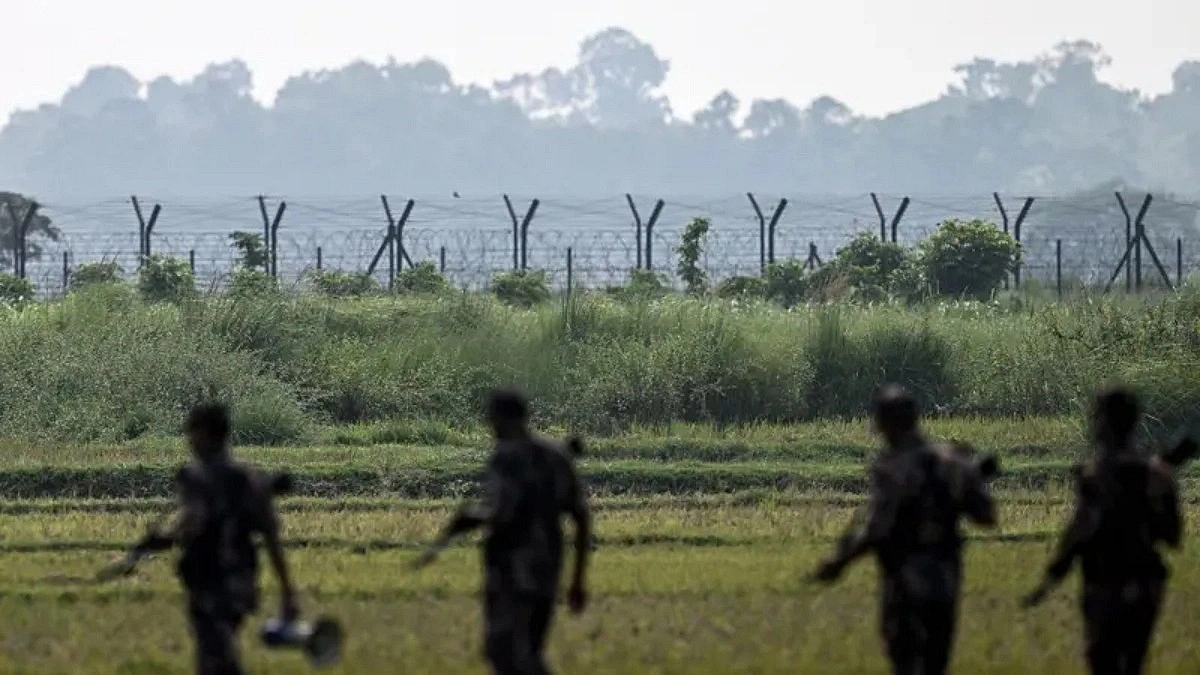
Barbed-wire fence along the Bangladesh-India border.
Home Affairs Adviser Salahuddin Ahmed has announced plans to construct barbed-wire fences along parts of Bangladesh’s borders with India and Myanmar to curb border killings, illegal crossings, and transnational crimes.
Responding to a question placed before Parliament on Wednesday, the adviser said initiatives have been taken to build fencing along the Myanmar border, while plans to install barbed-wire barriers at sensitive sections of the India border are currently under consideration.
The announcement has raised questions about how such fencing can be built, whether international rules apply, and whether consultations with neighboring countries are required.
What does international law say?
There is no universal international law governing the construction of border infrastructure. Sovereign states generally have the authority to build structures within their own territory for security and migration control purposes.
In some cases, border construction is guided by bilateral agreements. Under the 1974 agreement between Bangladesh and India, neither side can build defense-related structures within 150 yards of the zero line. Development projects within that area also require consent from the other side.
However, Professor Shahab Enam Khan of Jahangirnagar University’s Department of International Relations said that constructing border fencing for security purposes falls within a state's sovereign jurisdiction. As a result, neighboring countries have limited grounds to object.
He noted that while there is an international norm discouraging the construction of physical barriers during humanitarian crises or wartime situations, Bangladesh would not be violating any rules by pursuing the initiative, particularly because India has already fenced large portions of its side of the border.
According to the professor, concerns over forced push-ins from India have turned the issue into a matter of national security, making the proposal both reasonable and justifiable.
“While it does not violate international law, it may run contrary to certain international practices. Even so, the position outlined by the home affairs adviser remains within both national and international legal frameworks,” he said.
Former ambassador Munshi Faiz views border fences as a sign of declining trust between neighboring countries.
“If one or both countries build fences or similar barriers, it clearly reflects a lack of mutual confidence,” he said.
Technology may be a better solution
On April 26, the Executive Committee of the National Economic Council (ECNEC) approved the second phase of a border road construction project along the Bangladesh-Myanmar frontier, with an estimated cost of Tk 36.66 billion.
The first phase had earlier been approved with a budget of Tk 38.61 billion. Officials say fencing can be installed quickly once the border road network is completed.
A similar process would be required along the India border, including land management, road construction, and installation of fencing infrastructure, all of which would require substantial funding.
The home affairs adviser told Parliament that fencing is being considered only for sensitive areas along the India border.
He said the Border Guard Bangladesh (BGB) is implementing integrated measures to safeguard national interests and reduce crime in border regions.
Observers argue that technological solutions such as drones and artificial intelligence-based surveillance may be more effective than physical barriers.
“Strengthening monitoring capabilities is more important than erecting barbed-wire fences,” said Professor Shahab Enam Khan. “The goal should be to prevent illegal crossings and criminal activity without creating human rights concerns.”
He added that enhanced surveillance could help combat smuggling and other illegal activities while avoiding the international criticism often associated with border fences.
The adviser also noted that Border Outposts (BOPs), Temporary Operating Bases (TOBs), and Smart Border Surveillance Systems have already been established in highly sensitive areas along the country’s southwestern and northwestern frontiers.
How India's border fencing works?
Indian Home Minister Amit Shah previously told Parliament that the India-Bangladesh border in West Bengal stretches 2,216 kilometers. Of that, 1,653 kilometers have already been fenced, leaving about 563 kilometers without fencing.
Under a 2021 directive from India’s Ministry of Home Affairs, the operational jurisdiction of the Border Security Force (BSF) was expanded from 15 kilometers to 50 kilometers from the international border in several states, including West Bengal and Assam.
In accordance with the 1974 Bangladesh-India agreement, no permanent structures can be built within 150 yards of the zero line.
Landowners whose farmland lies between the border fence and the zero line are allowed to access their fields through designated gates. Farmers must register with BSF personnel, present identification, and return before the gates are closed in the evening.
The BSF also imposes restrictions on certain crops. For example, it discourages jute cultivation because tall plants can obstruct visibility and surveillance operations. The policy has drawn criticism from local farmers.
Residents living outside the fenced area are subject to similar procedures. They must register and present identification when crossing through the gates. Medical emergencies during nighttime hours have occasionally created difficulties, although local authorities have sometimes opened gates after receiving appropriate authorization.
The proposed Bangladeshi initiative is still in its early stages, but officials say it forms part of a broader effort to strengthen border security and address cross-border challenges.
Source: BBC ( Adapted)

