
One measles patient can infect 12 to 18 others

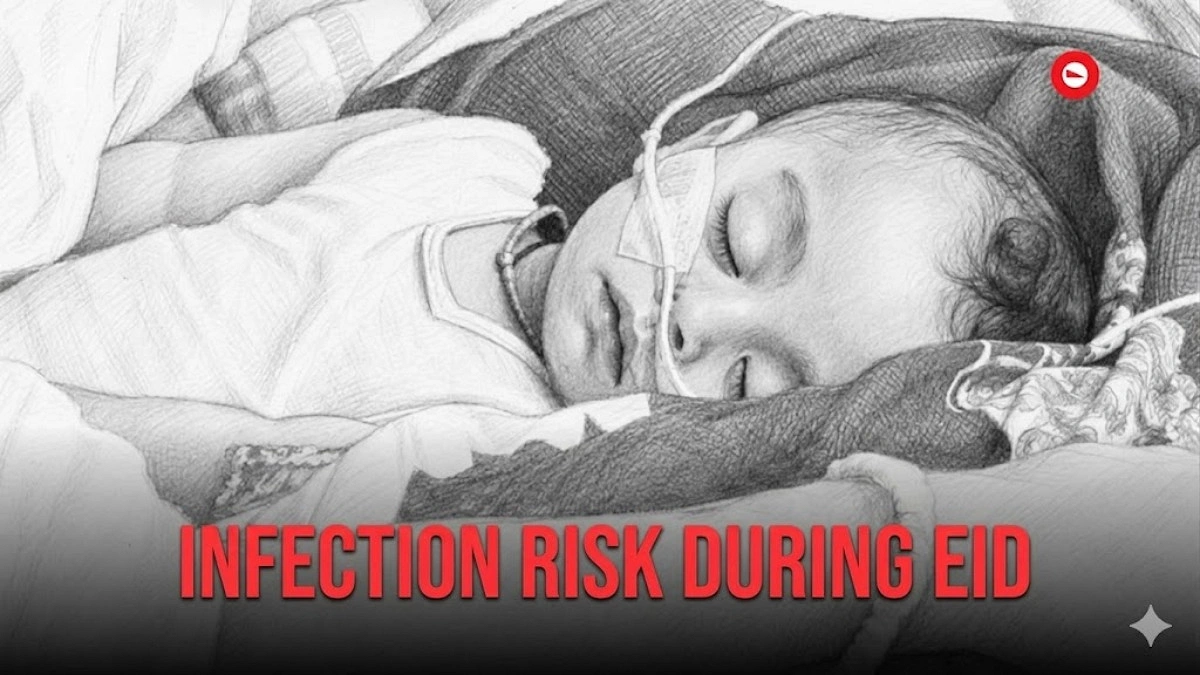
Agamir Somoy graphics renegerated by AI.
Measles is a highly contagious disease. From a single infected person, the virus can spread to 12 to 18 others. With increased travel and social interaction during the upcoming Eid holidays, public health experts fear a further surge in infections.
They warn that hospital-based care alone is no longer sufficient to manage the growing number of measles patients. To mitigate deaths, they say, temporary hospitals must be set up quickly at the community level, and anyone—especially children—who develops a fever should be immediately isolated.
Experts believe the measles situation in the country has now reached epidemic proportions. Alongside rising infections, deaths are also increasing sharply. This month, an average of 15 children are dying each day, up from nine per day last month. Public health specialists note that child mortality from measles is higher in Bangladesh than in many other countries. As completely stopping transmission has become difficult, they stress that the top priority must be reducing child deaths.
According to Mushtaq Hossain, former chief scientific officer of the Institute of Epidemiology, Disease Control and Research, measles has clearly entered the epidemic stage. “Infections will happen,” he said. “The key goal now should be ensuring that patients do not die. That requires bringing them under medical care before their condition becomes critical.”
Mushtaq Hossain added that malnutrition is a major cause of measles-related child deaths. Children from poor, floating, and slum communities in both rural and urban areas are at the highest risk. Many families cannot arrange proper isolation at home. For this reason, he suggested setting up tent-based temporary hospitals near existing hospitals, which would allow faster treatment while also reducing pressure on main facilities.
At the Bangladesh Shishu Hospital and Institute, a 10-month-old child, Mohammad Bayezid, received measles treatment after being admitted for 10 days. During the same period, his two older siblings were treated for the same disease at Sirajganj Sadar Hospital. Bayezid’s mother, Khadija Begum, said her youngest child was infected first, followed by the other two. “I didn’t know measles was so contagious,” she said. Treating her children in two different cities left the family exhausted, and the costs were substantial.
Veteran public health professional Mohammad Iqbal, who has worked in the field for more than four decades, said temporary hospitals can indeed be set up using tents. In this regard, he noted, the experience of icddr,b could be utilized. He also suggested converting community centers, large vacant buildings, or markets into temporary treatment facilities where infected patients could receive essential healthcare.
Public health experts emphasize that urgent preparations are needed now to control infections before and after Eid. If rapid case detection, isolation, treatment, and nutritional support can be ensured at the community level, they believe measles-related child deaths can be significantly reduced.
