

Says Professor Dr. Khaliquzzaman Elias
'I was most influenced by my elder brother, Akhtaruzzaman Elias'
- An Interview with famous writer Akhtaruzzaman Elias' younger brother Prof. Dr. Khaliquzzaman Elias

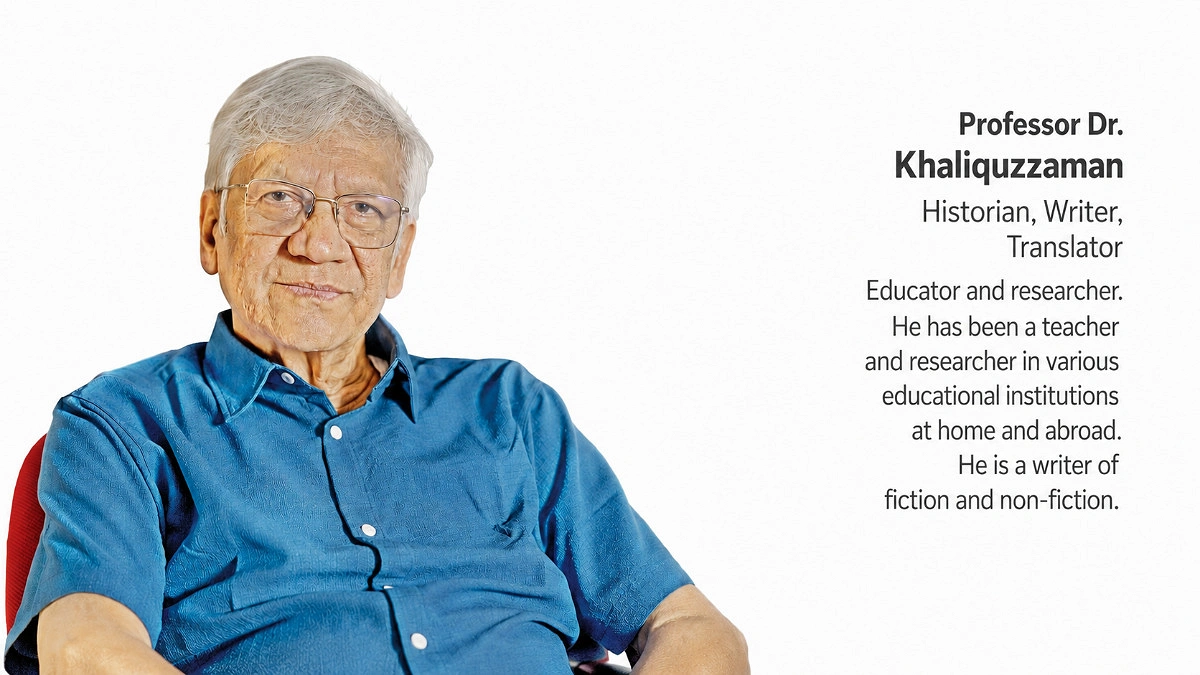
Prof. Dr. Khaliquzzaman. Photo: Sajjad Hossain.
Please tell us where were you born?
I was born on April 20, 1949, at the Mitford Hospital in Dhaka. At that time, my father, B.M. (Badiuzzaman Mohammad) Elias, was a Member of the Legislative Assembly (MLA) of East Pakistan. Habibullah Bahar Chowdhury was the Minister of the Health Department back then, and my father served as the Parliamentary Secretary for that very department. I was born at Mitford Hospital to my mother, Mariam Elias, delivered by Dr. Shirin Kazi. She and her sister, Dr. Zohra Kazi, were likely the first Bengali Muslim female doctors.
Father or mother—who played a bigger role in your upbringing?
My mother was a private person; she quietly managed and controlled everything in the family from behind the scenes. Whatever education and values we received, you could say it was all because of her. My father often didn't even know which class each of us was studying in. It was my mother who gave me my early lessons. I remember she used to tutor me herself up to Class 4 or 5. She had only completed primary school, but she had been reading Bankimchandra, Rabindranath, and Saratchandra since before her marriage. She maintained that reading habit throughout her life.
What about your father?
My father was involved in politics, though I feel he was more successful in student politics than in mainstream politics. He was quite active as the Joint Secretary of the All India Muslim Students' League. After passing his Matriculation, driven by Islamic zeal, he went to study at the Aligarh Muslim University. However, he fell ill, returned within a year, and enrolled at Islamia College in Kolkata. He later became the VP of the student union at that college. Three or four years later, Sheikh Mujib became the GS of this same college. They used to stay at the Baker Hostel. The poet Buddhadeva Bose was likely a house tutor at this hostel for some time.
When the Muslim League fell in 1954, my father moved to Bogura. From then on, I lived in Bogura. I got admitted to Bogura Zilla School and studied there from Class 3 up to my Matriculation. After passing Matric, I studied at Azizul Haque College, which was private back then but is a government college now. In my Intermediate exams, I secured the 5th position in the merit list for the Humanities section under the Rajshahi Board.
When did you enroll at Dhaka University?
In 1967... In English.
Why did you study English?
Since I had a strong interest in literature, I might have studied Bengali. However, many people discouraged me, saying that job prospects were limited. Back then, an English degree held significant value; many graduates would go on to join the civil service. That is why I chose English. I used to stay at Haji Muhammad Mohsin Hall.
Favorite teachers?
Dr. Sajjad Hussain taught us the Iliad. We also had professors like K.A. Munim and Ahsanul Haque. There was Hosne Ara Haque as well—her father was Sir Azizul Haque, after whom the Azizul Haque College in Bogra is named. In this way, I was fortunate to have several excellent teachers.
Would you please tell how did you find Serajul Islam Choudhury as a teacher?
Siraj Sir was excellent in the sense that his lectures were always worth noting down. He maintained very little eye contact with students in the classroom, perhaps due to his polite and naturally shy demeanor. However, everything he said was remarkably to the point and worth writing down. As a human being, he was a role model to many of us. We, the students, respected him immensely.
Were you involved in the student movement?
The entirety of the 1969 mass movement swept right over us. We regularly went out with bricks in our pockets to throw at the police. Massive processions were held, and there were constant chases and counter-chases with the police. Amanullah Asaduzzaman was at the forefront of one such procession when he was shot dead by the police. Because of my good results in my Intermediate exams, I used to receive a scholarship. I used that money to buy heaps of old books from the pavements of Nilkhet.
Did you play sports during your childhood?
A lot. I used to play football for the Bogra Zilla School team. I also played hockey, volleyball, and cricket; most of my time was spent on sports. I was the captain of the school's cadet troupe, and I would lead the march-past at any school event. During my university years, I continued playing football and represented the departmental team. It was a very active life, and perhaps that is why my health remains relatively good even now.
Tell us something about friendships during your school life?
There were many friends. One was Chishti Shah Helalur Rahman, who was killed by the Pakistan Army on the very night of March 25, 1971, during the raid on Iqbal Hall. Another was Humayun Ahmed. His father worked in police intelligence, and when he was transferred to Bogra, Humayun enrolled in Class 9 in the Science section at Zilla School. We completed our SSC exams together. During that time, we were incredibly close—bosom buddies, so to speak. He would often come over to our house after school. We had a small library at home, and he would borrow books from there to read. He also gave me a few interesting books to read. He was exceptionally brilliant and stood second in the merit list from the Science section in the SSC exams. He read a vast number of literary books and had a deep interest in various unusual subjects, like séances (planchette). My own interest in these things was sparked by him.
Did you ever do a séance?
Once, a few of us friends went to a crematorium located about two miles away along the banks of the Karatoya River in Bogra. We sat there and conducted a séance on a Tuesday night during a new moon. Humayun was the one who led it—sitting in a circle, keeping physical contact with one another, and so on.
Did you stay in touch after that?
Yes, we also studied together at Dhaka University. Both of us stayed at Mohsin Hall. I absolutely loved his first and finest novel, Nondito Noroke (In Blissful Hell). The manuscript of that book was actually read out right in my room at the hall, in front of Ahmad Sofa.
What was your experience like with Ahmad Sofa?
Sofa Bhai had a wonderful quality—if he saw potential in someone, he would encourage them immensely. It was he who arranged the publication of Humayun's book (Nondito Noroke). Sofa Bhai also got me into writing. One day, he brought me Satyen Sen's book Paper Shontan (Child of Sin) and said, "Read this and write a review." He then personally submitted it to the literary page of a daily newspaper for publication. He was a bit of a bohemian character. I heard he had even worked as a bus helper in Chittagong, rising up from that background. He was an entirely self-made person. He understood complex philosophical concepts deeply; even back then, he had thoroughly read Schopenhauer and went on to translate Goethe's Faust.
How do you assess Humayun Ahmed's literature?
To me, Nondito Noroke remains his best. He also gave me Shonkhonil Karagar (The Shankhanil Prison) to read, which I liked as well. By that time, we had left the university hall and entered professional life. He sent me the book with a note saying, "I know you won't like it because I am no Hermann Hesse or John Steinbeck. Still, I'd be happy if you wrote a review." I read it, wrote a positive review, and it was published on the literary page of a daily newspaper.
Humayun had diverse interests. He once gave me a book by Cheiro to read on palmistry. Seeing that I wasn't getting the hang of it, he took me to the Shahbagh Hotel one day and paid a 10-taka fee to have a palmist look at my hand. He also practiced magic. Once, a grand freshmen orientation ceremony was held at the TSC (Teacher-Student Centre). The Vice-Chancellor, Osman Ghani, and our English Department Chairman, Dr. Sajjad Hussain, were present. Suddenly, I saw Humayun get up on stage to perform magic. He was pulling all sorts of bizarre things out of an empty box, but at the very end, out came a live chicken! The chicken flew straight over and landed right at Osman Ghani's feet.
How many siblings are you?
We are four brothers. Akhtaruzzaman Elias is the eldest. I am six years younger than him. The brothers after me are each two years apart. However, I was most influenced by Akhtaruzzaman Elias.
Akhtaruzzaman Elias is a legendary writer.
I would call both of his novels masterpieces. Personally, I prefer Khwabnama (The Book of Dreams) more, and both books are so distinctly different from each other, aren't they? I feel that if a talent like his had been born in the Western world, they would have revered him on their shoulders. His two books have probably been read more in West Bengal than here. Right before the COVID-19 pandemic, the Sandipan magazine published a special Akhtaruzzaman Elias issue to mark their silver jubilee. It was massive—about 750 pages—and you could tell it was crafted with immense care and affection.
My elder brother used to write with grueling hard work. The year after Khwabnama was published, he passed away. The following year, I took a few young friends from the Lekhak Shibir (Writers' Camp) to Bogura to see the Katlahar Beel mentioned in Khwabnama. Seeing the crowd of boys arriving from Dhaka, a local man suddenly approached me and asked in the local Bogura dialect, "Didn't you come last year? What did you take away by writing it all down?" He mistook me for Elias.
How did he view you as a brother?
He was very affectionate and influenced me in many ways. Reading his notebooks was an absolute joy for me.
What about your other brothers?
My immediate younger brother, Dr. Shahiduzzaman Mohammad Elias, has passed away. He was an agricultural economist and served as the Director General of the Jute Research Institute. The next brother is Engineer Nuruzzaman Mohammad Elias. He is a civil engineering graduate from BUET, served as an Executive Engineer at WAPDA, and also worked in a government job in Kuwait for about ten years.
How did you enter the world of writing?
When I was a first-year student, my elder brother brought me a book called Christ Recrucified and said, "Read this, you'll like it." The author was Nikos Kazantzakis, a Greek writer. I loved it so much that I started looking for more of his work, but couldn't find any. Later, after searching through various means, I managed to read his Zorba the Greek, The Last Temptation of Christ, and The Odyssey: A Modern Sequel, and wrote an essay on them. It was a rather long, somewhat raw piece, packed with quotations from The Odyssey. That was my first large-scale essay.
I read this essay during one of the Sunday afternoon literary reading and discussion sessions held at the residence of Bengali Professor Dr. Ahmad Sharif. Hearing the numerous translated excerpts from the text, Sir told me, "Why don't you translate the whole thing?" Poet Humayun Kabir, who had just joined the Bengali Department, remarked, "The person who translates this epic could write such a book himself." I also gave this essay to the Chairman of the English Department, Dr. Khan Sarwar Murshid, to go through. A month later, he returned it and said, "You write beautiful Bangla." I then took the essay to the office of the Nazrul Academy Patrika. Shahabuddin Ahmad was the editor. Looking at the piece, he said, "Alright, I will publish this in the opening pages." I was in my third year then. It was published across two issues, and that was my first notable published essay.
How did you join your university job?
I used to work at Maulana Mohammad Ali College in Kagmari, Tangail. At the time, I was keeping an eye out for vacant posts at universities. An ad-hoc position opened up at Jahangirnagar University, where Zillur Rahman Siddiqui was the Vice-Chancellor. My true well-wisher, Professor Abu Taher Mojumder, was the Departmental Chairman. To top it off, I saw my favorite teacher, Siraj Sir, on the interview board. So, there was no way I wouldn't get the job! I joined the English Department there in 1978.
Would you please tell us about your life at Jahangirnagar University?
It was wonderful. A new campus, a fantastic environment, and nature that you couldn't help but fall in love with. I used to live in the bachelor's quarters. Selim Al Deen, Mohammad Rafique (whom we fondly called Rafique Bhai), and I were very close. We would often hang out until 1:00 or 2:00 AM, walking down the roads of Jahangirnagar lined with acacia trees. Under the moonlight, we would just walk and talk for hours. Those were beautiful times.
When did you get married?
In 1982. It was an arranged marriage. My wife, Parveen Khalil, was a lecturer in the English Department at the University of Chittagong at the time.

