

Price Hikes Fail to End Load-Shedding Plaguing Rural Areas

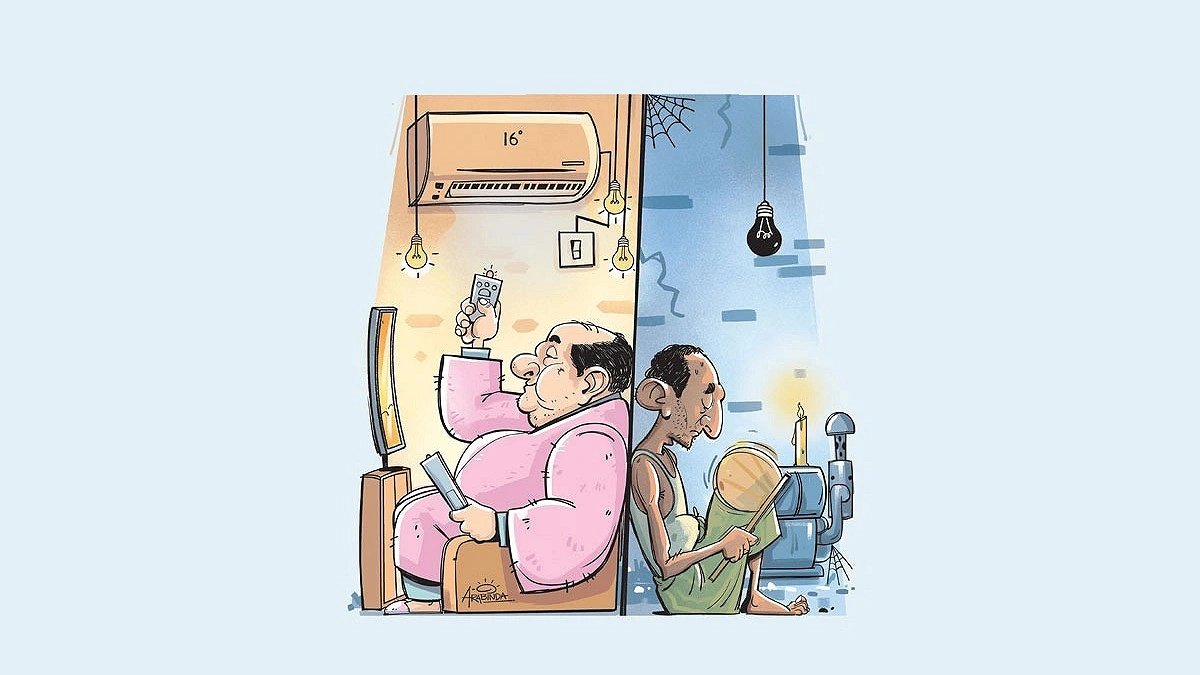
Graphics: Agamir Somoy
Despite repeated price hikes, citizens still face relentless load-shedding. Soaring temperatures worsen the crisis, with rural areas enduring 12 to 15-hour blackouts while cities do only slightly better.
For the rich, generators and IPS units keep the lights on. For the poor, there is only the wait - hour after hour. In this new reality, electricity has ceased to be a public good and has become a luxury product for the privileged few.
This persistent absence of power has not only dimmed lights but also crippled the pace of life, negatively affecting healthcare, education, manufacturing, agricultural irrigation, and commerce.
This month, the country implemented the highest price hike in 25 years (16.68%), yet load-shedding has exceeded 3,000 MW, with an average daily deficit of 2,500 MW.
Madaripur-1 MP Syed Uddin Ahmad Hanzala said in Parliament, “When there is no power in the area, even in the middle of the night, people call the MPs to express their anger. If this crisis is not resolved quickly, it will be difficult to survive with their dignity intact.”
On 7 June, Energy Minister Iqbal Hassan Mahmood claimed that the country faces no electricity shortage and that production deficits are not the cause of load-shedding.
He attributed temporary disruptions to storms, fallen trees, and faults in transmission and distribution lines. Iqbal argued that while there is no deficit relative to demand, occasional issues arise during peak summer demand due to primary fuel shortages, infrastructure limitations, and maintenance.
However, energy experts and officials from the Power Division claim the previous government constructed unnecessary power plants without securing fuel supplies or accurately assessing demand.
Nearly half of the country’s power plants are offline due to fuel shortages, maintenance, or mechanical failures. Despite the lack of production, the government must pay massive capacity charges under existing contracts, creating immense financial pressure that complicates the purchase of necessary fuel.
While the total installed capacity is approximately 29,000 MW, the peak summer demand averages 18,000 MW. Even on 20 May, when the country achieved a record production of 17,200 MW, load-shedding persisted. Current production levels average between 14,000 and 14,500 MW.
Power Development Board (PDB) Member (Generation) Md Zahurul Islam told Agamir Somoy that a coal shortage has reduced production at the SS Power Plant, while a unit at the Rampal Power Plant is down for maintenance.
He warned, “Even if these two plants become fully operational, load-shedding will persist because the required fuel supply cannot be ensured.”
Zahurul noted that while operating oil-based plants could potentially eliminate load-shedding, it would cause production costs to rise to unsustainable levels.
Gas-based plants are limited by low gas supply, and oil-based plants are producing well below their 6,000 MW capacity. These plants are also owed roughly Tk 9,000 crore in arrears.
Moreover, the Barapukuria Power Plant in Dinajpur is generating only 35 MW despite its 450 MW capacity.
Consumers Association of Bangladesh (CAB) Energy Advisor M Shamsul Alam told Agamir Somoy, “One of the main ways to solve the crisis is to reduce the cost of electricity production. For that, plunderous spending, waste, irregularities, and corruption in this sector must be stopped.
“But the government is trying to manage by increasing the price of electricity instead of following that path. In reality, the crisis will not be resolved this way. On the contrary, the situation will become more terrible.”
The suffering is disproportionately concentrated in rural areas. To manage the power deficit, authorities primarily implement load-shedding outside of Dhaka and major cities. On 16 June, for instance, the Rural Electrification Board (REB) accounted for 2,767 MW of the total 3,275 MW of load-shedding.
Rashed Ali, a resident in Chuadanga, said, “There is almost no load-shedding in the city. But load-shedding does not leave the village. Those who have the financial ability are meeting their demand through alternative means like charger fans, lights, IPS, or generators. But those who do not have that ability are suffering in extreme misery in the dark.”
Shamsul added, “The rich enjoy more of all the state benefits in various formats. That same discrimination has been created in the case of electricity. Yet, the rich are helpless without these marginalized people. This is a major social injustice.”
He expressed disappointment that despite the July uprising, energy inequality remains a low priority for politicians.
Observations from Agamir Somoy correspondents between 20 and 22 June highlight the severity:
- Satkhira: Urban areas face 3 to 5 hours of outages, while rural areas endure 10 to 16 hours.
- Gopalganj: Residents report 8 to 12 hours of load-shedding.
- Dinajpur: The district faces 4 to 5 hours of daily load-shedding.
- Bandarban: Supply recently fell below 60 MW against a demand of 94.5 MW.
- Chandpur: Rural residents report being without power for an average of 10 to 11 hours daily.

