


How deer destroying Hawaii’s environment are ending up on dinner plates

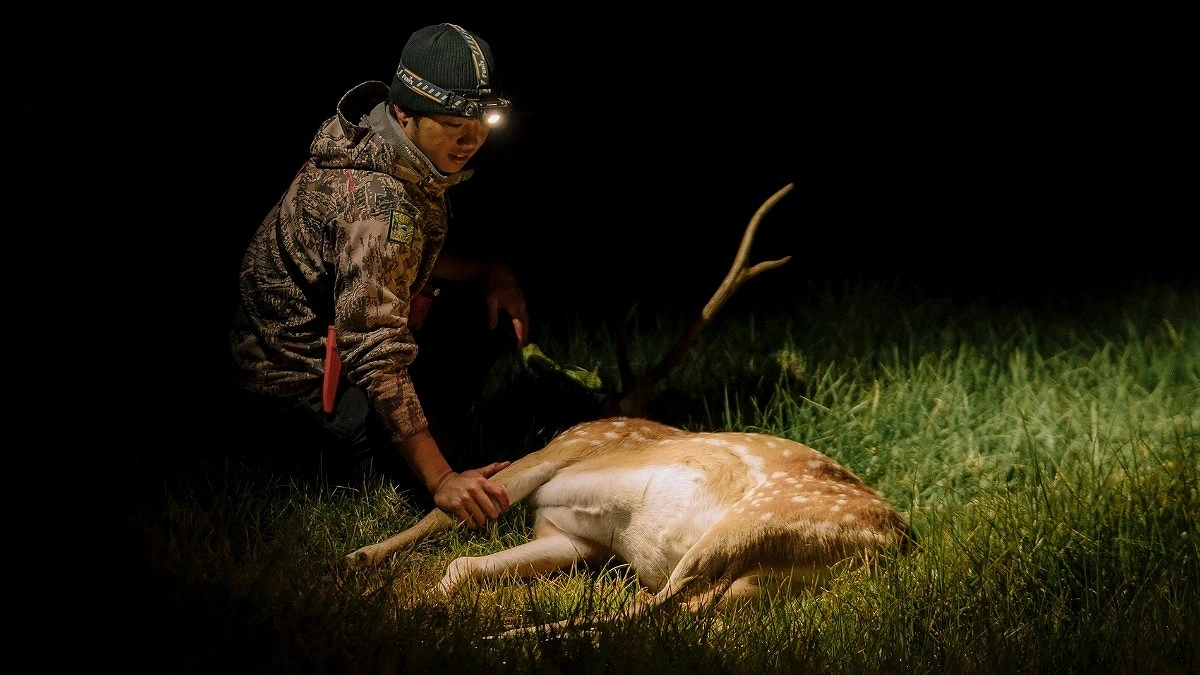
Photo: The Guardian
In 1868, the Hong Kong government gifted Hawaii’s King Kamehameha V eight axis deer. These animals, originally from South Asia, were strikingly beautiful. Their honey-colored coats were covered with small white spots. However, they did not arrive on the island of Maui until much later, in the 1950s. They were brought there for recreational hunters.
More than a century after their arrival in Hawaii, an estimated 60,000 axis deer now roam the islands of Lanai, Maui and Molokai. Moving in herds, the deer are changing the landscape. While the breeding season for the common white-tailed deer found on the US East Coast runs from October to January, axis deer breed throughout the year. As a result, their population continues to grow. They eat local grasses and endangered plants down to their roots, leaving large areas of land barren. They can jump over fences 10 feet high or break through them by force. They then eat farmers’ crops and the feed needed for Maui’s small cattle industry.
In February, while looking for a specific type of blood sausage for an aunt, I could not find it. Joy Enriquez, owner of Uncle Lui’s Sausage Company in Kahului, said, “We stopped making it. We couldn’t get enough green onion for it. The deer ate everything the local farmers were growing.”
Axis deer are destructive. Fortunately, their meat is also delicious. And for one company, the large number of excess deer has become an opportunity.
Maui Nui Venison collects deer from privately owned ranches. Ranch owners provide instructions on how many deer they want hunted. Officials from the US Department of Agriculture oversee the culling operation. They keep records of every deer killed and use high tech equipment to monitor the deer population. The meat is turned into steaks, ground meat, bone broth, jerky and even various organ based health supplements.
The company’s work could perhaps be viewed as a fair effort to restore balance among species. A 2011 US Department of the Interior report said, “This species is an extremely voracious consumer of understory vegetation in forests. This includes seedlings of native trees, which are extremely important to the survival of native Hawaiian forest birds.”
There were no natural predators for axis deer in Hawaii. As a result, they reproduced freely. In January, as drought conditions worsened because of axis deer, Governor Josh Green declared a state of emergency. It was the 25th such declaration related to the impact of axis deer in Hawaii.
Every Night Is Like a Military Operation
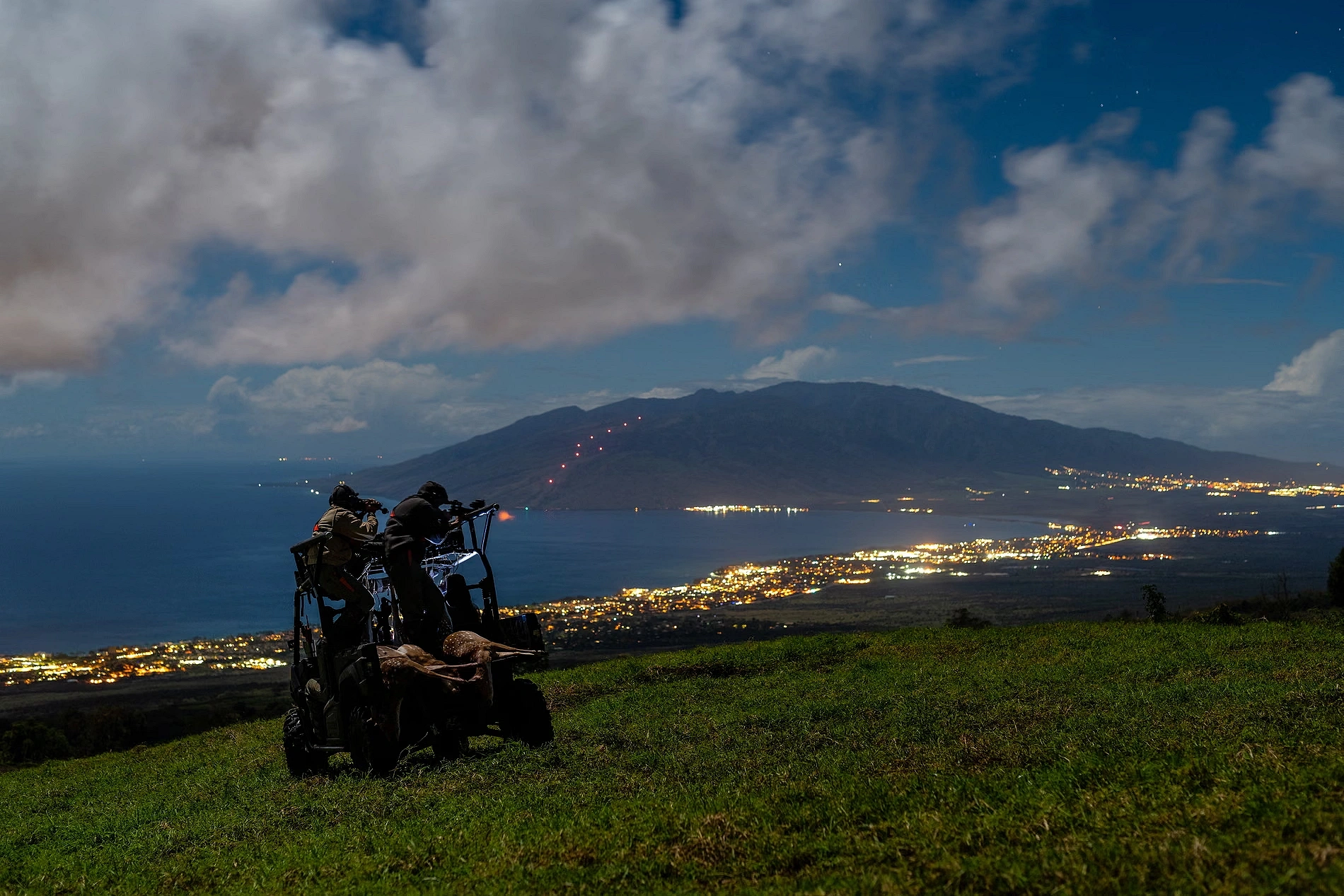
For nearly a decade, Maui Nui Venison has led an effort to turn axis deer into food. Using night vision technology, infrared drones, utility terrain vehicles and weapons similar to those used by military special forces, Maui Nui hunters hunt deer almost every night when weather conditions permit. Typically, 40 to 55 deer are killed each night, most of them only a few years old. Each deer yields about 42 pounds of meat. Some male deer weighing up to 200 pounds provide considerably more meat.
On an exceptionally clear and bright night in February, I followed Maui Nui hunters and their assistants through the shrub covered landscape of central Maui. The hunters were all men, most in their early 20s. They work seven days in a row and then have seven days off. During the day, they sleep in converted, insulated shipping containers. The containers are completely sealed with foil and duct tape to block out daylight.
Each night, they split into two separate groups and head in different directions. Each group is accompanied by an agriculture department inspector. The inspector examines each animal and gives the hunter permission to shoot. Their fleet of off road vehicles moves around thorny kiawe mesquite bushes. The hunters repeatedly said, “These are the kind of thorns that will puncture all four of your tires.”
Sheldon Simeon, chef and owner of Tiffany’s restaurant in Wailuku, fills his wontons with Maui Nui venison instead of the traditional ground pork.
Simeon said, “We have this wild food resource that has destroyed our ecosystem and spread unchecked into a nuisance. People may have some hesitation about venison because there is a perception that the meat has a wild animal smell and flavor.”
He said, “After becoming accustomed to the rationing system during World War II, people in Hawaii very easily gravitate toward ‘going to Costco and buying ground pork or canned pork.’ But Maui Nui venison does not have as much of that wild flavor because of what the deer eat in Maui. It is rich in flavor and very easy to cook.”
“And they are clean!” said Kiʻahi Kamara, a harvest specialist at Maui Nui Venison, excitedly. He was driving a UTV to the company’s base camp. Despite the destruction they cause, axis deer generally are not covered in feces or mud like many wild pigs.
There are other advantages. Kamara said, “On Molokai, a pound of regular ground beef is $20. Instead, wouldn’t you want to pay $5 for locally sourced, high quality venison and make burgers with it?”
Whenever a deer is spotted, hunters use an electronic call to attract its attention. The sound is somewhat like a melodic duck call. What follows is often a sequence of sounds: a popping sound, a whistle like sound cutting through the air, and then a thud as the animal falls.
Kamara said, “They make sure that we do not injure the animal and cause it to suffer. The agriculture department makes sure that the animals are immediately rendered unconscious.”
There are many rules. The shot must be to the head. If a deer does not die immediately after being shot in the head, the hunter can approach it and fire another shot to kill it. The deer must also be of a certain size. Very small deer and extremely large males both complicate the calculations for their meat processing team.
Kamara said, “You are not chasing the animal all day or tracking it. The guys love to hunt during the day, but then they use bows. When it comes to harvesting deer, we just shoot. The tracking has been replaced by technology.”
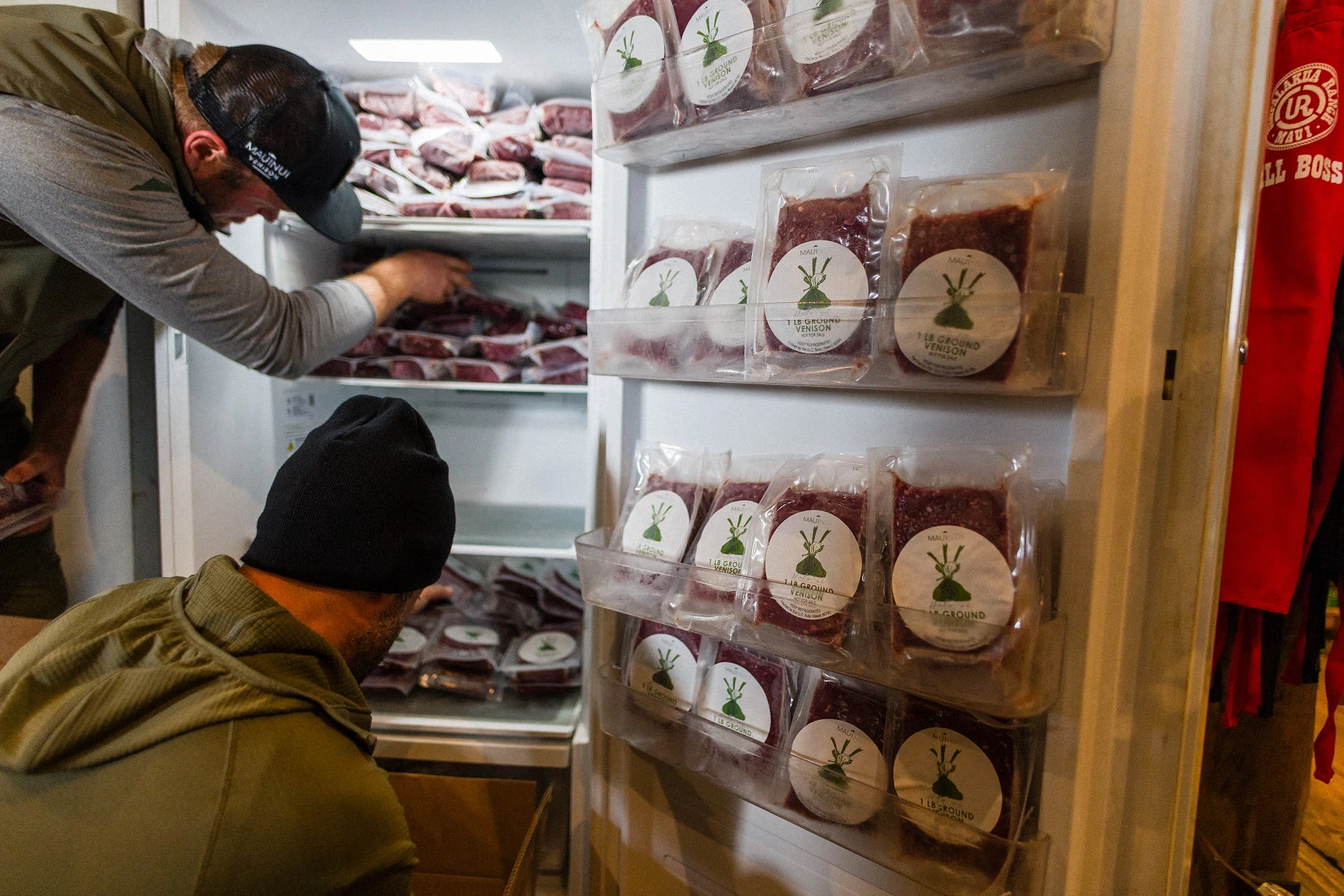
Every two weeks, on one night, they go out without the inspectors and specifically hunt deer for Maui residents. The meat from these deer is ground, frozen and distributed to various community hubs across Maui. The company has named the program “Holo ‘Ai.” In Hawaiian, “holo” means to flow and “ai” means food. The meat is free for local residents.
Hawaii imports about 85 to 90 percent of its food supply from the US mainland. During the pandemic, however, the problem was not food supply but food distribution.
Kamara said, “We had excess food because all the imported food was going to tourists, and there were no tourists during Covid. But at the same time, there was no food distribution system.”After recognizing the crisis in getting food to Maui residents, Maui Nui expanded its “Holo ‘Ai” program throughout Maui.
In Maui’s Upcountry area, which has steep mountain slopes, native forests were cleared to establish ranches. That history predates the arrival of the deer by a long time. Kamara said, “Yet we still glorify the paniolo, or Hawaiian cowboy, culture.”
The next morning, he took me through Ulupalakua Ranch in the same UTV. I was traveling through the same area in daylight where I had gone with the hunters in darkness just hours earlier. He pointed to the land above us. The higher land is used for cattle ranching, while the lower land is used for sugarcane cultivation.
He said, “You can see the imprint of everyone who has come here. What happens if another layer of destructive food production is added after all these layers in Hawaii?”
Despite all the problems caused by axis deer, Maui Nui does not want to eliminate them completely. Instead, it wants to keep their population in balance.
Kamara said, “Some ranchers call them ‘spotted rats.’ But our first goal was to change that mindset. This is a resource, not an invasive species.”
Kamara pointed toward areas of Ulupalakua Ranch that have been reforested. The ranch is still primarily used for cattle ranching. However, large areas have been set aside for the growth of endangered koa trees. Parts of the koa forest are filled with the calls of native birds such as the ʻapapane. I also saw endangered ʻohiʻa lehua trees, whose bright red and yellow flowers resemble spiky blooms.
Kamara said, “Native birds come after the flowering trees. But the deer do not allow the tree seedlings to grow. Now, however, some seedlings are surviving.”
Reforestation has also restored the groundwater level in the area. At sunrise, we heard the calls of pueo, or Hawaiian short eared owls, living in the shrubs, although we did not see them.
In February and March, a series of severe storms struck Maui and other islands. Low pressure weather systems brought hurricane force winds, heavy rainfall and flash flooding to West Maui, Oahu’s North Shore and Molokai. Farms were destroyed, highlighting how vulnerable Hawaii’s food system is. Even so, Maui Nui remained focused on hunting deer for local residents and filling local coolers and freezers with ground venison.
Source: The Guardian (Adapted)

