
Professor's Copy-Paste Research to Move from RU to DU

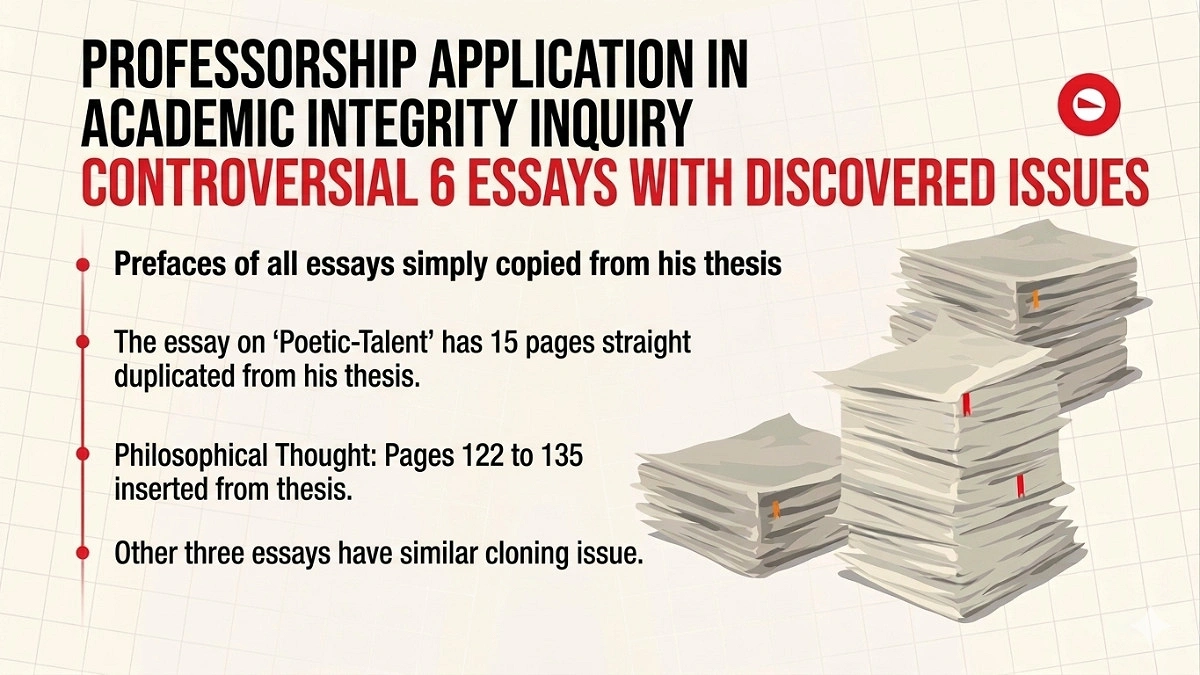
Image re-generated by AI.
Dr. Md. Ataullah, a professor at Rajshahi University (RU), aspires to become a teacher at Dhaka University (DU). However, he has submitted six controversial research articles that are facing serious allegations of fraudulances.
Professor Ataullah's PhD thesis focused on the Iranian poet Nizami Ganjavi, and it is alleged that he copied sections directly from that thesis to create these six articles without any changes, not even altering a single comma or period, in some cases.
An investigation by Agamir Somoy found significant similarities. The introduction and biographical sections of every article are taken verbatim from the thesis. In the article titled "Poetic Talent of Nizami Ganjavi," more than 15 pages were copied directly from the thesis. For "Influence of Al-Quran in Poetry," pages 147 to 161 of the thesis were directly duplicated. In "Philosophical Thoughts," pages 122 to 135 were also lifted word-for-word. The remaining three articles were similarly created by pasting pages from the thesis, without providing any references or citations.
These grave allegations of plagiarism have been brought against Professor Ataullah of RU’s Department of Persian Language and Literature. It is claimed that he published at least six research articles by copying and pasting large portions of his own PhD dissertation. Recently, he submitted those very articles along with his application for a circularized professor position in DU's Department of Persian Language and Literature.
It has been learned that he presented these six research articles, centered on Iranian poet Nizami Ganjavi, as proof of his academic qualifications. He had completed his PhD research on this same Iranian poet, with a thesis titled "Poetic Talent and Philosophy of Love of Nizami Ganjavi."
Allegations suggest that Professor Ataullah published these research articles by copying large portions of the thesis without following even the minimum rules of internationally recognized research methodology. Several teachers from the Department of Persian Language and Literature have stated that this is not just self-plagiarism, but an extreme violation of academic ethics. They consider it an unprecedented example of research fraud.
How the Evidence of Plagiarism Was Found
The investigation by Agamir Somoy revealed that the introduction, the poet's introduction, and the biography sections of each article were taken almost identically from various pages of the thesis. The same language, sentence structure, and framework were used in the introduction and life history sections of all six articles, which directly falls under the category of plagiarism. Furthermore, paragraphs in the main body of the articles were copied and pasted exactly from the thesis, including punctuation. Yet, no proper citations, references, or sources from the thesis were mentioned anywhere.
At a Glance: The Six Articles
Nizami Ganjavi’s Poetic Talent: A Review: The introduction and life history sections were copied from pages 1, 53, 54, 55, 57, and 58 of the thesis. The main body used extensive portions from pages 101 to 117 verbatim, with no citation of the thesis.
The Influence of Al-Quran in Nizami Ganjavi’s Poetry: The introduction duplicated pages 53, 57, and 58 from the thesis. The main section was copied from pages 147 to 161.
Wisdom in Nizami Ganjavi’s Poetry: The introduction was taken from pages 53, 54, and 57 of his thesis. The main body was cloned from pages 140 to 147.
Subject Diversity in Nizami Ganjavi’s Poetry: The introduction was drawn from thesis pages 164, 54, 57, and 74. The main section used pages 164 to 173 respectively.
Morality in Nizami Ganjavi’s Poetry: The introduction was taken from pages 134 and 58. The main body was copied from pages 134 to 140 from the research.
Philosophical Thoughts of Nizami Ganjavi: The introduction was taken from page 57. The main body used extensive verbatim portions from pages 122 to 135.
What Do Research Policies State?
International guidelines strictly prohibit "copy-pasting" verbatim when creating an article from a thesis. A researcher must summarize the detailed information from the thesis using new language and select only the necessary data segments for the article. Even when using one's own work, the thesis must be treated as a source with mandatory citations and references to avoid self-plagiarism. Proper referencing is required, and for unpublished theses, the title, library call number, year, and page numbers must be specified.
A senior teacher from the Department of Persian Language and Literature at Dhaka University confirmed the research fraud to Agamir Somoy. He said that after comparing Professor Ataullah's published articles with his own PhD dissertation, it was clear he did not follow even the minimum rules of internationally recognized research methodology. Instead, he published six research articles by copying and pasting page after page verbatim from his PhD thesis.
The teacher added, "This is not a mere irregularity; it is clear research fraud. From the perspective of academic ethics, it is an extremely serious offense. Presenting such research papers as original work to apply for a professorship is both unethical and questionable".
The senior teacher from the Department of Persian Language and Literature at Dhaka University expressed concerns that if Professor Ataullah’s other published research papers were independently reviewed, further evidence of similar plagiarism and irregularities might be uncovered. According to the teacher, the university administration should investigate the matter promptly and take necessary action.
Analysts state that lifting several paragraphs verbatim from a thesis and publishing them as a new research article constitutes serious academic misconduct and a punishable offense.
According to academician Professor Dr. Anwar Hossain, publishing sections copied directly from one’s own PhD thesis as a new research paper is a clear violation of internationally recognized research guidelines. He noted that a research paper implies new analysis, new presentation, and an original contribution. Copying and pasting page after page from a thesis to present it as a new article is entirely unacceptable, as it damages the quality of research and brings the credibility of the entire academic system into question.
However, Professor Ataullah claims that the articles he submitted did not violate university rules. He declined to comment further, suggesting that university policymakers be contacted for their statements on the matter.
Meanwhile, Dr. Md. Faridul Islam, the Vice-Chancellor of Rajshahi University, said if evidence of such research fraud is found, action will be taken in accordance with varsity laws.
