
The Night Calls


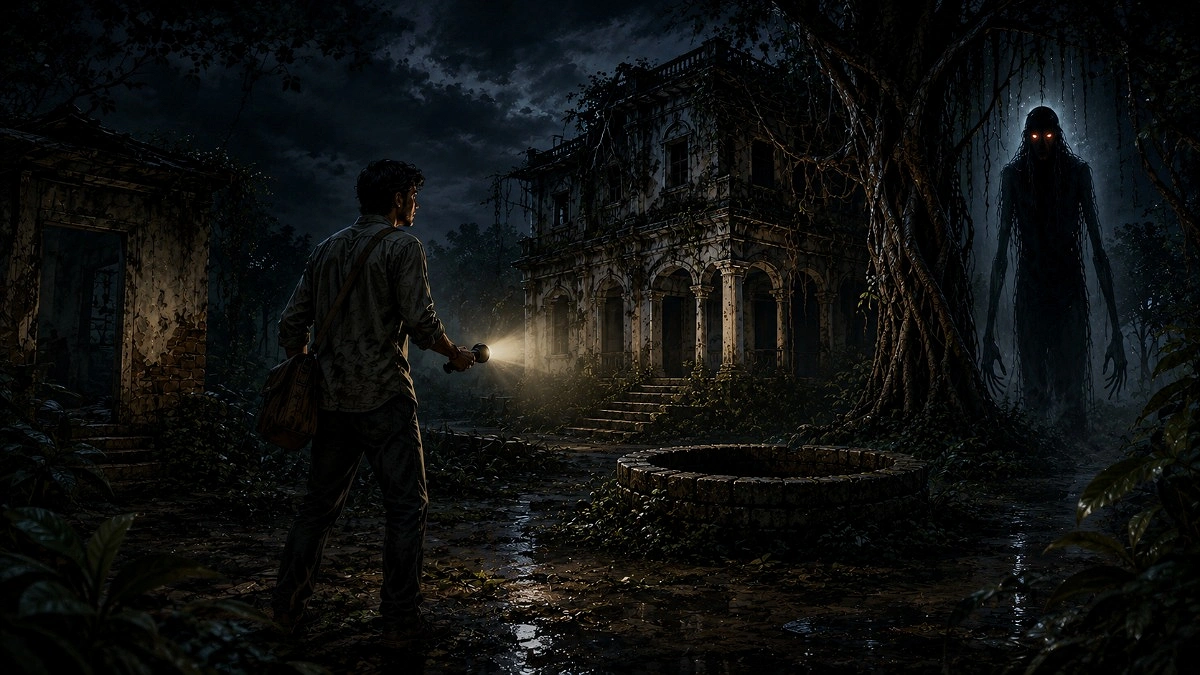
Graphics: Generated by AI
It was the last night of the monsoon month of Shraban. There was no moon in the sky, only a handful of stars peeking through gaps in the clouds now and then, as if some invisible eyes were keeping watch over the village from far away. There was no fog, yet the air carried a damp heaviness, as though nature itself were holding its breath, waiting for something.
At the edge of Rahimganj village, where the paddy fields end and the forest begins, stood a very old house. The villagers called it the zamindar’s house, though no zamindar lived there anymore, and no one lived there at all. Only the roots of banyan and fig trees had wrapped themselves around the broken bricks, as if the earth itself wanted to pull the house down into its chest.
Arif Hossain was not a son of this village. He had come from the city, for work, as the new schoolteacher. He had been here three months, living in a rented room in the middle of the village. By nature, he was a skeptic, with no belief in ghosts. He had taught science for many years, and the habit of understanding the world through reason had mixed into his blood. So, when the elders of the village had warned him, saying, do not go near the zamindar’s house after dark, son, the night calls there, he had only smiled to himself.
He had heard of this thing called the night calling ever since childhood. It was said that if someone called your name in the darkness in the voice of a loved one, you must never answer. Because it was not a person calling. It was some kind of being that stole the voices of the dead, and then called out in that very voice from the darkness, on lonely paths, to whoever it found alone. Whoever answered never returned. And even if something did return, it was no longer human.
Folklore, Arif had thought. A mixture of imagination and ignorance among village people. The call of a forest owl, the howl of a jackal, the cry of a night bird, all of it blending together to create this superstition. To him the explanation seemed simple enough.
But tonight, he had come to stand in front of the zamindar’s house, alone, drawn by his own curiosity. His students had told him that old books and documents from another era still lay inside the house. His interest in history had always been strong. He thought he would take a look, perhaps find something useful.
A torchlight in hand, a cloth bag on his shoulder. The main gate of the house was gone now, only two broken pillars stood, like the bones of some giant creature. Arif stepped inside.
The moment his foot touched the courtyard, he felt as if the wind had suddenly stopped. Not even the leaves were moving, though the breeze had been blowing just a moment ago. In the light of the torch he saw, in the middle of the courtyard, an old tulsi altar, broken, covered in moss. He walked past it toward the main building of the house.
There was no door to speak of, only an empty doorframe. As he stepped inside, a smell reached his nose, damp earth and rotting wood, mixed with another smell he could not quite place. Sweet, yet somehow unsettling, the way flowers smell when left forgotten for far too long.
On one side of the room lay a wooden cabinet, its door open, with a few books and papers inside. Arif moved closer and shone his torch over the books. They were written in old Bengali script, some ledgers of zamindari accounts, some letters. He began going through them one by one, losing track of time.
That was when he heard it, from somewhere far off, a voice.
Arif.
He started at the sound of his own name. The voice felt familiar, very familiar. It was his mother’s voice, who had passed away five years ago. He turned toward the doorway, but there was no one there.
A trick of the mind, he thought. Coming from exhaustion. He thought of his mother often, especially in the quiet of the night. The brain sometimes plays such tricks, conjuring familiar sounds out of pure silence. This could be explained scientifically enough, he told himself.
But the voice came again, closer this time.
Arif, come here, dear.
There was no doubt now, this was his mother’s voice, exact in every way. That same soft, slightly trembling tone she used to call him home in the evenings when he was a child. He felt a strange pull in his chest, both fear and longing at once.
He remembered the warning of the elders. The night calls in the voice of a loved one. Never answer.
But reason argued back inside him. This could simply be an echo, or some bird whose cry coincidentally resembled his mother’s voice. Or perhaps there was another person in this house whose voice happened to match. Testing reality was, after all, his nature. He decided he would find the source, but would not answer, only follow the sound in silence.
He left the room, crossed the courtyard, and walked toward the back of the house, in the direction he thought the voice had come from. There stood an old well, surrounded by wild plants. Standing near the well, he froze. The voice now seemed to be coming from inside it.
Arif, look, I have fallen in.
Every hair on his body stood up. His rational mind was still struggling to find an explanation, perhaps sound was distorting inside the well due to some echo, or perhaps someone really had fallen and was calling for help. It was this last thought that pushed him to lean over the edge of the well and look inside.
He shone the torch down into the well. Deep darkness, no sign of water, only a bottomless pit that seemed to descend straight into the earth. There was no one there. Yet the voice still rang in his ears, as if it were coming straight from the walls of the well itself.
Come now, dear, just take my hand.
Arif stepped back from the well, his heartbeat quickening. Now he was certain there was no ordinary explanation for this. But instead of fleeing, another instinct rose within him, the curiosity of a journalist, the stubbornness of a researcher. He thought he must get to the root of this, understand exactly what was happening in this house.
He turned and began walking back toward the house, deciding to leave, planning to return another day in daylight. But after only a few steps, he saw a shadowy figure standing in front of the main door of the house.
The figure had the shape of a person, but something about it was wrong. It was very tall, taller than any normal human, and its two arms were unnaturally long compared to its body, hanging almost down to its knees. Arif could not clearly see its face, but what little he did see showed him two eyes burning, dim, with a reddish glow, like two dying embers somewhere far off.
From its mouth came that voice again, in his mother’s tone.
Where are you going, dear? Will you leave me behind?
Arif’s feet seemed to root themselves into the ground. Not only from fear, but from a kind of trance as well. Somewhere deep in his mind a part of him was saying, this is not your mother, but another part, closer to his heart, was pulling him toward that voice.
He forced himself back into reality. He turned his face away and began running in the opposite direction, past the side of the house, through the forest, toward the path leading back to the village.
As he ran, he realized something was coming after him, but there was no sound of footsteps. Only a whistling noise of wind being cut through, as though something was moving at an unnatural speed without ever touching the ground.
The trees of the forest seemed to want to block his path, branches catching at his shirt, roots tangling around his feet. Still, he ran on, with all his strength, his heart pounding as if it had risen into his throat.
Suddenly he saw a light ahead. A hut on the edge of the village, an oil lamp burning inside. He rushed toward it and began pounding on the door.
The door was opened by an old man, named Karim Chacha, one of the eldest people in the village. Seeing Arif, his face went pale.
You went to the zamindar’s house, didn’t you? the old man said, his voice trembling.
Arif nodded, still gasping for breath. Karim Chacha pulled him inside and shut the door, then brought a copper plate and placed it in front of the entrance, scattering a handful of mustard seeds over it.
What are you doing? Arif asked, his voice still shaking.
An old custom, son, Karim Chacha said, sitting down before him. Whatever calls in the night cannot easily enter a home if there is iron or copper placed at the door, and mustard seeds or salt scattered there. Because it must count every single grain, and by the time it finishes counting, dawn arrives. And in the light of dawn, such things cannot survive.
Arif sat quietly for a while, then asked, did you know I would go there?
Karim Chacha shook his head. I did not know, but I feared it. You are a city man, you do not believe in these things. But if you knew the history of that house, you would understand.
Arif asked to hear that history.
Karim Chacha began his tale. Many years ago, when the zamindari system still ruled this land, a zamindar named Radharaman Chowdhury lived in that house. He was a cruel man, oppressing his tenants in the name of taxes, and he had a particular habit, bringing beautiful young women of the village to his house under cover of darkness.
Once, a girl from a poor family was brought there. Her name was Suleka. One night she tried to escape, but the zamindar’s men caught her near the well behind the house. In the struggle, she fell into the well. The zamindar made no attempt to rescue her, and instead had the mouth of the well-sealed with stones, so the whole matter would be buried along with her.
From then on, rumours began spreading through the village, that the girl’s spirit had never found peace. To take revenge for the injustice of her death, she was said to have become some kind of entity that stole the voices of people’s loved ones, calling them into the darkness, luring them toward that very well where her own life had ended. Many people had disappeared this way over the years, especially those who had gone alone near that house at night.
The zamindar himself did not escape in the end. One night he was found dead beside the well, his face frozen in an expression of strange terror. After his death the house was abandoned, and no one ever dared to live there again.
Arif listened quietly to the entire story. His rational mind still struggled between belief and disbelief, but the voice, the shadowy figure, all of it had felt so vividly real that there was no way to deny it.
Am I safe now? he asked.
Karim Chacha thought for a moment. Stay in this house tonight. Leave once dawn breaks. But son, remember one thing. It has heard your voice, seen your fear. You have caught its attention now. It will not let go so easily.
Somehow the night passed. Arif could not sleep even for a moment, only stared toward the door, startled at every sound. At one point in the middle of the night he heard someone walking outside, slowly, circling around the hut. Once, from near the door, came a whisper, so faint that the words could not be made out, but the tone was familiar, in his mother’s voice once more.
The moment dawn’s light broke, all the sounds stopped, as if everything had vanished along with the night. Arif thanked Karim Chacha and returned to his own room, but his peace of mind did not return with him. He spent the whole day restless, unable to concentrate even while teaching his classes at school.
As evening fell, he felt as though something were waiting outside his door. He shut every door and window, scattering mustard seeds inside his room in front of the entrance, following the method Karim Chacha had taught him. But once night grew deep, that voice came again, closer this time, as if it were coming from just beyond the window.
Arif, dear, open the door. I am cold.
He pressed his hands over his ears, sat on his bed with his eyes shut, and began counting numbers silently, trying to hold himself in reality. The voice sometimes pleaded, sometimes grew angry, sometimes wept, but Arif did not answer. Another night passed this way.
On the third day he decided there had to be an end to this matter. One could not spend a lifetime running away. He went again to Karim Chacha, asking if there was any way to be free of this curse.
Karim Chacha sat silent for a long while, then said, there is one thing the old people speak of. Suleka’s body was never properly laid to rest, her bones still remain inside that well. If someone could bring those bones out and perform the proper last rites, perhaps the spirit would find peace, and be freed from this bond.
But that would be dangerous, Arif said.
Very dangerous, son. Many have tried in the past, and none of them returned.
Arif knew this was the only way. His rational mind told him to flee, to return to the city, to forget this village. But he knew the voice would not let him go so easily. And even if he went elsewhere, perhaps the same danger would find him again.
He convinced a few young men of the village to help him, and learned the proper rites of the last ceremony from Karim Chacha. On the next night of the new moon, when the darkness would be at its deepest, they set out toward the zamindar’s house, carrying rope, a bucket, and some water blessed with sacred chants.
Reaching the well, they began their work. A young man was lowered down by rope, while the others stood above, holding it carefully. Arif stood at the edge of the well, shining his torch down into the darkness below.
Within a short while, the air changed. That same damp heaviness, that same stillness, as though nature had once again begun holding its breath. Then that voice was heard, now trembling with rage, screaming out from the darkness.
Do not touch my bones.
The young men shook with fear, but Arif gave them courage. Remember, she has never found peace, that is why she does this. We must set her free.
The young man inside the well shouted up that he had found some bones. Quickly they were placed into the bucket and pulled up. But at that very moment, the shadowy figure emerged from the darkness of the well, more horrifying than before, its long arms stretching out toward the young man still hanging from the rope inside.
Arif ran forward and threw the blessed water at the shadowy figure. At its touch the figure seemed to burn, and a piercing scream spread across the entire area, birds fled from the trees in fear, distant dogs began howling all at once. The young men quickly pulled their companion up out of the well, unharmed.
The shadowy figure retreated, but did not vanish entirely. Its red eyes remained fixed on Arif, and that voice, now in its own true tone, not his mother’s voice but something else, broken and full of sorrow, said, will you really set me free?
Arif nodded and said, yes, only let us help you.
They carried the bones to the riverbank, to the village’s old cremation ground. Karim Chacha was already waiting there with everything prepared. Following the proper rites, Suleka’s remains were given a proper cremation, amid the priest’s chanting, and the ashes were set afloat upon the river’s waters.
The moment the work was finished, a change came over the sky. In the east, the horizon slowly began to lighten, though dawn was still far away. A gentle breeze began to blow across the river, as though some long imprisoned breath had finally been released.
Everyone felt a weight lift from the air around them. As if nature itself had let out a sigh of relief.
From that night onward, the night never called again in that village. The zamindar’s house still stands there today, in ruins, but the air around it no longer carries that heaviness, that oppressive silence.
Arif stayed on in the village for some time longer, then was transferred elsewhere. But he never forgot those nights. As a man of science, he still wants to understand the world through reason, but he knows now that there exist certain corners of this world where the line between reason and belief grows blurred, where darkness speaks by its own rules.
Even today, when he walks alone down some quiet path on a lonely night, and hears a familiar voice calling from somewhere far off, a cold current runs through his chest. He does not stop. He does not turn back. He only repeats to himself, silently, that old warning, which no longer feels like mere superstition.
If the night calls, never answer.
Because there are certain calls, once heard, from which there is no path back.
