


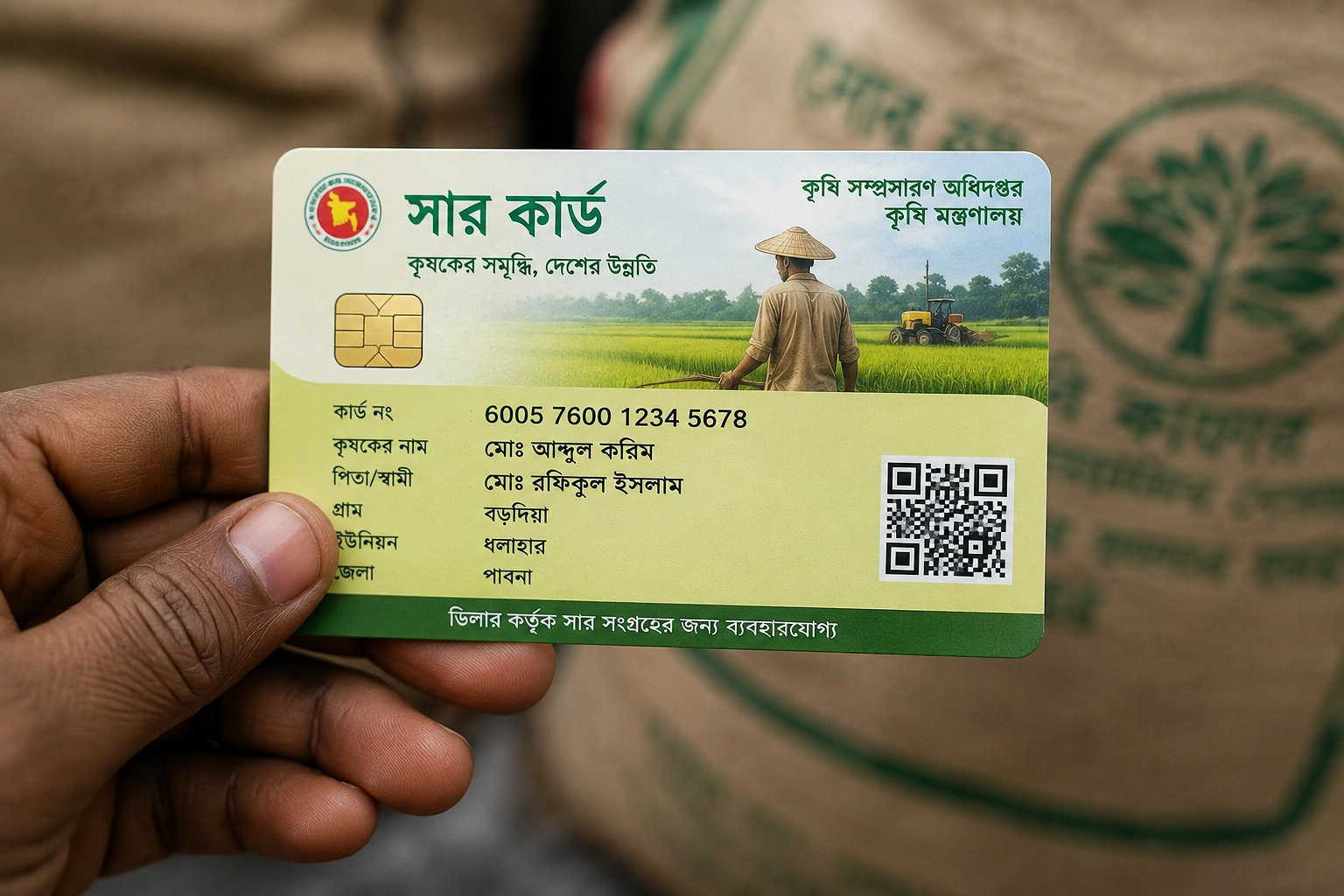
‘Fertilizer Card’ introduced to resolve crisis


Collected Photo
During the most critical period of the Aman season, farmers across the country are scrambling for fertilizer. In some places, long queues form at dealer points from early morning; in others, there are complaints against dealers charging several hundred taka extra per bag above the set price; and in still other areas, farmers are not receiving their allocated fertilizer on time. The government claims that the country has sufficient fertilizer stocks, but the ground reality tells a different story. Farmers fear that if they do not get the required amount of fertilizer amid this crisis and price hike, there could be a major negative impact on Aman production.
According to government documents, the allocation of urea fertilizer across the country for August was 279,412 metric tons. However, only 149,612 metric tons had been distributed as of August 20. In the four districts of the Mymensingh division, the allocation was 31,425 metric tons, but dealers had lifted only 9,992 metric tons during the same period. In the four districts of Sylhet division, only 2,679 metric tons were lifted against an allocation of 9,541 metric tons. This gap between government allocation and field-level supply has heightened farmers' concerns.
Investigations in various districts show that the problem is not limited to complaints about fertilizer shortages. There are also allegations of artificial crises, illegal hoarding, failure to lift allocated fertilizer on time, and overcharging above the fixed price. In Sherpur, Bogura, farmers have complained that TSP and DAP fertilizers are being sold at Tk 400–450 extra per bag. They claim they are not getting fertilizer at the official price. Although local MP and State Minister for Local Government, Rural Development and Cooperatives Mir Shah Alam has asserted that there is no shortage of fertilizer in the country, and that some farmers buying fertilizer in advance have created temporary pressure.
Image generated by AI.
In Nilphamari, farmers have alleged that while they are not getting fertilizer from dealers, it is being hoarded in various godowns, and allocated fertilizer is being diverted elsewhere. In Mithapukur, Rangpur, farmers have to stand in long lines at dealer points from dawn to get fertilizer for the Aman season. They allege that a crisis is being created artificially. However, the upazila agriculture office claims that there are adequate stocks and that farmers will get fertilizer as per demand.
In Habiganj too, despite government claims of sufficient stocks, farmers complain that fertilizer is not available at the fixed price. In Natore's Gurudaspur and other upazilas of the district, demand has increased during the Aman season, but farmers are not getting the required amount of fertilizer. Farmers in the greater Khulna region have also made similar complaints.
On the other hand, in response to allegations of illegal hoarding, raids were conducted in Dinajpur's Sadar and Kaharole upazilas on August 27, seizing 669 bags of fertilizer. Two businessmen were fined Tk 30,000 each and sentenced to one month of hard labor without pay.
In this situation, the Chuadanga district agriculture office has taken an exceptional initiative. To prevent artificial crises and irregularities by dealers, a ‘Fertilizer Card’ has been introduced. Fertilizer allocation and distribution are now being carried out through agriculture officers at the union level, based on the amount of cultivable land each farmer owns. Those concerned hope this will make it easier to deliver the prescribed amount of fertilizer to genuine farmers.
Agriculture Secretary Md. Selim Khan has claimed that there is no fertilizer shortage in the country. He said action will be taken against those creating artificial crises, illegal hoarding, or selling fertilizer at excessive prices.
However, the concerns of farmers and traders on the ground have not subsided. A trader from Rangpur, speaking on condition of anonymity, said that the government had informed them that fertilizer would reach the districts by September 15 according to the demand for October and November, but in reality, that supply has not yet arrived.


