
'Bangladesh–India ties more than neighborly, they are a soulful connection'

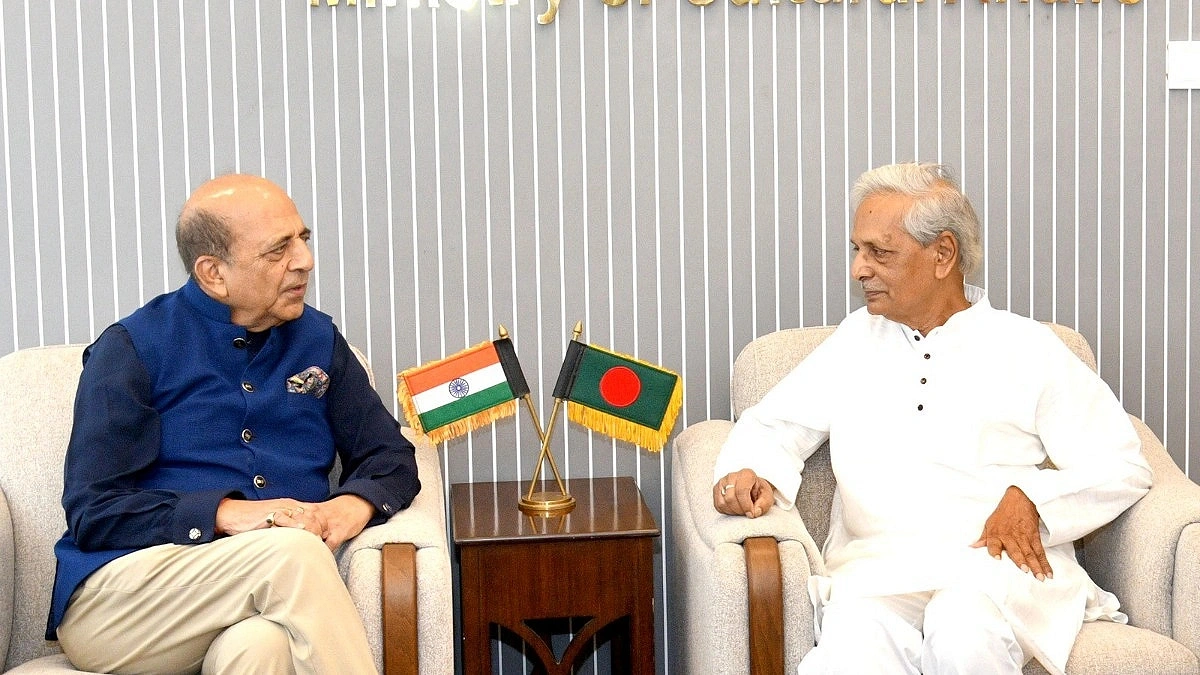
Culture Minister of Bangladesh Nitai Roy Chowdhury and Indian High Commissioner Dinesh Trivedi in Dhaka. Collected photo.
Culture Minister of Bangladesh Nitai Roy Chowdhury has said that the relationship between Bangladesh and India is not merely that of neighboring states, but a soulful bond. He emphasized that the deep connections rooted in language, literature, music, folk tradition, and human values form the strongest foundation of bilateral relations.
The Minister made these remarks during a courtesy meeting with Indian High Commissioner Dinesh Trivedi at his office on Sunday morning.
During the nearly hour-long meeting, discussions focused on the historical and cultural ties between the two nations, celebrating Nazrul Year, exchanges of artists and researchers, classical music, folk culture, nurturing young talent, and joint initiatives to preserve maritime cultural heritage.
Highlighting the essence of heritage, the Culture Minister remarked that the true identity of a nation lies in its culture. He noted that culture unites people rather than dividing them.
Referring to legendary artists of the subcontinent—such as Mohammad Rafi, Hemanta Mukherjee, Alka Yagnik, and Pandit Ravi Shankar—he mentioned that their creations resonate equally in the hearts of millions across both countries. Their creative contributions prove that art and culture transcend geographic borders to speak the language of the human heart.
He extended an official invitation for renowned Nazrul scholars, performers, and cultural experts from India to participate in the national and international events organized in Bangladesh for the ongoing Nazrul Year.
Furthermore, he cited Rabindranath Tagore, Kazi Nazrul Islam, Lalon Shah, and Bengali folk music as key pillars of the shared cultural legacy connecting both nations.
The Minister concluded that a cultural awakening serves as the most effective resistance against religious extremism, intolerance, and communal polarization in today's world. He called for collaborative efforts between Bangladesh and India to strengthen human values and harmony through literature, music, theater, and folk culture.
During the meeting, State Minister for Cultural Affairs Ali Newaz Mahmud Khaiyam proposed establishing a classical music network between the two countries. As an initial step, he suggested inviting two classical artists from India to conduct workshops in Bangladesh. He also called for adopting a new action plan through the renewal of the Bangladesh-India Cultural Cooperation Agreement.
Indian High Commissioner Dinesh Trivedi reiterated that the relationship between Bangladesh and India is a connection of souls, noting deep commonalities across food habits, language, history, heritage, and culture.
He highlighted Bangladesh as a land of communal harmony, music, and a rich cultural legacy.
The High Commissioner assured full cooperation in organizing larger, international-standard events in Churulia—the birthplace of Kazi Nazrul Islam—and expressed his personal desire to attend the event. He also stressed the importance of organizing regular joint cultural programs between institutions in West Bengal and Bangladesh.
Furthermore, he noted that launching joint training programs, residency opportunities, and cultural exchanges for young talents would strengthen mutual understanding among future generations.
State Minister for Cultural Affairs Ali Newaz Mahmud Khaiyam and Secretary Yasmin Begum were also present at the meeting, alongside the Joint Secretary of the Ministry of Culture, the Deputy High Commissioner of the Indian High Commission, and the Director of the Indira Gandhi Cultural Centre.


