
The last catch


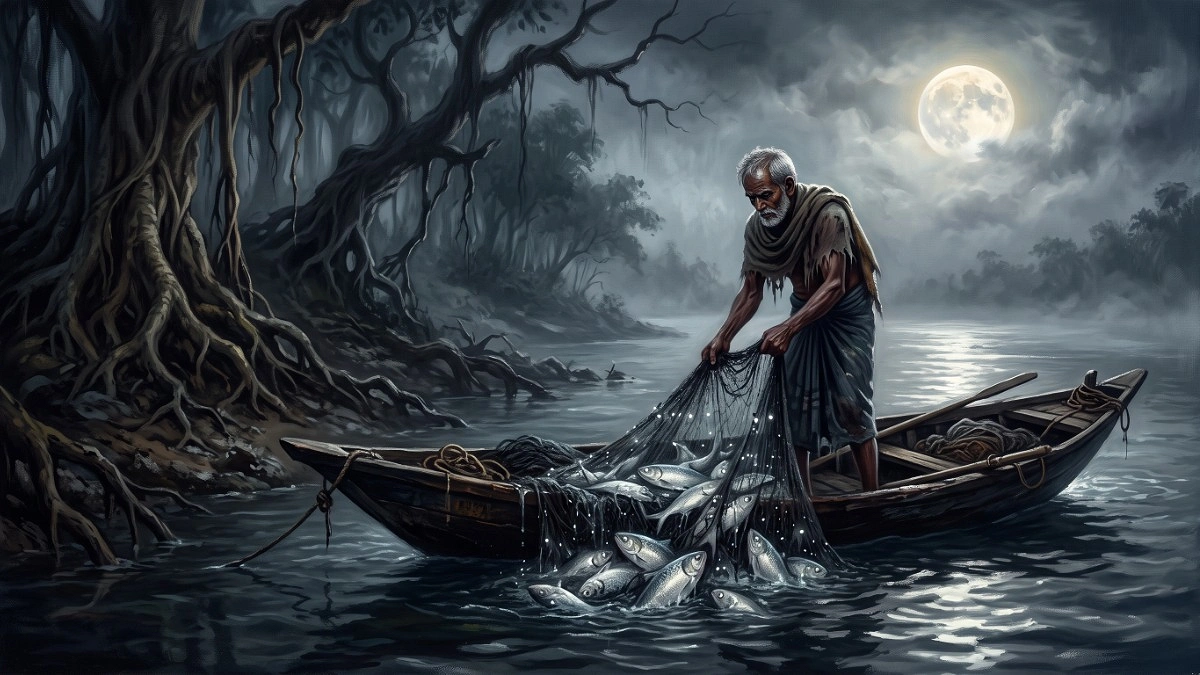
Picture: Generated By AI
The river Padma had a smell that Kalachand knew better than his own mother’s voice. It was the smell of silt and rain and something older, something that lived under the water and only came up in whispers when the monsoon thickened the current. He had been born on its bank, in a tin roofed house that leaned toward the water as though it too wanted to drown, and for forty-three years he had pulled nets from that same brown water without once being afraid of it.
That changed the year the hilsa came back wrong.
It was the last week of Bhadra, when the fish traditionally swam upriver fat and silver to spawn, when every fisherman from Chandpur to Barisal waited with nets mended and boats caulked, hungry for the season that fed their families for the rest of the year. The hilsa was more than food in that part of Bengal. It was blessing, it was dowry, it was the fish sent as a gift to a new bride’s family, it was the taste that every person born near that river carried in memory even after they left for the cities and forgot everything else about home. To catch hilsa well was to be respected. To catch none was to be pitied, or worse, to be suspected of some sin the river was punishing.
Kalachand’s boat, the Ma Ganga, had never come back empty in all his years on the water. That season it came back with something far stranger than empty.
The first time it happened, his nephew Bijoy was rowing while Kalachand worked the net, and the net came up heavier than any of them expected, so heavy that the boat tilted and water slapped over the low side. They hauled together, arms shaking, sure they had caught the largest school of the year. When the net broke the surface, it was full of hilsa indeed, dozens of them, scales flashing that particular blue silver that made buyers in the market fight over baskets. But every single fish in that net had its eyes open and fixed, not glazed with the milky film of death that fish get within minutes of leaving water, but wet and dark and looking, as though each one had died still watching something on the riverbed that it could not look away from.
Bijoy would not touch them. He said later, sitting outside the tea stall with his hands wrapped around a cup he did not drink, that when he lifted one hilsa by the tail to put it in the basket, its mouth opened and closed twice, slow, like it was trying to speak, and no sound came out except a small wet noise like a sigh let go underwater.
Kalachand slapped the fear out of his own chest by scolding the boy. Fish gasp, he said. Fish will do that even on land, muscles working long after the animal is gone, it means nothing, it is only the body forgetting it is dead. He said this with the practiced calm of an old man who has told frightened boys many things to keep them steady, but that night, alone in his room while his wife slept, he found himself staring at the ceiling and thinking of those open eyes, and how none of them, not one in the whole basket, had ever closed.
The second time was worse.
They went out three nights later under a moon that kept disappearing behind low cloud, and this time the net came up with fish still alive, thrashing the way hilsa always thrashed, silver bodies snapping against each other in the bottom of the boat. Ordinary, almost a relief after the last catch. But as Kalachand knelt to gather them into the basket, one of the larger fish twisted itself upright in a way no fish should be able to do, balancing for a heartbeat on its tail fin against the wet wood of the boat, and it looked directly at him.
He would tell this part only once, to the village priest, and never again, because saying it out loud made his hands shake so badly, he had to sit down. The fish’s eye, he said, was not a fish’s eye anymore. It had gone the color of wet ash, and behind that grey was a shape, small and curled, like a child sleeping with its knees drawn to its chest. Then the fish fell back down among the others and became only a fish again, gasping in the ordinary desperate way that dying fish gasp, and Kalachand rowed home without another word, leaving half the net still baited in the river, something he had never once done in his whole life.
Word moves along a riverbank faster than water moves in it. By the following week, four other boats had their own stories. The Sardars, an old fishing family from two villages downstream, swore that their catch had come up singing, a low continuous hum from inside the basket that stopped the moment anyone lifted the lid to look. A young fisherman named Nitai, who had mocked the older men for being superstitious old fools frightened of their own dinner, went out alone one evening to prove there was nothing to fear, and did not come back until past midnight, soaked through, his boat empty of fish and full instead of water he could not explain, since there had been no rain and no wave large enough to swamp him. He refused to speak of what he saw. He simply stopped fishing that season, took work instead loading trucks at the bazaar, and would not go near the ghat even in daylight.
The village elders gathered at the temple, as they always did when something threatened the harvest of fish, food, or peace, and an old woman named Rashida Bibi, who was neither Hindu nor entirely welcome at that particular temple but was tolerated because everyone secretly believed she understood the river better than the priests did, told them a story that had not been told out loud in that village for two generations.
Long before Kalachand’s grandfather was born, she said, there had been a terrible flood that came in the middle of the harvest season, swallowing three villages whole in a single night. Families drowned in their beds. Children were swept from their mothers’ arms in the dark. And among the dead, uncounted and unclaimed, were a great many who were never given proper rites, because there were not enough priests, not enough wood for pyres, not enough hands left standing to carry out the dead with the honor they deserved. The river, Rashida Bibi said, does not forget an unfinished rite. It holds what it takes until the debt is paid, and sometimes, when the current changes or the moon sits wrong in the sky, it gives some part of what it holds back up, not as a gift, but as a reminder.
The hilsa, she said, quietly, almost as if she did not want the fish themselves to hear her, was the messenger the river had always used. It swam up from the sea every year carrying the taste of deep water into human mouths. What better vessel, she asked the gathered men, for a river to use when it wanted the living to remember what they owed the dead.
Most of the younger men laughed this off once they were outside the temple and away from the old woman’s unsettling calm, the way young men always laugh at what frightens them in front of their elders. But none of them went out on the water again that week without at least a whispered prayer, and none of them laughed very loudly.
Kalachand did not laugh at all.
He was the oldest fisherman still working that stretch of river, and he alone among them remembered a story his own grandfather used to talk about that same flood, a story he had always taken as an old man’s exaggeration meant to frighten children into respecting the water. His grandfather had spoken of a particular bend in the river, a slow dark curve past the old banyan roots where the current pooled and turned in on itself instead of flowing straight, and had said that no boat should ever cast a net there during Bhadra, because that was where the river had swallowed the most people during the great flood, and that was where it still, his grandfather claimed, kept them.
Kalachand had fished past that bend a thousand times without incident. But when he thought back over the last two weeks, he realized with a cold drop in his stomach that both bad catches, the fish with open eyes and the fish that stood on its tail, had come from nets cast closer to that bend than he usually dared, chasing a school that seemed, now that he considered it, to have led him there on purpose.
He decided to go back one final time. Not out of bravery, and not entirely out of need, though the season’s poor catches had left his family short on money and shorter on rice. He went because he could not bear the thought of never fishing that water again while not knowing, one way or another, what exactly it was that lived in that bend and wanted something from him.
He went alone, against Bijoy’s pleading, against his wife’s tears, telling them both that an old man’s fear was worse than any river ghost, since fear left untreated would keep him from ever earning a living again. He took the Ma Ganga out at dusk, when the sky over the water turned the color of a healing bruise, purple sliding into a deep unclean yellow at the horizon, and he rowed with a steadiness he did not entirely feel toward the slow dark curve past the banyan roots.
The water there was different. He noticed it the moment his oar dipped in, a resistance that felt less like current and more like something underneath pressing back, gentle but deliberate, the way a hand rests on a shoulder to stop someone from walking further. The air smelled less of river and more of something close to a closed room after rain, damp cloth and old incense and beneath it all a faint sweetness that he did not want to identify but that his body recognized anyway as the smell that clings to a house where someone has recently died.
He cast his net anyway.
For a long while nothing happened. The moon rose fully clear that night, unusually clear, laying a long silver road across the water that led straight toward the bend, and Kalachand sat in his boat watching that road of light and feeling, for the first time in his long life on that river, entirely and completely small.
When the net finally pulled, it did not pull the way fish pull, in short desperate bursts of struggle. It pulled once, long and slow and heavy, the way a stone sinks, and Kalachand had to brace his whole body against the side of the boat to keep from being dragged in himself. He hauled with everything his old arms had left, sweat mixing with river spray on his face, his heart slamming so hard he could feel it in his throat, and when the net finally broke the surface, it was full, brimming, more hilsa than he had ever pulled in a single catch in his entire life.
But every fish was facing the same direction. Every single one, dozens of them, tangled together in that net, had its head turned toward him, and their eyes, all of their eyes, were the ash grey color he had seen once before, and behind every eye was that same small curled shape, a child sleeping, a person folded into themselves the way the drowned are sometimes found folded, knees to chest, arms wrapped tight, as if trying at the very last moment to hold themselves together against water that would not let them stay whole.
The fish began to sing.
It was not the low hum the Sardars had described. It was closer to a wail, thin and layered, dozens of voices at once, some of them clearly the pitch of grown men, some of them, unmistakably, and this was the sound that would stay with Kalachand for the rest of his life, the high thin cry of children. It rose from the net in a single wave of sound and rolled across the still water of the bend and came back to him off the banyan roots, doubled, so that for one unbearable moment it seemed the whole riverbank was crying at once.
Kalachand did not think. He fell to his knees in the shifting boat, hands pressed together, and did the only thing his grandfather’s old warnings had left him prepared to do. He began to recite the rites for the dead, the words every child in that village learned by heart for funerals, stumbling over them at first in his terror, then steadying as the old familiar rhythm took hold of his voice the way it always did no matter how afraid the mouth speaking it might be. He named no one, because he knew no names to give, but he spoke into the singing net as though every fish inside it were a person he had personally failed to bury, asking forgiveness for the great flood that none of them had caused, for the debt his grandfather’s grandfather’s generation had left unpaid, for the years the river had waited patiently through while the living upstream went on eating what it sent up to remind them.
The singing did not stop all at once. It faded the way a fever breaks, slowly, in waves that grew further apart, until the only sound left on the water was his own ragged breathing and the small ordinary splash of ordinary fish beginning, at last, to struggle against the net the way fish are supposed to struggle. When he finally found the courage to look, the eyes were ordinary too, black and glassy and blind in the way a dead fish’s eyes should be, nothing curled behind them, nothing looking back.
He did not sell that catch. He could not have brought himself to weigh it out for money, to let it be carried into kitchens and fried in mustard oil and eaten at wedding feasts as though nothing unusual had passed through those small silver bodies. Instead, he rowed to the bank near the old banyan, and by lamplight, alone, he buried every fish in that net beneath the roots, digging with his bare hands until his nails split, murmuring the rites over and over until the last body was covered.
He never fished that bend again, and he told Bijoy, and later Bijoy’s own son, never to fish it either, not during Bhadra, not ever, no matter how thick the schools ran there or how empty the nets came up elsewhere. The family kept that promise for three generations, and the river, as far as anyone in that village could say, kept its peace in return. The hilsa still ran fat and silver every monsoon, still fed the tables of families up and down that stretch of water, still traveled in baskets to markets and weddings and homesick sons working far from home who paid triple the ordinary price just for the memory that fish carried in its taste.
But old women in that village, even now, will tell a young bride buying her first hilsa of the season to look carefully at its eyes before she lets the knife touch it, and if those eyes seem too clear, too open, too much like something is looking back through them, she should not cook that fish at all. She should carry it, instead, wrapped gently in cloth, down to the water’s edge, and let the river take back what it never truly let go.
