
Hasina’s December return unlikely amid pressure

Graphics: Agamir Somoy
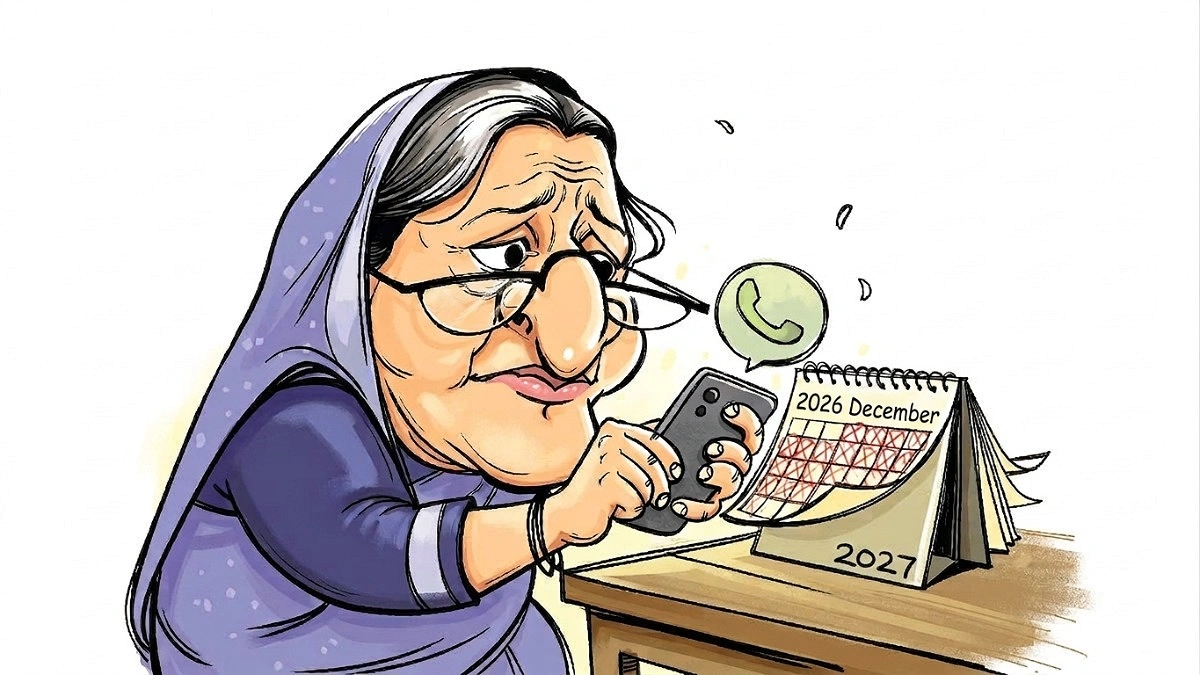
The deposed prime minister Sheikh Hasina, residing in India, had announced her return to the country in December. However, analyzing the situation, the Dhaka-Delhi diplomatic equations, and statements of Awami League leaders shows that she is not returning in December.
Her path to returning to the country is essentially closed from three directions - legal, diplomatic, and political.
Investigations have also revealed that Dhaka is no longer stuck solely on the question of extraditing Hasina. A clear message has been sent to India by the government that Hasina may reside in India; but she should not be given the opportunity to become active in Bangladesh’s politics, deliver political speeches, or engage in any form of organizational activities from there.
Dhaka’s stance is quite clear - whether India keeps Hasina is India’s matter, but she cannot use Indian soil to influence Bangladesh’s politics.
In the face of July mass uprising, Hasina fled and took refuge in India on 5 August 2024. Following this, many top-level leaders of the Awami League left the country. Many are in prison, while some are in hiding. After the change in power, the party virtually fell into a leadership and organizational crisis.
Despite this, Hasina has been maintaining contact with leaders and activists through virtual mediums. To alleviate the frustration of grassroots leaders, she had announced her decision to return to the country by December in an interview given to Reuters on July.
The announcement instilled new hope at the field level of the Awami League. However, there has been no visible progress in implementing that announcement so far.
Announcement of return, but no practical preparations
Several policymaking-level leaders of the Awami League residing abroad said the message circulated about Hasina’s return to the country is confined to a political statement. There are no visible preparations centered on her return at the party level.
Rather, it is being assumed within the party that she cannot return to the country by December. A new question stands before Awami League policymakers - if Hasina does not return to the country in December, what explanation will the party provide and how will it manage the expectations of its workers?
Dhaka’s demand
The most significant new factor behind the decreasing probability of Hasina’s return to the country is the government’s stance regarding India. Dhaka is no longer stuck solely on the question of extraditing Hasina.
According to investigations, the government’s immediate priority is to ensure that Indian territory does not become a source of political instability in Bangladesh. The government has informed that India can keep Hasina there if it wishes, but her presence must under no circumstances be allowed to be used as a platform for conducting political activities or exerting influence in Bangladesh.
If Hasina, staying on Indian soil, continues to deliver regular political speeches, maintain contact with Awami League leaders and activists, or issue instructions for party activities, the country’s political stability could be harmed.
Therefore, Dhaka’s stance is clear - if Hasina stays in India, let her stay, but she must not get the opportunity to interfere in Bangladesh’s politics. This assurance has now become crucial in Bangladesh-India diplomatic discussions.
This stance is also directly impacting the proposed visit of Prime Minister Tarique Rahman to India. Amid efforts to normalize Dhaka-Delhi relations, discomfort has arisen over Hasina’s political activities.
From Bangladesh’s side, to begin a new chapter in relations between the two countries, India’s stance must also be clarified. Prior to Tarique’s visit to India, Dhaka wants a clear commitment from Delhi that even if Hasina stays in India, she will not be able to disrupt the political stability of Bangladesh.
In the discussions regarding Tarique’s visit, the issue is no longer just trade, borders, water, or bilateral relations; Hasina’s future political status has also become a significant issue.
An adviser to the government told Agamir Somoy, “If Hasina stays in India and can conduct political activities from there, the discomfort in Dhaka’s relations with Delhi will increase. And if India imposes limits on her political activities, then her announcement of returning to the country in December will become even weaker.”
One of the major obstacles to Hasina’s return is now legal. She was tried in the International Crimes Tribunal in crimes against humanity cases committed in July uprising. A death sentence was also handed down to her in one of the cases.
As a result, she will have to face legal proceedings as soon as she returns to the country. There is no opportunity for her to avoid arrest or conduct political activities.
An extradition treaty exists between Bangladesh and India. Bangladesh said its legal position on the question of extraditing Hasina. However, she is staying in India and the issue of her return is no longer something that can be determined by Bangladesh’s decision alone.
It depends on India’s legal processes, diplomatic considerations, and the relations between the two countries.
Awami League’s organizational weakness
The highly centralized, individual-centric political structure created within the Awami League over the last 15 and a half years collapsed rapidly after 5 August. Many central-level leaders are in prison, many are abroad, and some are in hiding.
A large portion of field-level leaders and activists are mired in lawsuits and political uncertainty. Under these circumstances, if Hasina returns to the country, the Awami League no longer possesses the organized strength it once had to politically receive her.
Her to the country does not merely signify the repatriation of a former prime minister; it is a major political event. There are apprehensions of protests, counter-programs, and a deterioration of the law and order situation surrounding her return. The public anger generated against her following the uprising has not subsided.
A presidium member of the Awami League staying abroad said, “The announcement of Hasina’s return to the country was largely her own decision. She had directed the party’s central leaders to return to the country.
“However, due to lawsuits, arrests, and personal safety concerns, no one was able to implement it. Hasina herself announced her return to the country. But the reality has not changed since the announcement.”
Another member added, “Various diplomatic issues have now become entangled with her return. International support, India’s stance, and legal processes - everything must be taken into consideration.”
According to the other, “Even if she does not return in December, the expectation of her return will be maintained among Awami League leaders and activists.”
Hardliners’ calculations are different
A secretary of the Awami League, however, offers a different calculation. He claims that there is public discontent in the country regarding oil, gas, electricity, and the law and order situation. People have started comparing the situation with the era of the Awami League government.
In his opinion, if the situation deteriorates further, a political background could be created for Hasina’s return. He believes that she still maintains her international contacts. As a result, she possesses the capacity to project her position in the international arena.
What analysts are saying
Citizens for Good Governance (SHUJAN) Political Analyst and Secretary Badiul Alam Majumdar said it is not possible for Hasina to return by December. The day after taking refuge in India, she said they are no longer interested in Bangladesh. Her son also came live and announced that his mother is no longer interested in politics. She wants to spend the rest of her life in exile. Therefore, her return in December is just a figure of speech.”
He added, “Sitting abroad, Hasina speaks of democracy and accountability. But many lives were lost so that she could remain in power. She is still not taking responsibility for it. The country’s economy has been crippled through corruption, looting, and money laundering. To be held accountable for this, she should return or be brought back.”
Kazi Mohammad Mahbubur Rahman of the Department of Political Science at University of Dhaka said, “Hasina’s return no longer depends solely on her individual decision. It involves Bangladesh-India relations, the demands of both countries, geopolitics, and India’s legal aspects - which is a long-term process.
“But December is not very far away. And within this short timeframe, there is no clear sign of her return yet. I also do not see any preparation among party leaders and activists regarding her return. The overall situation does not indicate any sign of her return.”
