

Where a God has slept for millennia

Picture: Sudipto Acharjee Dhruvo
It happened many years ago. One day, an elderly man in his seventies, without much hesitation, set off along the narrow stream path of Taracha Canal. He had only one purpose—to see if he could catch some extra fish from the depths of this khum, surrounded by dense, ancient, and wild forest.
Absorbed in his passion for fishing, the old man did not even realize when he had wandered into the deepest part of the khum, standing face to face with a gigantic royal rock. Suddenly, the eerie silence around him was shattered by the appearance of a gigantic turtle! Fear froze the blood in his veins. Dropping his fishing gear, he fled for his life back to Shilbadha village.
That very night, the old man was struck by a severe fever. In the delirium of his burning sleep, he saw the strange turtle once again. But this time, the creature was not terrifying. Instead, in a solemn voice, it said:
“Do not fear me. Rather, tell everyone about me. I am your spirit, your deity. From now on, whenever you come here to fish, place an offering tray upon that royal rock and seek my permission. And beware, never try to disturb my sleep. The consequences will not be good.”
Many more stories like this are still told. According to the beliefs of the local Marma people community, righteous deities have lived in this deep and silent gorge since ancient times. The hill people regard this place with deep reverence, considering it sacred and supernatural.
According to another popular local legend, two local young men once poured poison into the entire khum to catch fish. Although the poison caused all the fish in the waters to die and float to the surface, two gigantic fish remained unharmed and could never be caught. Indigenous communities believe that these were no ordinary fish, they were deities themselves. It is from this miraculous event that the place came to be known as Debotakhum, the Abode of the Gods.
According to the elders of the local Marma and Bawm communities, this khum was once home to two enormous fish. Their gills shimmered with a golden glow, resembling ornaments of gold. Despite repeated attempts, locals were never able to catch them. On one occasion, poison was poured into the waters in an effort to hunt fish, but even then, no trace of the two mysterious creatures was found. According to local belief, the fish were not ordinary beings but divine entities or gods. Since then, local residents have referred to the place as “Debotakhum,” meaning the dwelling place of deities. In the Marma language, it is also sometimes called Thongchikhum.
The stories I have shared so far were not my own,they were being narrated to us by our guide, Priyo Da.
Today, I will take you into the kingdom of a khum. But before discovering which khum, it is important to understand what the word itself means. Khum is a Marma word meaning waterfall or a deep natural water basin. These formations are usually found upstream, where water relentlessly carves its way through winding paths between rocks and boulders, creating streams of crystal-clear water that eventually settle into a khum. While the surface appears calm and still, beneath lies an undercurrent of restless motion. This endless cycle of mountains, rocks, and water forms a rugged, stony civilization of nature.
Bandarban is often called the paradise of khums. But why is Debotakhum known as the “King of All Khums”? Today, I will share the story of our journey to Debotakhum.
Bandarban is a magical symphony of hills, clouds, and waterfalls. Yet, in recent years, the aspect of Bandarban that has become the greatest attraction for trekkers and travel enthusiasts is the khum. A khum refers to a deep natural pool or gorge. Located in the Rowangchhari Upazila of Bandarban, Debotakhum is one such breathtaking, primitive, and adventurous destination. This crystal-green waterway, nestled between two towering mountain walls, feels like a completely different world. Far removed from the noise and chaos of urban life, there is hardly any place comparable to Debotakhum for witnessing nature in its serene yet majestic form.
Recently, I had the privilege of visiting this divinely beautiful place. The plan to visit Debotakhum came about rather suddenly during a casual gathering with friends. Since the trip involved trekking and a fair bit of adventure, we prepared ourselves mentally and packed carefully. Our journey began from Dhaka. Boarding a night bus, we set off for Bandarban. As dawn light touched the winding mountain roads, our bus entered Bandarban town.
After arriving in the town, we freshened up at a hotel and enjoyed a traditional hill-style breakfast. Then we headed toward our main destination, the Liragaon Army Camp in Rowangchhari Upazila.
From Bandarban town, we hired a Chander Gari (local jeep) for Rowangchhari. As the vehicle sped along paved roads cutting through the mountains, the sight of green hills and drifting clouds on both sides erased all our fatigue in an instant.
Upon reaching Rowangchhari, our first task was to visit the army camp, where we submitted our names, addresses, and copies of our national identity cards to obtain permission. For security reasons, this regulation is strictly enforced in the hill regions. Once we received permission, we arranged for a guide. Hiring a local guide is mandatory for visiting Debotakhum or Shilbandha Waterfall. Our guide’s name was Priyo, a warm, friendly, and energetic young hillman.
After completing all the formalities regarding permission and the guide, we boarded another Chander Gari and headed toward Kachchhoptoli Bazaar. It is from Kachchhoptoli that the real trekking journey begins.
After arriving at Kachchhoptoli Bazaar, we left our extra luggage at a local shop and prepared for trekking. We carried only waterproof cameras, life jackets, and some dry food. Wearing plastic or anti-slip shoes is extremely important for the journey to Debotakhum, as the mountain streams and rocky paths can be dangerously slippery.
Our trek began from Kachchhoptoli. At first, we walked along earthen roads, and before long, we descended into the stream trail.
Picture: Sudipto Acharjee Dhruvo
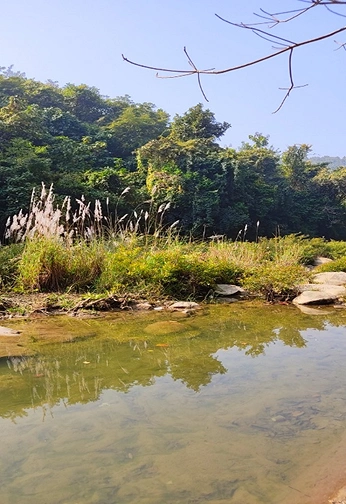
Towering hills surrounded us on all sides, while beneath our feet lay pebbled paths and streams of crystal-clear water flowing endlessly. The touch of the cold water against our feet brought an indescribable sense of peace. After nearly 45 minutes of trekking through stream trails and crossing small hills, we arrived at a Tanchangya village called Shilbandha Para. Nestled against the mountains, it was a quiet and serene settlement. The stilt houses, built from bamboo and wood, looked remarkably beautiful.
Beside Shilbandha Para lies the shimmering Shilbandha Waterfall, also known as the Silver Waterfall. The thunderous sound of water crashing down from above could be heard from quite a distance. Upon reaching the waterfall, we paused for a while to rest. Washing our faces and hands in the cool mountain water refreshed both body and mind. Yet, deep within us, excitement continued to build for the true highlight of our journey:Debotakhum.
Picture: Sudipto Acharjee Dhruvo
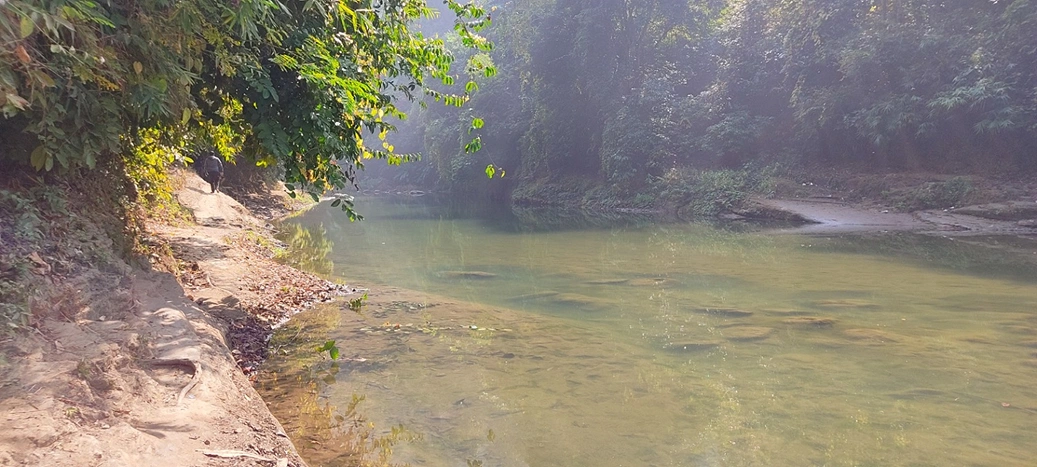
After crossing Shilbandha Waterfall, the path became even more challenging. We had to climb over massive rocks, wade through knee-deep water at times, and waist-deep streams at others as we continued our journey. After trekking for nearly another half an hour, we finally arrived at the entrance to Debotakhum.
The moment we looked ahead; words failed us.
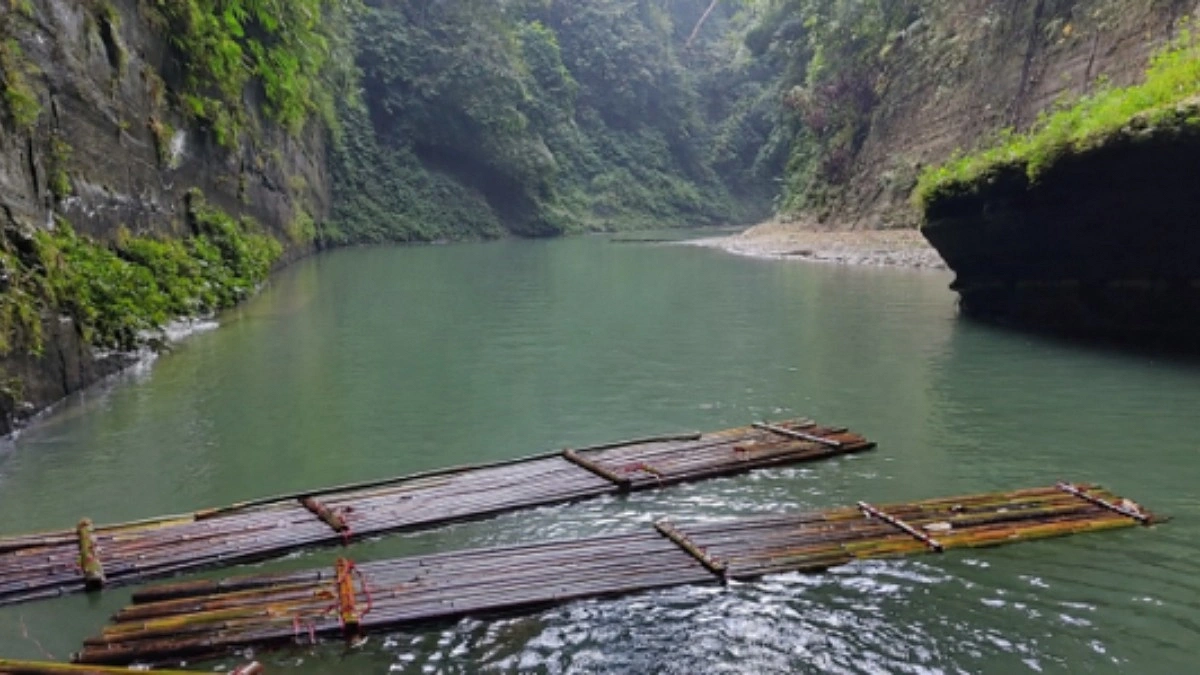
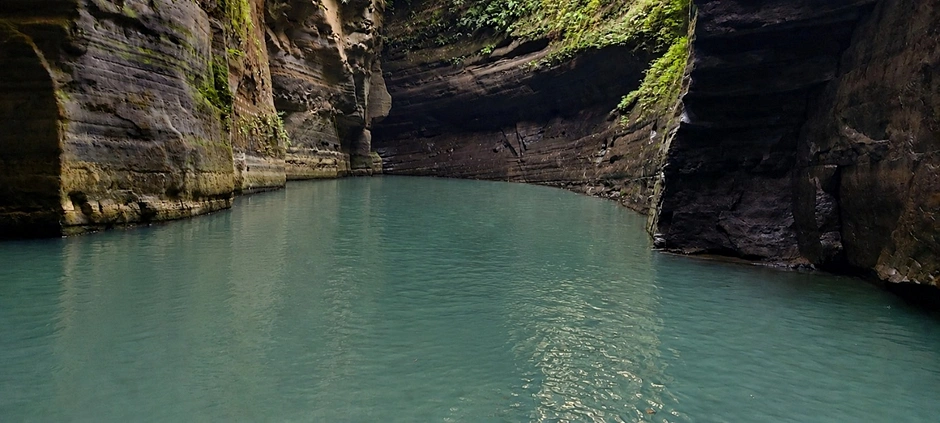
An overwhelming silence and an ancient solemnity seemed to engulf the entire surroundings. On both sides stood towering rock walls stretching toward the sky, while in between flowed a calm, motionless waterway of deep emerald green. Sunlight barely reached this hidden place, leaving the atmosphere dim, mysterious, and almost otherworldly. According to the beliefs of the local Marma and Tanchangya communities, deities reside within this khum, and its depth is impossible to measure. That is why it came to be known as Debotakhum, the Abode of the Gods.
Swimming in Debotakhum is considered dangerous because of its immense depth and the possibility of strong underwater currents. For this reason, wearing a life jacket is mandatory for everyone. The only way to explore the khum is by using bamboo rafts crafted by the local people.
With the help of our guide, we climbed onto one of those rafts.
As the raft slowly drifted deeper into the khum, it felt as though we had stepped into a time machine and travelled thousands of years back to some ancient, untouched world. A profound silence surrounded us,so complete that only the rhythmic splash of the oars against the water and the faint dripping of water from above could be heard.
The towering rock walls on both sides rose so high that, when we looked upward, the sky appeared only as a thin strip of light. Green vines and moss cascaded down the stone surfaces, adding to the surreal beauty of the place. The water of the khum was astonishingly clear, creating an almost ethereal feeling whenever we gazed into it, though its true depth remained impossible to comprehend. As the raft ventured farther inward, the walls of the khum gradually narrowed. At one point, it felt as though nature itself was embracing us with open arms.
We eventually reached the farthest end of the khum. There, the water felt even colder, and the atmosphere grew even more mysterious. Standing before such overwhelming grandeur of nature made us feel incredibly small and insignificant. The exhaustion, rush, and mental burdens of city life seemed to vanish into the tranquil waters of the khum like camphor dissolving into air. We spent quite some time sitting there in silence, absorbing the serenity around us. No conversations, no chaos,only a heavenly stillness.
After spending nearly an hour and a half at Debotakhum, we boarded the raft once again and returned to the entrance of the khum. As we made our way back, an indescribable sense of contentment lingered within us. The return trek somehow felt easier, perhaps because our hearts and minds were still captivated by the beauty of Debotakhum.
Picture: Sudipto Acharjee Dhruvo
Returning to Kachchhoptoli Bazaar, we had our lunch. The taste of that meal will remain unforgettable to us for a lifetime, rice made from jum (hill) grains, local chicken curry, bamboo shoots, and traditional lentils. Blending hunger with exhaustion, that simple meal felt nothing less than a divine feast.
The journey to Debotakhum is not merely an ordinary trip; it is an experience of losing oneself within the mysterious depths of nature. Such a perfect harmony of mountains, rocks, and water can only be imagined as the work of a divine creator. To escape the monotony of mechanical urban life and to awaken the adventurous spirit within, this journey to Debotakhum will remain one of the most treasured memories of my life.
The mountain trails, the cold waters of Shilbandha, and the serene silver-like flow of Debotakhum’s waters will keep calling me back. Even while sitting amidst the familiar chaos of city life, I will often find myself drifting back to that primordial, mythical realm once again.