Rangpur city on the path to development after years of neglect

Graphics: Agamir Somoy
The government is giving special priority to infrastructure development in Rangpur City Corporation, a long neglected urban area in northern Bangladesh. As part of the initiative, it is undertaking a special project worth Tk 16.53 billion. Concerned officials expect the project to bring overall infrastructure development to the newly established city corporation area. To this end, the Local Government Division has proposed a project titled ‘Development of Important Infrastructure of Rangpur City Corporation.’
After receiving the proposal, the Planning Commission held a meeting of the Project Evaluation Committee, or PEC, on July 23. The committee decided to return the Development Project Proposal, or DPP, to the Ministry of Local Government, Rural Development and Cooperatives with several recommendations for revision, according to relevant sources.
A senior official of the Planning Commission told Agamir Somoy that the project has been included in the list of unapproved new projects under the Annual Development Program, or ADP, known as the Green Page. Once implemented, the project will ensure the effective use of roads through road development, widening, repair, and maintenance. This will make transportation easier and improve convenience for road users and travelers. The road network will also be upgraded. In addition, improvements to the drainage system will reduce waterlogging. New bridges will be built to ensure the natural flow of water through canals. This will also improve the transportation system. Considering these aspects, the Planning Commission is treating the project as a priority.
According to sources, the total estimated cost of the project is Tk 16.53 billion. Of the total, the government will provide Tk 6.94 billion as loans and Tk 4.63 billion as grants. The remaining Tk 4.96 billion will come from the own funds of Rangpur City Corporation, the implementing agency.
After the processing is completed, the project is expected to be placed before the Executive Committee of the National Economic Council, or ECNEC, for approval. If approved, implementation is planned to begin this year and be completed by December 2028.
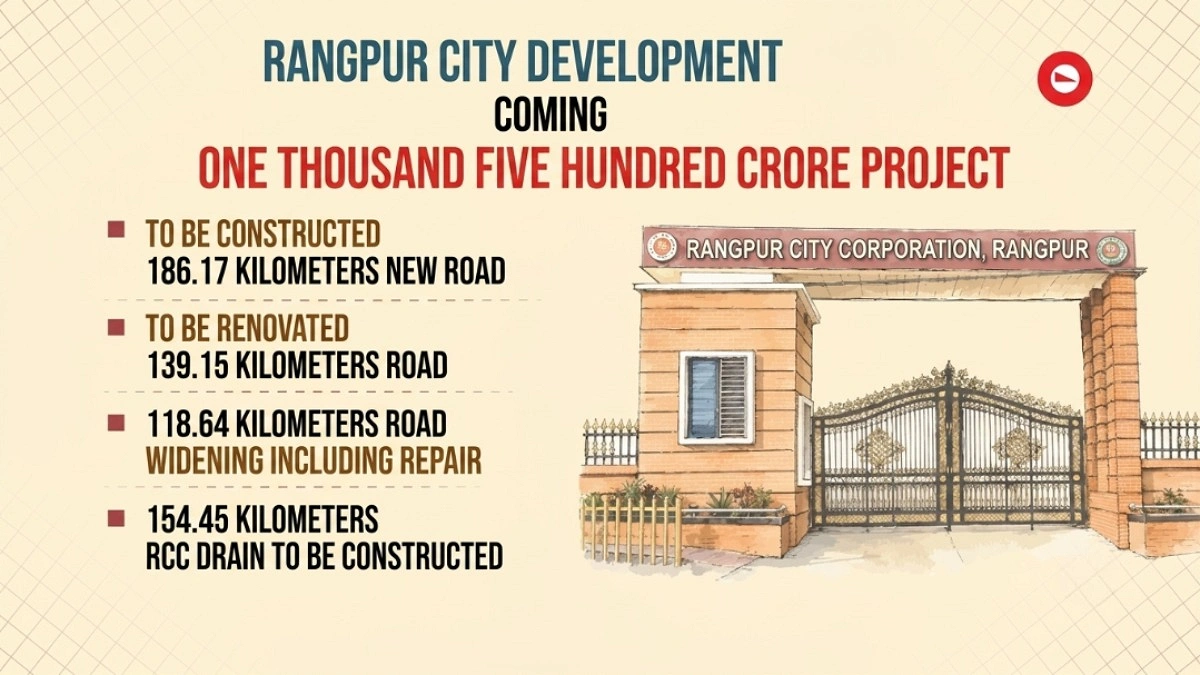
Officials involved with the project said that 186.17 kilometers of new roads will be constructed under the project. In addition, 139.15 kilometers of roads will be rehabilitated, 118.64 kilometers of roads will be repaired and widened, 31.60 kilometers of RCC roads will be built, and 154.45 kilometers of RCC drains will be constructed. The project also includes the widening of RCC roads and drains along 55.99 kilometers and the construction of 22 bridges with a total length of 661.35 meters.
According to sources at the PEC meeting, the proposed implementation period of the project from January 2026 to December 2028 has already elapsed. Therefore, it has been recommended that the implementation period be revised from July 2026 to June 2029. The meeting also noted that the project proposes Tk 11.57 billion in government funding and Tk 4.96 billion from the own resources of Rangpur City Corporation. In this regard, considering the city's revenue generation capacity, it has been recommended that the amount of self financing be reduced to a reasonable level.
The PEC meeting also recommended a review of several expenditure items. It said that the proposed allocation of Tk 558,000 for computers and laptops under the capital expenditure head should be reduced to Tk 200,000. It also recommended purchasing two motorcycles instead of the five proposed in the project. At the same time, it advised fixing the unit price of each motorcycle at Tk 140,000 in line with the Ministry of Finance circular. It further recommended that the DPP clearly mention in the relevant section how the project aligns with the government's election manifesto.
Former Secretary of the Implementation Monitoring and Evaluation Division, or IMED, Abul Monsur Md. Faizullah, told Agamir Somoy, “Such projects are necessary for local development. However, strict supervision must be ensured at every stage of project implementation. Otherwise, the pace of implementation may slow down. There is a risk of various complications arising.”
“It is also essential to appoint a competent and experienced project director to ensure the successful implementation of the project,” he added.