
Tk 100 Crore Proposed for Climate Change Response

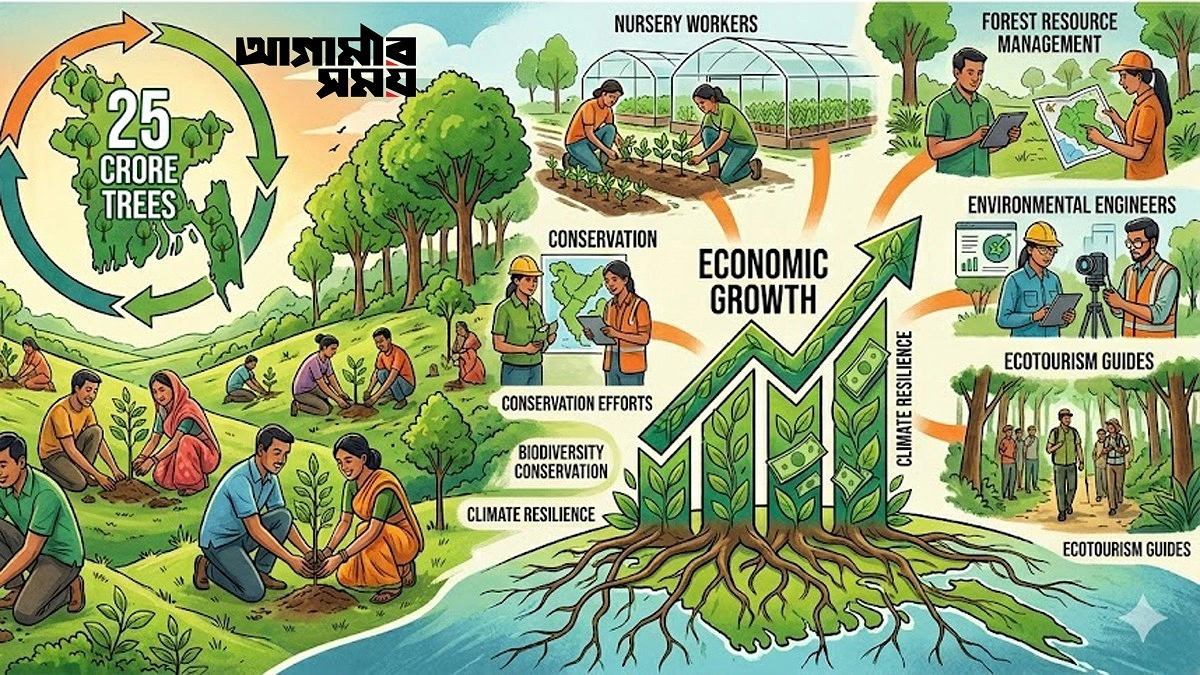
Graphics: Agamir Somoy
The government has announced a series of programs in the budget for the 2026-27 fiscal year to address the multifaceted impacts of climate change, including rising global temperatures, sea-level rise, salinity intrusion, cyclones, and floods. To this end, a proposed allocation of Tk 100 crore has been placed under the Bangladesh Climate Change Trust.
In his budget speech in Parliament on Thursday, Finance Minister Amir Khasru Mahmud Chowdhury said the government will plant 2.5 billion trees across the country over the next five years. The program is expected to generate around 350,000 green jobs, both directly and indirectly. In FY 2026-27, the government has set a target of planting 428.97 million saplings in 25,960 hectares of block plantations, 37.27 million saplings along 3,727 km of strip plantations, and 177.76 million saplings across 4,000 hectares of mangrove plantations. An additional 56 million saplings will be planted under homestead afforestation.
Under the ‘One Child, One Tree’ initiative, the government has finalized a plan to plant 100 million trees through primary school students in their homes or courtyards. To combat the effects of climate change, authorities will bring 50 percent of coastal mangrove forests under carbon trading initiatives. A ‘circular future model’ will also be implemented for waste management.
The budget also outlines several measures to control environmental pollution. To reduce air pollution, air quality will be regularly monitored through 15 Continuous Ambient Air Monitoring Systems (CAMS) and 16 additional C- CAMS stations. To control vehicular emissions, the government plans to establish 10 modern vehicle inspection centers under the Bangladesh Road Transport Authority (BRTA) and introduce electric bus services. New guidelines and updated regulations will also be introduced for e-waste management. Under the ‘reduce, reuse, recycle (3R)’ policy, the government has set a target to reduce plastic waste by 30 percent over the next five years.
Water resource management has also been identified as a key priority. The finance minister said large-scale canal excavation and re-excavation projects are being implemented nationwide to reduce waterlogging, expand irrigation facilities, and maintain ecological balance. Over the next five years, the government plans to excavate and re-excavate 20,000 km of rivers, canals, and water bodies. So far, 6,598 km of canal excavation work is already underway.
In the next fiscal year, the government will construct, rebuild, and repair 309 km of embankments and flood walls. It has also set a target to improve 484 km of river routes by increasing navigability and removing submerged chars. Under the river restoration program, at least one river or water body in each division will be freed from encroachment and revived. Restoration and flow improvement work is also ongoing for rivers including the Dhaleshwari, Lohajang, Alai Kuri, Magra, Salta, Sutang, Bankkhali, and Barnai.
In addition, integrated development of haor and baor regions and measures to reduce salinity in coastal areas will be implemented through various projects. The ECNEC-approved ‘Padma Barrage Project’ will be implemented over the next seven years, benefiting around 37 percent of the population. The government has also initiated the ‘Teesta Master Plan’ for the development of the northern region.
The budget proposes Tk 10,533 crore for the Ministry of Water Resources and Tk 10,350 crore for the Ministry of Disaster Management and Relief. The government expects these initiatives to play a significant role in addressing climate risks, strengthening environmental protection, and improving water and disaster management systems across the country.
