
Big incentives for industries, retail businesses in tax net

Agamir Somoy graphics regenerated by AI.
A village shopkeeper will have to pay 2 Taka as VAT for selling goods worth 1,000 Taka. This will be imposed as Advance Income Tax (AIT) in the 2026-27 fiscal year budget. In other words, a proposal will be made to impose AIT at a rate of 0.20% at the retail supply stage. Through this, a vast number of small traders will come under the tax net for the first time.
Additionally, an announcement may be made to introduce a 'flat rate turnover tax' on market and area-based shopkeepers. According to government sources, this will simplify tax payment. But in reality, small shopkeepers will be compulsorily brought under tax registration. According to economists, while there is a need to increase revenue collection, this decision will impose additional pressure on small traders amid rising inflation.
However, to provide relief to the lower and middle classes, significant reductions in VAT and taxes are being offered on many essential goods. At the same time, various incentives through tax exemptions are being announced to foster new industries, aiming to attract domestic and foreign investors. Finance Minister Amir Khasru Mahmud Chowdhury believes this will create new employment opportunities. He is set to announce the new budget at a time when multiple crises must be confronted, including rising inflation, investment stagnation, banking sector instability, the impact of the war in the Middle East, and the challenges posed by the new US tariff policy.
Amidst such adversities, the Finance Minister will present the first budget of the BNP government today. This will be his first budget presentation. The budget will be approved by the cabinet chaired by the Prime Minister before being presented in the National Parliament at 3 PM.
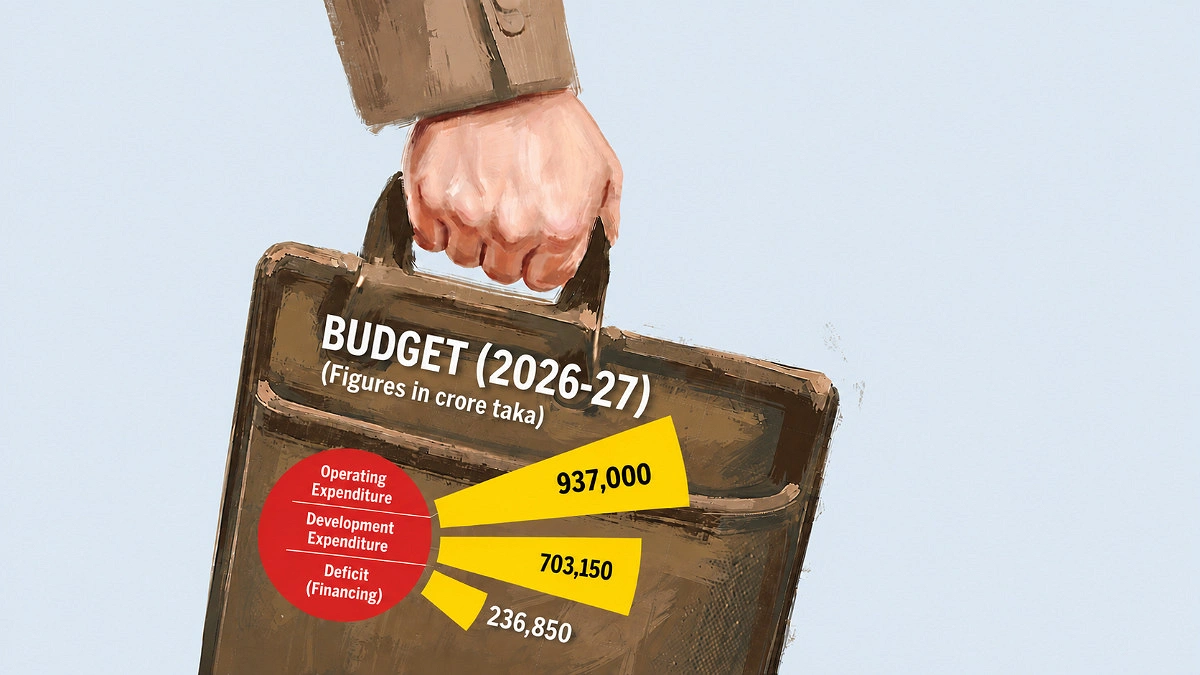
For the 2026-27 fiscal year, total expenditure is budgeted at 9 lakh 38 thousand crore Taka, and revenue at 7 lakh 1 thousand 150 crore Taka. The deficit (including grants) is 2 lakh 36 thousand 850 crore Taka, and excluding grants, it is 2 lakh 43 thousand crore Taka.
While there are tax exemptions in the upcoming fiscal year, the tax net has been strategically spread. To manage the pressure of a large budget, the government's focus for revenue collection will be everywhere, from cities to villages. The NBR (National Board of Revenue) will need to collect over 6 lakh crore Taka. However, past experience with revenue collection is not favorable. Analysts say that achieving such a huge revenue target without reforms is impossible.
In the new budget, the NBR has fixed five-year tax rates for companies, firms, trusts, and associations of persons. Publicly traded companies, banks, insurance, financial institutions, and tobacco companies will face income tax ranging from 22.5% to a maximum of 45%. Additionally, mobile phone operators, associations of persons, cooperative societies, private universities, medical colleges, dental, and engineering colleges will have to pay 10% to 45% income tax.
The government wants to allocate funds to various areas of the education system. In that context, allocations may be made for introducing a mid-day meal, 'One Teacher One Tab', and education on third languages. The Finance Minister may propose keeping turnover up to 50 lakh Taka tax-free for SME entrepreneurs.
Tax-Free Income Limit: For the 2026-27 and 2027-28 fiscal years, the annual tax-free income limit for individual taxpayers will be increased from 3.5 lakh Taka to 4.75 lakh Taka. Alongside general taxpayers, the tax-free income limit will also be increased for female taxpayers, taxpayers over 65 years of age, third-gender taxpayers, taxpayers with disabilities, gazetted freedom fighter taxpayers, and gazetted injured July 2024 warrior taxpayers. The tax-free income limit for each child or dependent of parents or legal guardians of persons with disabilities will also be increased.
Relief on Essential Goods: A reduction in taxes at source on 60 essential goods will be announced. Currently, taxpayers must pay tax at source at rates of 5%, 2%, or 1% on the supply of agricultural and consumer goods. In the new budget, this will be reduced to 0.5%.
Additionally, the 5% advance tax on the import of kidney dialysis filters will be waived; the 5% advance tax on importing kidney dialysis filters will be reduced; advance income tax on importing 15 products used by persons with special needs will be reduced from 2% to 1%; tax at source on the supply of gold and gold jewelry will be reduced from 5% to 0.5%; advance tax on importing computer printers, laptops/portable data processing machines, flash memory, and monitors will be reduced from 5% to 2%. Furthermore, advance tax on importing 22 raw materials for the local mobile phone manufacturing industry will be reduced from 5% and 2% to 1%.
Having a Tax Identification Number (TIN) will be made mandatory for opening bank accounts. However, students, government allowance recipients, and pension beneficiaries will be exempt from this condition.
Major Incentives for Investment and Industrialization: Among the initiatives for investment and industrialization in the new budget, customs duties on importing solar power sector materials will remain zero, and this benefit will remain in effect until 2031. Additionally, substantial customs duty exemptions will be provided for the production of electric cars, buses, and trucks, effective until 2031. Concessional benefits will be available for importing raw materials and components for the e-bike industry. Existing tax-customs benefits for the production of mobile phones, refrigerators, ACs, washing machines, ATMs, and CCTV cameras, and tax-customs exemptions for the computer and digital device industry will remain in effect until 2030. Additional import duties will be waived on 10 raw materials for the production of smart cards and bank cards.
Consumer Goods: Import duties on raw materials for baby food production will be reduced from 15% to 10%, which will help reduce baby food prices in the market. Additionally, the 5% regulatory duty on all types of spices and the 5% regulatory duty on date imports will be completely withdrawn. To encourage local agricultural production, VAT will be waived on 36 raw materials for pesticide and insecticide production, and duties on importing zinc ash, a raw material for zinc sulfate fertilizer, will be reduced to zero. Concessional benefits for importing veterinary medicines will also be expanded. At the same time, import duties on cashew nuts will be increased to protect domestic cashew farming, a 20% supplementary duty will be imposed on importing pangas fish fillets, and initiatives have been taken to provide duty exemptions on importing raw materials for feed and machinery for the poultry, dairy, and fisheries sectors.
For electric vehicle (EV) imports, the current tax-duty burden is 93%. Under the new proposal, for EVs priced up to $25,000, the tax-duty rate will be 64%, and for EVs priced between $25,000 and $50,000, it will be 80%. Advance tax is deducted during EV registration and fitness renewal, and initiatives are also being taken to reduce this. Additionally, the regulatory duty on importing brand-new hybrid cars with engine capacities up to 1800cc may be withdrawn.
Tax at source is currently deducted at various rates on export incentive funds. In the upcoming fiscal year, tax at source may be reduced from 10% to 5%. Additionally, tax at source on interest on loans taken by private sector entrepreneurs from various foreign sources may be reduced from 20% to 10%. Previously, this tax at source was waived.
To increase the use of renewable energy, companies engaged in generating and supplying power by establishing solar power plants may be granted income tax exemptions on their earnings until June 30, 2035. VAT per gram on gold jewelry may be halved to 5,000 Taka.
The 15% VAT at the production stage for ACs and refrigerators is being reduced to 7.5%. This may also reduce the price of ACs and refrigerators. Furthermore, advance tax on importing 22 types of raw materials for mobile phone production may be reduced from 5% to 1%. This could potentially lower the price of domestically produced mobile phones.
To encourage cashless transactions, initiatives have been taken to reduce the import duty on Point of Sale (POS) machines from 10% to 5%. This could lower the price of POS machines.
Proposals are coming to make all types of customs duties zero until 2031 on importing necessary materials for the solar power industry. At the same time, substantial tax-customs exemptions will be provided for importing parts and raw materials used in producing electric cars, buses, and trucks domestically, which will remain in effect until 2031.
Proposals have been made to completely withdraw the existing 39.75% tax burden on importing electric vehicle chargers and charging stations and to reduce taxes on importing electric vehicles and plug-in hybrid vehicles. Conversely, tax rates on petrol and diesel vehicles with engine capacities from 1200cc to 1600cc will be increased.
For the development of the IT sector, proposals include significant tax-customs reductions on importing computers, laptops, servers, printers, monitors, and SSDs, and tax reductions on importing POS machines. Simultaneously, proposals include VAT exemptions for startups, freelancers, and content creators, and the withdrawal of the 300 Taka tax imposed on mobile SIM cards.
Proposals have also been made for tax exemptions on fertilizers and pesticides in the agriculture sector, VAT and tax exemptions on heart stents, eye lenses, and dialysis supplies in the health sector, and complete customs duty waivers on importing 21 types of assistive materials for persons with special needs.
Due to various tax changes in the budget, the prices of some goods may increase this time. For example, the price tier for tobacco products, including cigarettes and bidis, may increase by up to 15%.
Budget Structure: Total expenditure is 9 lakh 38 thousand crore Taka, total revenue is 7 lakh 1 thousand 150 crore Taka, deficit (including grants) is 2 lakh 36 thousand 850 crore Taka, and deficit (excluding grants) is 2 lakh 43 thousand crore Taka. For revenue collection, the National Board of Revenue (NBR) aims to collect 6 lakh 4 thousand crore Taka, non-NBR revenue is 25 thousand crore Taka, and receipts excluding taxes are 66 thousand crore Taka. Additionally, foreign grants are 6 thousand 150 crore Taka. To cover the deficit, foreign loans of 1 lakh 9 thousand 850 crore Taka, bank loans of 1 lakh 12 thousand crore Taka, savings certificates of 8 thousand 500 crore Taka, and other sources of 6 thousand 500 crore Taka will be utilized this year. The inflation target is 7.5%, and the GDP target is 6.5%. However, there will be few specific measures to control inflation.
What's in the Operating Sector: Operating budget expenditure has been set at 6 lakh 5 thousand 740 crore Taka. Of this, interest payments will cost 1 lakh 27 thousand crore Taka. The allocation for the Annual Development Program is 3 lakh crore Taka. Additionally, a new pay scale for employees will be announced, with an extra allocation of 35 thousand crore Taka in the budget. Eight new programs are being added to the social security sector in the upcoming budget. Furthermore, an allocation of 300 crore Taka is set for the creative economy. Allocations for the education and health sectors are seeing significant increases. The health sector allocation is nearly doubling to 79 thousand crore Taka. The education allocation is 1 lakh 36 thousand 646 crore Taka.
