


How far is the circular corridor bypassing the capital?

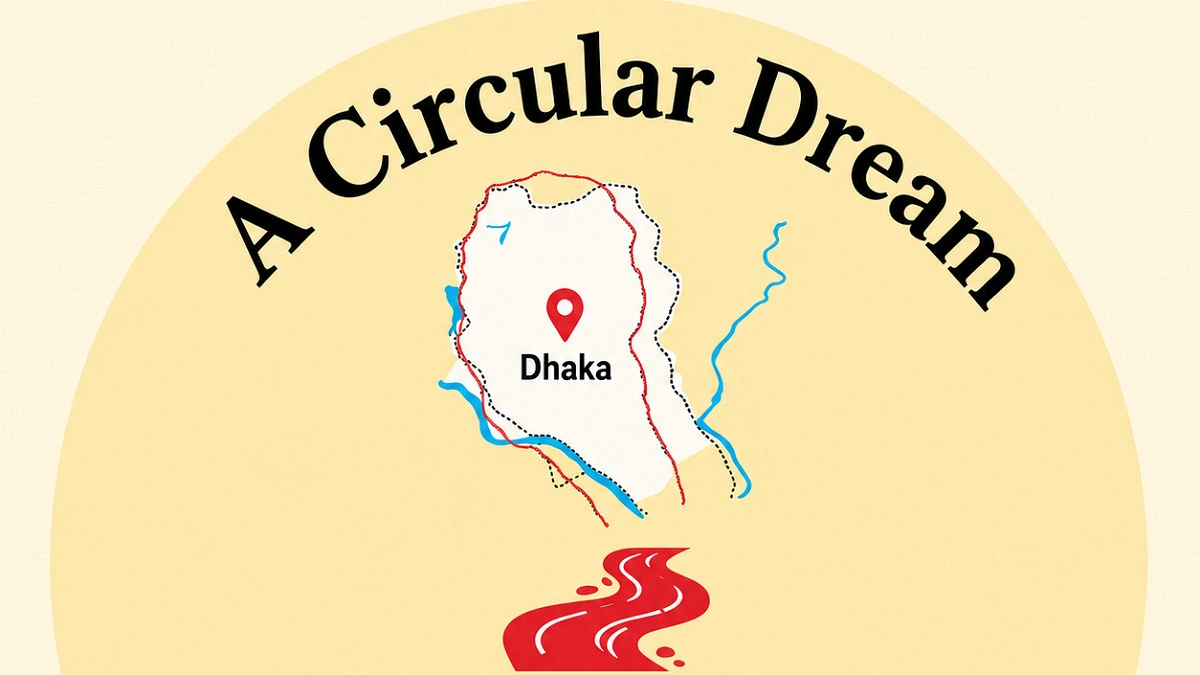
Agamir Somoy graphics regenerated by AI.
Numerous rivers surround the capital. Roads lie along the riverbanks, with railways running above them. An ultra-modern corridor designed to bypass the capital—this painted picture of public transit represents circular communication. This report explores the current stage of implementing this dream route.
Focus on Waterways for the Solution
Believe it or not, the government has to spent nearly 15 taka to earn just 1 taka. And, over years operating a dozen water buses generated a revenue of BDT 2.52 crore, against an expenditure of BDT 37.87 crore—resulting in a loss of BDT 35.35 crore!
Losses were inevitable. Water buses were dispatched every hour from Sadarghat, taking another hour to reach their destination, whereas the road journey takes a little over half an hour. Why, then, would passengers choose water buses? Due to the hassle of reaching the terminals, river pollution, and falling behind in time efficiency compared to road and rail, the water bus service was ultimately shut down.
However, this circular waterway remains essential. Experts agree, and the incumbent government is refocusing on the circular waterway once again. Yet, the causes of past failures in waterway development, terminal, and ghat construction remain unaddressed. If this route is reopened without resolving those issues, it risks being shut down once more.
Last July, multiple meetings took place involving the Prime Minister's Office, the Ministry of Shipping, and the Bangladesh Inland Water Transport Authority (BIWTA). In a meeting chaired by the Prime Minister Tarique Rahman on July 1, instructions were given to arrange the deployment of electric water buses on the existing circular waterway within one month. Following this, on July 9, the Ministry of Shipping decided during a meeting to discuss with interested entrepreneurs the launch of private commercial public transport on the Gabtoli–Sadarghat waterway route. On July 14, BIWTA held discussions with operators interested in running high-speed launches, speedboats, passenger catamarans, and tourist vessels.
Md. Zakaria, Secretary to the Ministry of Shipping, said that the waterway is operational and there are no major issues for small to medium vessels on most of the route. However, due to the Bosila Bridge, larger vessels cannot navigate that segment, though there is currently no plan to operate large vessels there. The problem lies in the Ashulia–Tongi section, where even small vessels cannot operate. According to him, initiatives will be taken to launch water buses every 20 minutes from Gabtoli to Sadarghat, which will increase the likelihood of attracting passengers. On the remaining stretches, passengers are being transported via smaller local routes.
The new initiative proposes operating smaller vessels at higher frequencies, building modern landing stations, repairing and widening connecting roads, preventing passenger harassment at ghats, and controlling river pollution. However, almost all of these were the very weaknesses of the previous water bus service. Consequently, if the effort is limited once again to merely purchasing vessels or hiring operators, the risk of repeating past failures remains high.
There is a 110-kilometer circular waterway encompassing the Buriganga, Turag, Shitalakshya, Balu, and Dhaleshwari rivers around Dhaka. Among this, 63 kilometers have a depth of 12 feet, and the remaining 47 kilometers have a depth of 8 feet. Maintenance dredging is currently underway to increase a 10-kilometer section to a depth of 12 feet. In short, the problem is not a lack of waterways; even with the waterways and infrastructure in place, it could not be turned into an effective passenger transportation system.
Here is the English translation of the provided article:
According to transport expert Professor Shamsul Hoque of BUET, speaking to Agamir Somoy, it would be a mistake to design waterways solely around passenger transport. If people need to travel quickly, they will choose whatever mode is most convenient for them. The focus should instead be on freight transport, as moving goods by water is cost-effective. The waterway could become truly effective if the issue of large vessels being unable to move from one river to another is resolved, making all five rivers navigable along a single unified route.
Efforts to keep the waterways operational by freeing riverbanks from illegal occupation have also been ongoing for a long time. From 2009 to 2024, a total of 17,829 illegal structures were demolished in the area stretching from the BG Mouth to Ashulia, recovering 519.04 acres of foreshore land. Under the jurisdiction of the Narayanganj River Port area, an additional 6,963 illegal structures were evicted between 2010 and 2024, reclaiming 316.06 acres of land. Furthermore, against a target of installing 7,100 boundary pillars to demarcate the waterway, 6,320 pillars have been erected so far.
Professor Moazzem Hossain of BUET emphasized that to ease the pressure on Dhaka's roads, there is no alternative to effectively activating the circular waterway. If this initiative succeeds, overall traffic capacity will increase. However, the reasons behind past failures must be addressed; otherwise, questions will remain regarding how long the service can survive. Water bus services were initially launched on August 28, 2010, on the Badamtali–Gabtoli route and on November 22, 2014, on the Narayanganj–Tongi route. Later, the Narayanganj–Tongi route was shut down in September 2019, followed by the Badamtali–Gabtoli route in March 2020.
According to official documents from the Bangladesh Inland Water Transport Corporation (BIWTC), the primary reason cited for the closure of the water buses was the improvement of road connectivity. Passengers could reach their destinations faster by road on the Gabtoli–Sadarghat route. Daily, 105 large and small buses, minibuses, and legunas operated on the road from below the Badamtali Bridge to Gabtoli. Consequently, commuters preferred road transport over water buses.
On the Narayanganj–Tongi route, the water bus faced direct competition from railways. Frequent shuttle trains run between Narayanganj and Tongi. Since the Narayanganj railway station is located near the river port, passengers chose the train as a faster mode of communication. Thus, the assumption that simply deploying vessels on the river would guarantee passengers proved far removed from reality. Because the water bus terminals were located on the periphery of the city, passengers faced severe traffic jams just to reach the ghats. Connecting feeder transport to the ghats was also inadequate. Communication infrastructure at the Gabtoli landing station was poorly developed, and intermediate landing stations lacked sufficient facilities for passengers to board and alight. As a result, commuters could reach their final destinations by road in the time it took just to arrive at a water bus terminal.
Another reason for the lack of passengers was river pollution. During a Ministry of Shipping meeting, severe water pollution in the Buriganga was highlighted as a key factor. However, there is no evidence of significant improvement in the pollution levels today. A recent survey identified 424 liquid waste discharge outlets into the rivers surrounding Dhaka: 66 from Dhaka WASA, 21 from Dhaka South City Corporation, 16 from Dhaka North City Corporation, 37 from Narayanganj City Corporation, and 244 from various private factories and industrial units. For over two decades, numerous initiatives—including river dredging, terminal construction, eviction drives, and purchasing water buses—have been undertaken. Yet, the circular waterway has failed to become a reliable daily commute option for Dhaka's residents. Now, a fresh initiative has been launched to introduce electric water buses. Relevant stakeholders are asking: will the new vessels solve old problems, or will they simply hit the water only to add new numbers to the loss ledger?
A Major Opportunity along Roads Stagnant for 40 Years
The concept of building a circular road around Dhaka to mitigate city traffic originated nearly four decades ago, right after the devastating floods of 1988. Subsequent transport planning for Dhaka was built around this concept. Yet, after 38 years, the capital has still not received a complete ring road. Instead, bits and pieces have emerged—a road segment here, an elevated expressway or bridge there, construction preparations somewhere else, and plans stalled on paper in other stretches. In short, the desired bypass route connecting one end of the city to another to avoid traffic bottlenecks remains unbuilt.
Now, hope has emerged once again regarding the circular road. Most recently, on August 23, a view-exchange meeting regarding the implementation of the Dhaka Inner Circular or Ring Route was held at the Road Transport and Highways Division with relevant officials, chaired by State Minister for Road Transport Habibor Rashid. It was stated at the meeting that the total length of the Dhaka Inner Circular Route will be 88.80 kilometers, comprising a 25.80-kilometer "Eastern Bypass" and a 63-kilometer "Western Bypass." Notably, the Revised Strategic Transport Plan (RSTP) of 2015 had identified the Inner Circular Road as a crucial infrastructure component for mitigating traffic congestion, setting its length at 73 kilometers back then. A decade later, a major portion of the newly proposed route still awaits construction.
Md. Anisur Rahman, Additional Secretary (Urban Transport Section) of the Road Transport and Highways Division, told Agamir Somoy, "Given Dhaka's traffic reality, there is no alternative to this road. It is critical to implement the project as quickly as possible; it has already been delayed significantly due to various reasons."
Originated in 1988: The concept of the circular road began after the devastating flood of 1988. Alongside the plan to build embankments around Dhaka for flood protection came the idea of constructing a ring road on top of those embankments. While the western embankment was implemented in the early 1990s, the eastern embankment and road were never realized. Subsequently, multiple feasibility studies were conducted for the eastern section in 1998, 2006, and 2017. It was officially incorporated as the "Inner Circular Road" in the 2015 RSTP. In essence, more time has been spent on planning and feasibility studies alone than it would take to build a major highway several times over.
88.80 km Road Divided into Two Sections
According to data from the Road Transport and Highways Division, the proposed Inner Circular Route will start from Abdullahpur and loop through Dhour, Birulia, Gabtoli, Bosila, Loharpul, Babubazar (Swarighat), Kamrangirchar, Teturia, Postogola, Kutubpur, Chashara, Hajiganj, Shimrail, Demra, Beraid, Purbachal, and Tetuljhum before returning to Abdullahpur to complete the circle. The total length is 88.80 kilometers. The 25.80-kilometer "Eastern Bypass" section—stretching through Demra, Beraid, and Purbachal up to Abdullahpur—will largely have to be constructed through new alignment and land acquisition. Official documents state that its feasibility study is complete, but physical construction has not yet begun.
On the other hand, the 63-kilometer "Western Bypass" section extends from Abdullahpur through Dhour, Birulia, Gabtoli, Bosila, Loharpul, Babubazar, Postogola, Chashara, Hajiganj, Shimrail, and Demra. A major portion of this segment has either already been built or is currently being executed under various separate projects.
63 km Fragmented Across Projects: Out of the 63 kilometers of the Western Bypass, approximately 18 kilometers are implemented or under implementation through separate projects by different agencies. This includes 5.90 kilometers from Abdullahpur to Dhour under the Dhaka-Ashulia Elevated Expressway project, 8.10 kilometers from Chunkutia to the Postogola Bridge end under the Dhaka-Mawa Expressway project, 3 kilometers from Shimrail to Demra on a Public-Private Partnership (PPP) basis, and 5 kilometers from Bosila to Loharpul under the Dhaka South City Corporation.
Thus, instead of executing the ring road as a single unified project, its various segments have been absorbed into multiple disparate projects—some as expressways, some as road developments, and others as city corporation initiatives—leaving the route disconnected as a functional ring road. For the remaining 45 kilometers, the Roads and Highways Department (RHD) has drafted four project proposals to upgrade a total of 32.5 kilometers across the Dhour–Birulia–Gabtoli–Rayerbazar section (including the Gabtoli Interchange) and the Postogola–Chashara section. This means these segments have not yet progressed to full construction.
For the remaining ~12.95 kilometers, RHD has completed a feasibility study for a second bridge at Babubazar or Swarighat, where the design is in its final stages and the Development Project Proposal (DPP) is being formulated.
One Ring Road, Countless Projects: Implementing fragments of a unified ring road through standalone projects has emerged as a major reason behind the project's prolonged delay. In 2024, the Bangladesh Bridge Authority (BBA) also reported completing a feasibility study for the Dhaka Elevated Inner Circular Ring Road. According to their data, the alignment's total length is roughly 88 kilometers, with about 25.80 kilometers of elevated sections planned for execution under BBA's supervision.
Meanwhile, Dhaka South City Corporation has initiated the process to hire consultants for developing the segment of the Inner Circular Ring Road from Rayerbazar Sluice Gate to Loha Bridge. Official tender documents published in 2024 set the timeframe for the first phase of this work from July 2024 to December 2027.
A Decade-Old Plan Still Unimplemented: The 2015 RSTP outlined plans for three ring roads: Inner, Middle, and Outer. The Inner Ring Road was set at 73 kilometers, with different segments listed as separate development projects. Since then, even the alignment has shifted. In previous plans, the southern portion was supposed to route toward Signboard via the Dhaka-Chittagong Highway; the current alignment, however, extends nearly 10 kilometers further south through Chashara in Narayanganj.
Over time, it is not just physical construction that has been delayed—the planned route, project framework, and implementing agencies have repeatedly changed as well. During the latest view-exchange meeting, progress reports were presented alongside reviews of the current status of the Inner Circular Road. Although verification committees and project proposals for individual components are moving forward, no concrete deadline has been set for overall completion.
Infrastructure expert Professor Moazzem Hossain of BUET noted, "This bypass is essential to reduce pressure on Dhaka. Although planned long ago, proper initiatives were not taken for implementation. If executed now, it will be immensely beneficial. This road will not only discourage unnecessary vehicles from entering Dhaka but will also expand the city's overall capacity."
After 38 years trapped in a web of feasibility studies, alignment changes, and overlapping projects, the circular road is once again back in the spotlight. However, if it remains confined to fragmented projects across multiple agencies this time as well, this long-standing plan to ease Dhaka's gridlock will simply keep spinning in another endless cycle of studies rather than reaching reality.
Railways Currently Out of Consideration
Circular railway: two words representing the idea of a train line looping around Dhaka. That vision is now effectively put on shelve. The government has no active plans for it either. Even in the Revised Strategic Transport Plan (RSTP), which was updated through 2045, it failed to find a place.
Yet, the feasibility of this project was assessed twice, and both times the results indicated that the project was economically viable. At one point, project financing was actively sought. Loan negotiations with South Korea had progressed, and discussions were underway with the Asian Development Bank (ADB) as well. Records show that constructing and operating it along the lines of the Metro Rail was documented, with a completion target set for 2028. All of that is now in the past; work on the project was halted in 2021.
Md. Afzal Hossain, Director General of Bangladesh Railway, told Agami's Somoy, "It all depends on the government's plans. We have kept many aspects prepared. If the government wishes, the project can be implemented."
According to the latest information, the main objective of the feasibility study for the circular railway was to determine the viability of constructing a rail line around Dhaka so that, if the survey results were positive, an investment project could subsequently be undertaken. The study evaluated potential routes, operational systems, technology, rolling stock, electric traction, and signaling systems, alongside economic, social, and financial feasibility.
One feasibility study stated that by 2035, the circular train would transport 1,065,016 passengers daily. By 2055, passenger numbers would rise to 1,575,130. The highest passenger density would be in the Gabtoli area, where an estimated 146,215 passengers would board and alight daily by 2035. Consequently, the circular train station in Gabtoli was planned to connect with Metro Rail Lines 2 and 5.
An 80.89-kilometer railway line was proposed along the perimeter of the Dhaka metropolitan area. Of this, 70.99 kilometers would be elevated, while 9.9 kilometers would run underground. Underground stations were planned for Kamrangirchar, Sadarghat, and Gabtoli. Electric trains would stop at stations every 3 minutes on average, with a mean distance of 3.37 kilometers between stations. Electrical substations were planned in Uttara, Kamrangirchar, and Demra to power the system.
However, according to transport expert Professor Md. Hadiuzzaman of BUET, "Implementing such a massive project with this budget was nearly impossible. Had it been on ground level, it might have been different, but constructing elevated railway tracks is extremely expensive."
Meanwhile, a picture of the government's current stance on the future of the circular railway emerged during an August 22 meeting held at the Road Transport and Highways Division. The meeting focused on the circular road, but Bangladesh Railway was also invited. Md. Monirul Islam Firozi, former director of the circular railway project, attended on behalf of the railway. However, no discussion took place regarding the circular railway during the meeting.
The feasibility study for the railway was completed in 2021. The final report was submitted in May 2021 and accepted by Bangladesh Railway in June. Since then, no progress has been made toward physical construction. According to project data, as of March 2021, the physical progress of the feasibility study project stood at 98.5%, with financial progress at 45.50%.
The study proposed constructing an approximately 81-kilometer railway line around Dhaka—roughly 71 kilometers elevated and 10 kilometers underground. The line was designed to be electric, double-track, and 1,435 mm standard gauge, with a maximum speed set at 120 km/h. The proposed alignment planned to connect various areas, including Tongi, Dhour, Gabtoli, Mohammadpur, Sadarghat, Chashara, Siddhirganj, Demra, Trimohoni, Beraid, and Purbachal, with plans for interchanges connecting to Metro Rail, buses, and other public transport modes.
Another major hurdle for the circular railway was alignment conflicts with other infrastructure projects. The feasibility study noted that nearly 22 kilometers of the rail alignment overlapped with the Eastern Bypass and road infrastructure within the same corridor. Plans called for multi-level rail and road construction in those segments, identifying land acquisition, eviction, cost-sharing, and clear division of work between the two projects as major challenges.
Additionally, coordination between the circular railway, circular road, and Eastern Bypass emerged as a critical issue. Any change in the alignment of one project risked affecting the design of the others.
Although the circular railway is not currently in the government's active plans, Bangladesh Railway does not want to rule out the possibility entirely. Once a road is built, finding space for a adjacent railway track becomes difficult. Therefore, Bangladesh Railway has requested that at least five meters of space be reserved alongside the circular road during its construction. This position makes it clear that while the project is not presently on the implementation list, the agency aims to keep the door open should future government policy shift.


