


Inside the Myanmar military's campaign to reclaim lost territory

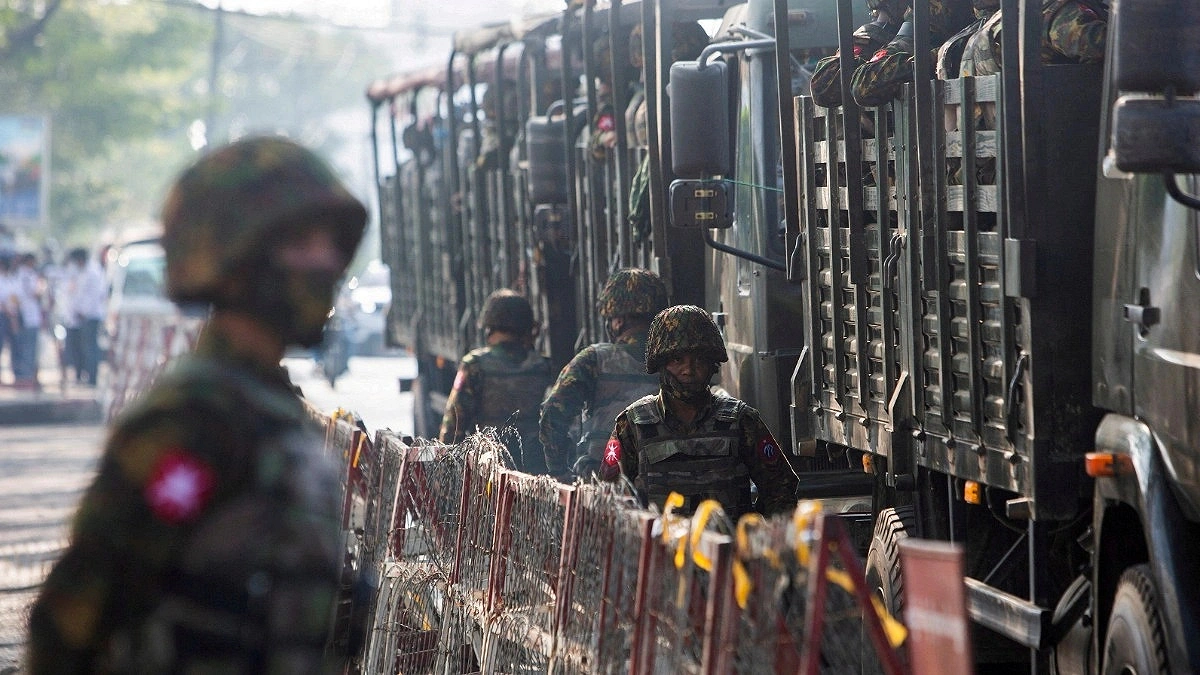
Photo: Reuters.
Resistance groups had once cornered Myanmar's military by seizing one town after another. But that picture has now changed. Through airstrikes, new troop enlistments, and support from China, the country's military junta is growing stronger.
The military is now recapturing lost areas, forcing resistance forces to retreat from key towns. However, there is no sign of the war ending; rather, Myanmar is heading toward a longer and bloodier conflict.
In Chin State, resistance forces have lost three more towns within just a few weeks. By late May, Myanmar's military claimed that the entire northern part of the state was under their control.
Salai William Chin, a member of the Chin Brotherhood alliance, said, "The fall of Falam town has taught us an important lesson. Capturing a town and holding onto it are completely different challenges."
According to him, holding an area requires manpower, supplies, administrative capacity, and the ability to withstand repeated aerial attacks.
However, Salai William Chin affirmed that they would continue fighting. He told Al Jazeera that success should not be judged solely by whether they can permanently hold every town. Where the military has a major advantage in air power, swift guerrilla tactics may prove more effective. The current goal is to sustain their forces, protect civilians, and maintain the capacity for a prolonged struggle.
Myanmar on the Path to a Protracted War
This retreat by resistance forces signals a major shift in Myanmar's ongoing conflict. Since the 2021 military coup, various militias and ethnic armed organizations have been fighting against the junta. However, their alliance has now weakened compared to before.
In 2023 and 2024, resistance forces launched coordinated offensives, capturing dozens of towns from the military. But that success has now largely faded. They are gradually retreating from towns they once held.
According to analysts, several factors are behind this change in the situation, including the military's large-scale troop enlistment, airstrikes, and China's support.
Through compulsory conscription, Myanmar's military has bolstered its manpower. At the same time, they have intensified pressure on resistance forces and their supporters with airstrikes.
On the other hand, China has mediated ceasefires between the military and several powerful ethnic armed groups, while also playing a role in halting arms supplies to some opposition groups.
According to Su Mon, an analyst at the 'Armed Conflict Location and Event Data (ACLED) project', although the military cannot achieve a final victory over the opposition, the situation is moving toward a prolonged war. The humanitarian crisis in the country is likely to worsen in the coming months.
The War That Has Been Going On for Five Years
This war in Myanmar began after the military coup in February 2021. Following a brutal crackdown on unarmed protesters, a section of young people took up arms. They formed various armed groups called the "People's Defence Forces" (PDF). Powerful armed organizations that control the country's border regions also cooperated with them. Some of these organizations have been fighting for autonomy since Myanmar's independence in 1948.
According to ACLED, the death toll in this conflict has exceeded 100,000. The UN estimates that about 3.9 million people have been displaced. One in every three people in the country needs humanitarian assistance.
Earlier this year, Senior General Min Aung Hlaing, who led the 2021 coup, organized elections under strict control. Major opposition parties were not allowed to participate. Voting was not possible in many parts of the country, and there were also boycotts.
In April, Min Aung Hlaing was sworn in as President. Through this, he transitioned from army chief to the nominal head of a civilian government in Naypyidaw.
Min Aung Hlaing now claims he wants peace talks with armed opposition groups in Chin State and other regions. However, the fighting has not stopped.
The Junta Is Seizing Strategic Towns
Myanmar's military launched new offensives this year in Chin, Kachin, Karen, and Rakhine States.
According to the independent research institute ISP-Myanmar, of the 101 towns the military lost after the coup, it has so far recaptured 22—meaning about 9% of the lost territory has come back under their control.
However, the recaptured areas are of great strategic importance. The key trade routes in these regions connect border areas to central Myanmar, where the military's main bases are also located.
According to Su Mon of ACLED, the recapture of towns has disrupted the economic and logistical capabilities of many resistance groups. Although the junta has not yet fully established administrative control in these areas, its military success has weakened coordination among the resistance forces.
As a result, resistance groups have shifted from large-scale coordinated offensives to largely defensive guerrilla tactics.
Myanmar's military, of course, is publicizing these successes prominently. In a speech in Bangkok this month, Min Aung Hlaing said Myanmar is moving toward democracy. State media has also published photos of soldiers returning victoriously after operations in various areas.
Bangkok-based security analyst Anthony Davis said that the military's massive troop recruitment and China's support have played crucial roles in changing the situation.
According to his estimates, since 2024, about 150,000 soldiers have been added to the military's combat units through compulsory conscription. Although many of them have limited training, their sheer numbers have allowed the military to advance gradually.
Under Chinese pressure, two powerful opposition forces—the Myanmar National Democratic Alliance Army and the Ta'ang National Liberation Army—have withdrawn from fighting. This has given the junta the opportunity to deploy troops to other areas.
In addition, Beijing has also pressured the United Wa State Army to stop selling weapons to opposition groups, further exacerbating the ammunition shortage across the country.
Davis said that one of the military's biggest advantages from the start has been its nearly unchallenged air power. Through this, it supplies its troops while striking opposition forces.
The increased use of drones for surveillance and strikes, along with better coordination among military units, has also enhanced the junta's capabilities.
Civilian Casualties Rising from Airstrikes
The heaviest price of the airstrikes is being paid by ordinary people. According to the Myanmar Internet Project, there were 520 airstrikes in the country from April to June. These strikes hit 87 townships, killing at least 314 civilians, including 41 children.
Chin State was the worst hit, with 122 airstrikes, followed by Sagaing region with 101 and Rakhine with 98.
Phil Robertson, director of Asia Human Rights and Labor Advocates, said that the resistance forces' momentum has slowed because they cannot counter the military's air superiority.
He told Al Jazeera that airstrikes are demoralizing PDF members and other resistance fighters, while also dispersing civilians who support the insurgents.
However, anti-military groups still believe the war is not over.
Exiled rights activist Thinzar Shunlei Yi said opposition networks are still training organizers and building public support.
She stated that despite mass killings and human rights violations, they have maintained the courage to continue resistance. The people of Myanmar have also kept that spirit alive and will keep fighting.
Salai William Chin of Chin State is also determined to continue the fight. He said they have more plans but it is not yet time to disclose them publicly. He does not believe that air power has permanently determined the outcome of the war—it is a major challenge, but battle tactics are changing.
He believes the resistance forces are also learning, changing, and adapting to the situation.
Source: Al Jazeera


