


Tk 44-crore ‘All-Weather’ road consumed by river

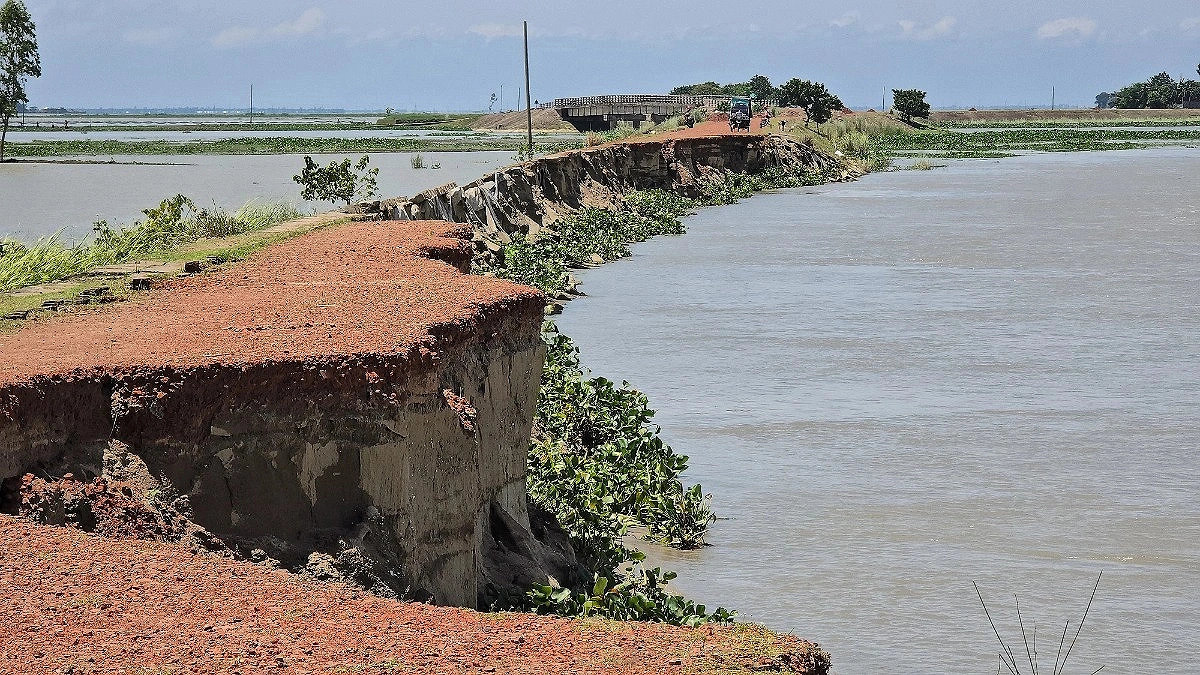
Photo: Agamir Somoy
The ‘All-Weather’ road which had been the sole lifeline for the people of the haor region for year-round communication has gone washed away.
The poeple of the region-- during the monsoon or the dry season--- rely on this road to get connected with the upazila and district headquarters. However, that very road is now eroding into the river, consumed by the fierce erosion of the Meghna.
At least 500 meters of the 7-kilometer road, built at a cost of nearly Tk 44 crore, have collapsed into the Meghna River. As a result, vehicular movement has completely stopped. With the road link severed, residents of several villages face extreme hardship, with relatives of sick patients, women, and children suffering the most.
Locals allege that despite the situation turning dire over the last three months since the erosion began, no visible, effective measures have been taken to protect the road. Initially, the Water Development Board dumped some geobags, but they proved useless against the intense river erosion. The river is now eroding its banks further, advancing towards farmland and homesteads, leaving an entire village at risk.
An on-the-spot visit revealed that the 7-kilometer-long road from Bangalpara to Noagaon in Ashtagram Upazila of Kishoreganj was constructed about seven years ago. Implemented by the Local Government Engineering Department (LGED), the road was built at a cost of around Tk 44 crore. Currently, renovation work on the road was underway at a cost of nearly Tk 13 crore. In the meantime, a large portion of the road began caving in due to the Meghna’s erosion. Owning to the severity of the collapse, nearly 500 meters of the road are now under the river, completely halting all vehicular traffic. Lacking any alternative routes, ordinary people are facing severe misery, as even walking across the stretch is no longer possible.
To travel to the upazila or district headquarters for emergencies, people are forced to commute with extra time, money, and risk. Initially, the Water Development Board dumped 8,104 geobags at a cost of about Tk 30 lakh to stop the erosion. However, this initiative failed to build a permanent defense against the Meghna's strong currents and erosion.
At the end of this road, a 1,000-meter-long bridge is currently under construction over the Meghna River. Built at a cost of nearly Tk 177 crore, this road is crucial as a connecting route for the bridge. Yet, the connecting road itself is now facing river erosion. As a result, locals fear that the long-cherished dream bridge project of the haor people could also face risks in the future.
Local residents said that river erosion in the area had been increasing over the last few years due to changes in the course of the Meghna River. However, no effective steps were taken initially to prevent it. Slowly consuming farmland, the river has now reached the vital road. Even after a large portion of the road went into the riverbed, no permanent protective measures were put in place. No visible efforts have been seen since the dumping of geobags, allowing the erosion to continue unabated.
Patients are suffering the most as road communication has come to a halt. The situation turns dire whenever a patient needs to be rushed to the hospital. In cases requiring emergency medical treatment, people are forced to travel by river, leaving relatives in constant anxiety over whether they can reach the hospital in time.
Firoz Alam, a local resident, said, "I cannot explain in words the hardship we are facing due to the road damage. Our movement has virtually ground to a halt; there is not even a way to go on foot. We men can manage to travel somehow despite the suffering, but women face even greater difficulties. We are in deep trouble, especially with sick people. Three months have passed with promises that it would be repaired. A few bags were dumped when the erosion started, but no one has been seen since."
Abdul Quadir, a resident of Noagaon village, said, "Before this road broke, there was land beside it. Hundreds of acres of that land have been lost to the river. Nobody looks into our suffering. There is no way left to grow paddy or crops now. The river has been eroding for many years, but no one took any initiative. Action was only taken after the river gradually eroded its way to the road. Dumping a few bags was where it ended. Had they worked earlier, our farmlands and the road wouldn't have been swallowed by the river. Now the river is set to wash away our village. We beg the authorities to save our lives."
LGED Ashtagram Upazila Engineer Md. Mozammel Haq said, "At the beginning of the erosion, the Water Development Board dumped some geobags. Currently, BIWTA is diverting the river's course through dredging and filling the eroded area with sand. Once filled, carpeting will be done to restore road movement to normal as quickly as possible."


